PUBG Ally: a voice-enabled AI agent joins matches as a teammate
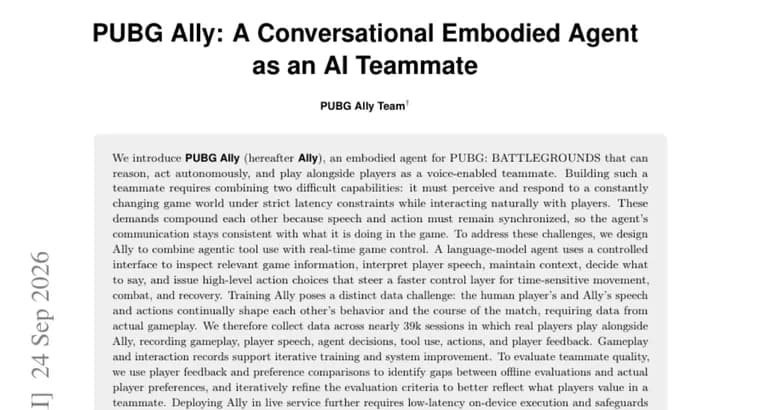
A paper posted to Hugging Face's papers section introduces PUBG Ally, an embodied AI agent built to play PUBG: BATTLEGROUNDS as a voice-enabled teammate rather than a scripted bot. The system splits its work into two layers: a language-model agent that inspects game information, interprets a player's speech, keeps track of context, decides what to say, and issues high-level action choices, and a faster, separate control layer that turns those choices into real-time movement, combat, and recovery. The authors say building a teammate like this means solving two hard problems at once: perceiving and reacting to a constantly changing match under strict latency limits, while keeping Ally's speech in sync with what it is actually doing on screen.
Because a player's and Ally's speech and actions continuously shape each other and the outcome of a match, the team argues that training the agent requires data from real matches rather than simulation alone. They collected data across nearly 39,000 sessions in which real players played alongside Ally, logging gameplay, player speech, the agent's decisions, its tool use, its in-game actions, and player feedback, then used these records for iterative training. To judge teammate quality, they combined player feedback with preference comparisons, using the gap between offline evaluation scores and actual player preferences to refine their evaluation criteria over time.
Running Ally as part of a live game service brought its own requirements: low-latency execution on-device, plus safeguards for anything Ally says to players. The authors address these through model compression, context compaction, targeted safety training, runtime guardrails, and memory redaction. During live service, the team surveyed players in 141 countries. Among respondents whose play alongside Ally was confirmed by in-game records, positive responses exceeded negative ones by 25.1 percentage points when players were asked whether they would recommend Ally, with players describing Ally not only as a tool but also as a teammate or companion.
Key facts
- PUBG Ally combines a language-model agent (reasoning, speech, high-level decisions) with a separate real-time control layer for movement, combat, and recovery
- Training data came from nearly 39,000 sessions of real players playing alongside Ally, covering gameplay, speech, agent decisions, tool use, and player feedback
- Live deployment required model compression, context compaction, targeted safety training, runtime guardrails, and memory redaction for low-latency, safe on-device execution
- The team surveyed players in 141 countries during live service; among those confirmed to have played with Ally, positive responses on recommending it exceeded negative ones by 25.1 percentage points
- Surveyed players described Ally not just as a tool but as a teammate or companion
Why it matters
PUBG Ally is a working example of an embodied agent that has to reason and speak like a language model while also acting inside a fast-paced game at real-time speed, and it was trained on real matches rather than only simulated ones. The combination of an LLM-driven decision layer with a separate fast control layer, plus a training loop built entirely from live player sessions, is the technical core of the work, and it comes with player-facing evaluation data rather than only offline benchmarks.
Who it affects
The direct audience is PUBG: BATTLEGROUNDS players who encountered Ally during live service, and researchers or studios working on embodied game agents, voice-enabled NPCs, or human-AI teaming in real-time environments. The paper does not name the authors, their institution, or any company behind the work.
How to use it
This is a research paper describing a system already running inside PUBG: BATTLEGROUNDS live service rather than a separately released product, tool, or API. No pricing, licensing, release plan, or underlying base model is given in the source.
How solid is it
The account comes from the paper's own description of its methods and results, evaluated on hard numbers: nearly 39,000 training sessions, a 141-country survey, and a 25.1 percentage-point gap between positive and negative responses on recommending Ally. The source does not give author names, institutional affiliation, a publication date, the underlying base language model, or the absolute counts of positive and negative responses behind that percentage-point figure.
Risks and caveats
The 25.1 percentage-point figure is a gap, not a share of respondents, and no raw counts are given to check it against. The survey's timeframe within live service is not specified, and the safety measures described (compression, guardrails, memory redaction) are named but not detailed enough to assess how robust they are. The result is also domain-specific to one battle-royale game, with no evidence offered about generalizing to other titles or genres.
“players describing Ally not only as a tool but also as a teammate or companion”
— PUBG Ally research paper