Qwen-Planner-Agent tops MobilePA-Bench via a closed-loop AI-for-AI framework
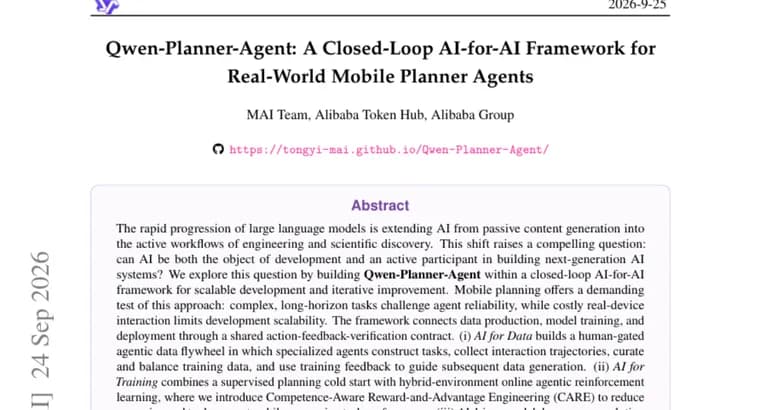
A paper describes Qwen-Planner-Agent, a mobile planning agent built to test whether AI can act as both the object of development and an active participant in building next-generation AI systems. The authors chose mobile planning as the test case because it involves complex, long-horizon tasks that stress agent reliability, while real-device interaction is too costly to scale development through manual iteration alone. To address this, they built a closed-loop 'AI-for-AI' framework that connects data production, model training, and deployment through what the paper calls a shared action-feedback-verification contract. The framework has three parts. 'AI for Data' runs a human-gated agentic data flywheel in which specialized agents construct tasks, collect interaction trajectories, curate and balance training data, and use feedback from training to guide what data gets generated next. 'AI for Training' combines a supervised planning cold start with reinforcement learning conducted in a hybrid-environment online agentic setup; within this stage the authors introduce a technique called Competence-Aware Reward-and-Advantage Engineering (CARE), designed to cut the cost of reasoning and tool use during training while preserving task performance. The third part drives co-evolution of the model and its runtime harness through an execution-evidence-driven loop that orchestrates memory, skills, and tools at runtime and feeds structured action feedback and preserved failure traces back into coordinated adjustments of both the model and the harness. On MobilePA-Bench, a benchmark for mobile planning agents, the paper reports that Qwen-Planner-Agent achieves the best overall performance among all evaluated models and systems, improving over its own base model across tool use, memory, skills, and sub-agent coordination. The authors also report that further evaluation on non-mobile agentic benchmarks shows improvements there too, while general capabilities are largely preserved. The source does not give specific benchmark scores, percentages, or dataset sizes, nor does it name the authors, their institutions, or a publication date.
Key facts
- Qwen-Planner-Agent is a mobile planning agent built inside a closed-loop 'AI-for-AI' framework that connects data production, model training, and deployment through a shared action-feedback-verification contract.
- The framework has three parts: an agentic data flywheel ('AI for Data'), a supervised cold start plus reinforcement learning using a new Competence-Aware Reward-and-Advantage Engineering (CARE) method to cut reasoning and tool-use costs ('AI for Training'), and a runtime loop that co-evolves the model and its harness using memory, skills, tools, and failure traces.
- The paper reports Qwen-Planner-Agent achieves the best overall performance among all evaluated models and systems on MobilePA-Bench, improving over its base model on tool use, memory, skills, and sub-agent coordination.
- The paper also reports improvements on non-mobile agentic benchmarks while largely preserving general capabilities.
- No specific benchmark scores, comparison numbers, author names, or institutions are given in the source.
Why it matters
The paper frames its central question directly: can AI be both the object of development and an active participant in building the next generation of AI systems? Mobile planning is used as a demanding proving ground because long-horizon tasks strain agent reliability while real-device testing is too expensive to scale by hand. Building a closed loop where AI generates its own training data, trains itself, and co-evolves with its own runtime harness is presented as a way to keep improving such agents without that manual bottleneck.
Who it affects
The work is aimed at researchers and engineers building agentic systems for mobile devices, and more broadly at teams designing training pipelines where data generation, reinforcement learning, and deployment feedback need to reinforce each other. It also speaks to anyone evaluating agent benchmarks like MobilePA-Bench as a way to compare planning agents.
How to use it
This is a research framework and an accompanying agent, not a released consumer product; the source gives no pricing, licence, or availability details. Practically, the paper's three components describe a template: use a human-gated data flywheel to keep training data fresh, combine supervised cold-start training with hybrid online reinforcement learning (using CARE to control reasoning and tool-use costs), and let a runtime loop feed execution evidence and failure traces back into both the model and its harness.
How solid is it
The claims come from the paper itself: the source text describes the framework and reports that Qwen-Planner-Agent leads on MobilePA-Bench and improves on non-mobile agentic benchmarks, but it does not name authors or institutions, give a publication date, or provide the actual benchmark scores, percentages, or comparison numbers that would let a reader independently gauge the size of the improvement.
Risks and caveats
Without concrete scores or comparison figures, the magnitude of 'best overall performance' or 'largely preserving general capabilities' cannot be checked from the source text alone. The absence of named authors or institutions also limits the ability to assess authorship or potential conflicts of interest, and all performance claims are self-reported by the paper rather than externally verified.
“The framework connects data production, model training, and deployment through a shared action-feedback-verification contract.”
— the paper