Researchers extract GPT-6 Astra's hidden chain-of-thought
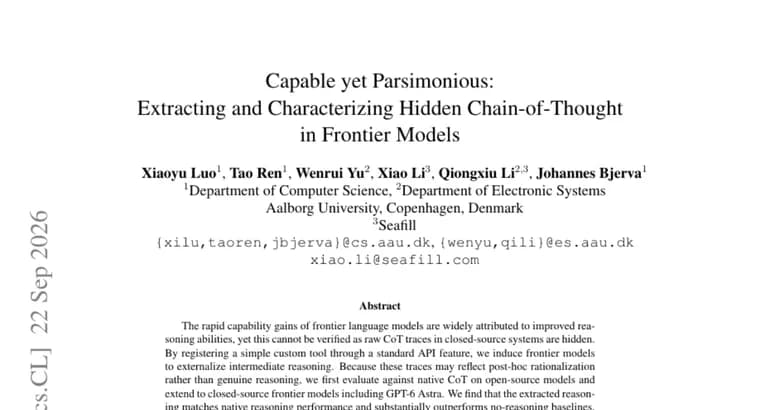
A research paper argues that the rapid capability gains of frontier language models are widely credited to improved reasoning, but that claim cannot be checked directly because the raw chain-of-thought traces inside closed-source systems are hidden from view. To get around this, the authors describe a technique that registers a simple custom tool through a standard API feature, which induces frontier models to externalize their intermediate reasoning as they work through a problem.
Because an externalized trace could simply be a post-hoc rationalization dressed up to look like genuine reasoning rather than the real thing, the authors first test the extracted reasoning against each model's native chain-of-thought on open-source models, where the real internal trace is available for comparison. Only after that validation do they extend the method to closed-source frontier models, including a model referred to as GPT-6 Astra.
Across competition mathematics, science, and code generation tasks, the extracted reasoning matches the performance of native reasoning and substantially outperforms baselines that skip reasoning altogether. The paper does not report specific scores, percentages, or token counts for these comparisons.
The authors then use the extracted traces to characterize how frontier models structure their reasoning, looking at token efficiency, the types of reasoning steps used, and reasoning trees induced from the traces. They find systematic differences between models in how they externalize, compress, and organize reasoning. Astra in particular shows what the authors call token-efficient directed reasoning: it tends to settle on a correct solution path earlier than other models, working through elementary steps internally without writing them out, and externalizing only the reasoning it judges crucial. The authors present this as a behavioral way to study frontier-model reasoning that goes beyond simple benchmark scores.
Key facts
- The method registers a custom tool through a standard API feature to induce frontier language models to externalize hidden intermediate reasoning.
- The extraction technique is first validated against native chain-of-thought on open-source models, then extended to closed-source frontier models including GPT-6 Astra.
- Extracted reasoning matches native reasoning performance and substantially outperforms no-reasoning baselines across competition mathematics, science, and code generation.
- GPT-6 Astra shows token-efficient directed reasoning, settling on a correct trajectory earlier while resolving elementary steps internally and externalizing only crucial reasoning.
- The authors caution that the externalized traces may reflect post-hoc rationalization rather than genuine reasoning.
Why it matters
Claims that frontier models owe their gains to better reasoning have been hard to check, because closed-source systems keep their raw chain-of-thought hidden. This work offers a way to pull that hidden reasoning out into the open and compare it against a model's real internal process, giving a behavioral lens on frontier-model reasoning that goes beyond benchmark scores alone.
Who it affects
The result is aimed at researchers and evaluators who study how large language models reason, and by extension at developers of closed-source frontier systems such as GPT-6 Astra, whose internal reasoning process is otherwise opaque to outside scrutiny.
How to use it
The technique works by registering a simple custom tool through a standard API feature, which prompts the model to write out its intermediate reasoning as it solves a problem. The authors validate it against native chain-of-thought on open-source models first, then apply it to closed-source frontier models, using it to compare reasoning quality across competition mathematics, science, and code generation, and to analyze token efficiency, reasoning-step types, and reasoning trees.
How solid is it
The source text reads as a paper abstract with no named authors, institutions, or publication date, and it does not report specific numeric results, such as exact scores or token counts, for the reasoning-matching and outperformance claims, or details on which open-source models were used for the native chain-of-thought comparison. The qualitative claims quoted here are stated directly in the text.
Risks and caveats
The authors themselves flag the central risk: an externalized trace may be a post-hoc rationalization rather than the model's genuine reasoning process, which is why they validate the method against known native traces on open-source models before trusting it on closed-source systems. That validation step does not eliminate the possibility that the extraction behaves differently once applied to models whose real internal reasoning cannot be directly observed.
“the extracted reasoning matches native reasoning performance and substantially outperforms no-reasoning baselines, across competition mathematics, science, and code generation”
— the authors