Qwen-UI-Agent hits SOTA on mobile GUI benchmarks
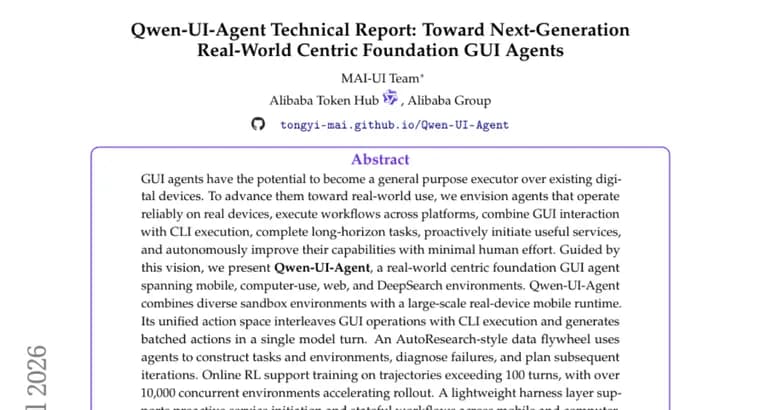
Researchers led by Hanzhang Zhou and co-authors published a technical report on Qwen-UI-Agent, a foundation GUI agent built to act as a general-purpose executor across real devices. The stated goal is an agent that works reliably on actual hardware, carries out workflows across platforms, mixes GUI clicks and taps with command-line execution, handles long-horizon tasks, starts useful services on its own initiative, and improves itself with minimal human input. Qwen-UI-Agent covers four environments at once: mobile, computer-use, web, and DeepSearch. It trains on a mix of sandbox environments plus a large-scale real-device mobile runtime, and its action space is unified so GUI operations and CLI commands can be issued together, with the model producing batched actions in a single turn rather than one action per step. Training data comes from an AutoResearch-style flywheel, where agents themselves construct tasks and environments, diagnose why attempts fail, and plan the next round of iteration. The model is trained with online reinforcement learning on trajectories that run past 100 turns, using more than 10,000 concurrent environments to speed up rollout. A lightweight harness layer lets the agent start services proactively and keep state across workflows that span both mobile and computer sessions.
On benchmarks, Qwen-UI-Agent sets state-of-the-art results on mobile-use tests and posts competitive numbers on computer- and browser-use tasks against frontier models, explicitly named as Opus 4.8, Gemini 3.1 Pro, and GPT-5.6 Sol. On mobile, it scores 82.1% on MobileWorld, 92.2% on MobileWorld-Real, and 97.5% on AndroidDaily. On computer use, it reaches 79.5% on OSWorld-Verified and a 40.0% partial-progress score on OSWorld-v2. On browser use it scores 73.6% on WebArena, and on GUI grounding it hits 81.5% on ScreenSpot-Pro. The paper does not state model size, release date, licensing terms, or pricing.
Key facts
- Qwen-UI-Agent is a foundation GUI agent spanning mobile, computer-use, web, and DeepSearch environments
- It scores 82.1% on MobileWorld, 92.2% on MobileWorld-Real, and 97.5% on AndroidDaily, described as state-of-the-art on mobile-use benchmarks
- On computer use it reaches 79.5% on OSWorld-Verified and 40.0% partial progress on OSWorld-v2; on browser use, 73.6% on WebArena
- The report claims competitive results against frontier models Opus 4.8, Gemini 3.1 Pro, and GPT-5.6 Sol on computer- and browser-use tasks
- Training combines an AutoResearch-style data flywheel with online RL on trajectories over 100 turns across more than 10,000 concurrent environments
Why it matters
GUI agents that can act across mobile, desktop and browser without separate models per surface are a step toward a single agent that operates real devices the way a person does. Qwen-UI-Agent's unified action space, mixing GUI taps with CLI commands and batching multiple actions per turn, targets the practical bottleneck of long, multi-step device tasks rather than isolated clicks.
Who it affects
The report speaks to AI labs and product teams building device-control or computer-use agents, since it names Opus 4.8, Gemini 3.1 Pro, and GPT-5.6 Sol as the frontier models it compares against. It also matters to anyone evaluating mobile automation, since the mobile-use scores are claimed as state-of-the-art rather than merely competitive.
How to use it
The paper is a technical report on Hugging Face, not a product announcement; it gives no release date, model size, access method, licence, or price. There is nothing here yet to install or call as an API.
How solid is it
The claims come from the authors' own technical report, evaluated on a suite of benchmarks (MobileWorld, MobileWorld-Real, AndroidDaily, OSWorld-Verified, OSWorld-v2, WebArena, ScreenSpot-Pro), not from independent third-party evaluation. The paper drew 102 points and 3 comments on Hugging Face within 38 hours, a modest but active discussion for a single technical report.
Risks and caveats
Self-reported benchmark numbers from a paper's own authors carry the usual caveat: they are not independently verified, and 'competitive with frontier models' on computer- and browser-use is short of the outright state-of-the-art claim made for mobile. No information on cost, availability, safety evaluation, or failure modes on the harder long-horizon tasks the report describes as the eventual goal.
“Qwen-UI-Agent sets state-of-the-art performance on mobile-use benchmarks while delivering competitive performance on computer- and browser-use tasks against frontier models, including Opus 4.8, Gemini 3.1 Pro, and GPT-5.6 Sol.”
— Qwen-UI-Agent technical report