PhiZero proposes a physical language to model world dynamics
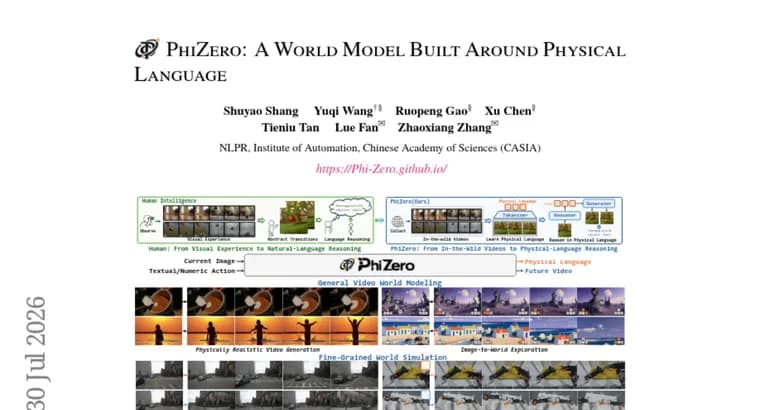
Researchers introduce PhiZero, a physical world model built around what they call physical language, a compact discrete representation of world-state transitions. Most existing physical world models predict future video directly in pixel space, which means the underlying rules of physics stay implicit, buried inside a high-dimensional visual predictor rather than expressed as anything explicit or inspectable. The authors take a different starting point: humans can abstract a predictive structure from what they see and put it into natural language to reason about it explicitly. PhiZero tries to do the same for physical dynamics. It learns its physical language from in-the-wild videos through self-supervision, without labeled annotations of the underlying physics. The model then follows what the authors call a reason-then-render paradigm: it first infers how the world will evolve as a sequence in this physical language, and only afterward renders that inferred sequence into an actual video. The paper reports testing PhiZero across both generation and understanding benchmarks to check whether it produces physically coherent world evolution, and the authors present this as evidence the approach works. They also point to further potential uses: realistic and interactive world modeling, fine-grained action-conditioned simulation (where an action drives a specific, controllable outcome), and zero-shot motion transfer, applying motion patterns to new content without additional training.
Key facts
- PhiZero introduces "physical language," a compact discrete representation of world-state transitions, instead of predicting future video directly in pixel space.
- The physical language is learned from in-the-wild videos through self-supervision, without explicit physics labels.
- PhiZero works in a reason-then-render paradigm: it first infers future world evolution as a physical-language sequence, then renders that sequence into video.
- The authors report testing it on generation and understanding benchmarks to validate physically coherent world evolution.
- The paper also demonstrates potential for interactive world modeling, fine-grained action-conditioned simulation, and zero-shot motion transfer.
Why it matters
Most video-generation world models bury the physics inside a black-box visual predictor: you get a plausible-looking next frame, but no explicit account of why the world moved that way. PhiZero's bet is to make that reasoning step explicit and separate from rendering, first working out what happens in a compact symbolic language, then turning that into pixels. If it holds up, that split could make world models easier to inspect, control, and reuse for tasks beyond raw video prediction.
Who it affects
This is aimed at researchers building world models, video generation systems, and simulation environments for robotics or embodied AI, rather than at end consumers. Anyone working on action-conditioned simulation, where a system needs to predict the specific effect of a specific action, or on transferring a motion pattern to new footage without retraining, is the direct audience.
How to use it
The source is a paper describing an architecture and its evaluation, not a released product; it does not state a license, pricing, code availability, or a public demo, so there is nothing yet to install or subscribe to based on this text alone.
How solid is it
The claims come from a single paper reporting benchmark evaluations across generation and understanding tasks, and from a self-supervised training approach on unlabeled in-the-wild video. The text names no specific benchmark, dataset, or numerical result, so the evaluation's strength cannot be judged beyond the authors' own summary of it.
Risks and caveats
Because the available text gives no concrete metrics, comparison baselines, or failure cases, it is not possible to independently verify how much PhiZero improves over pixel-space world models, or under what conditions the reason-then-render approach breaks down. Claims of generalization to zero-shot motion transfer and interactive modeling are presented as the authors' own findings and have not been checked against independent replication here.