Qwen3-0.6B paper escalates 4-bit to 8-bit weights when unsure
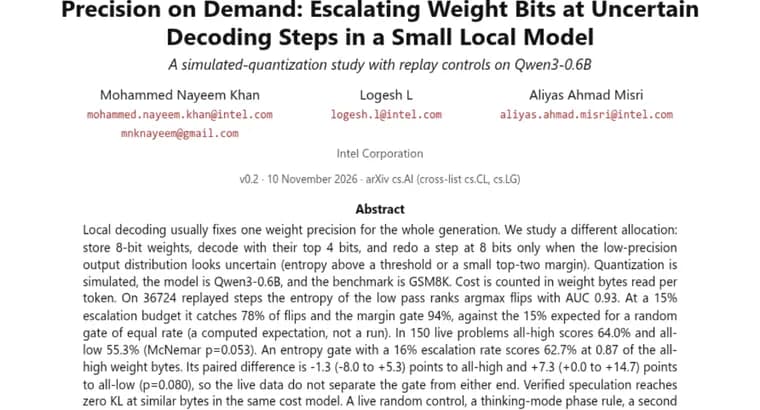
Local decoding usually fixes one weight precision for the whole generation. This preprint, listed on Hugging Face Papers, studies a different allocation. The model stores 8-bit weights, decodes each step using only their top 4 bits, and redoes a step at full 8 bits only when the low-precision output distribution looks uncertain. Uncertainty is judged two ways: entropy above a threshold, or a small margin between the top two candidates.
The setup is deliberately narrow. Quantization is simulated, the model is Qwen3-0.6B, and the benchmark is GSM8K. Cost is counted in weight bytes read per token, not in measured speed.
The first result comes from replaying 36,724 decoding steps. There, the entropy of the low-precision pass ranks argmax flips (steps where the top choice changes between low and high precision) with an AUC of 0.93. At a 15% escalation budget the entropy gate catches 78% of flips and the margin gate catches 94%. A random gate of equal rate would catch 15%, but the paper labels that figure a computed expectation, not a run.
The live test is smaller. On 150 GSM8K problems, the all-high setting (8 bits throughout) scores 64.0% and the all-low setting (top 4 bits throughout) scores 55.3%, a gap with McNemar p=0.053. An entropy gate with a 16% escalation rate scores 62.7% while reading 0.87 of the all-high weight bytes per token. Its paired difference is -1.3 points (interval -8.0 to +5.3) against all-high, and +7.3 points (interval +0.0 to +14.7, p=0.080) against all-low. The authors conclude that the live data do not separate the gate from either end.
For comparison, the paper notes that verified speculation reaches zero KL at similar bytes in the same cost model. Several checks were not run: a live random control, a thinking-mode phase rule, a second model, and live KL.
Key facts
- Method: keep 8-bit weights, decode with their top 4 bits, and redo a step at 8 bits only when the low-precision output looks uncertain (entropy above a threshold or a small top-two margin).
- On 36,724 replayed steps, low-pass entropy ranks argmax flips with AUC 0.93; at a 15% escalation budget the entropy gate catches 78% of flips and the margin gate 94%.
- Live, on 150 GSM8K problems with Qwen3-0.6B: all-high 64.0%, all-low 55.3% (McNemar p=0.053), entropy gate 62.7% at 0.87 of the all-high weight bytes with a 16% escalation rate.
- The gate's paired difference is -1.3 points (-8.0 to +5.3) versus all-high and +7.3 points (+0.0 to +14.7, p=0.080) versus all-low, so the live data do not separate it from either end.
- Quantization is simulated and cost is weight bytes read per token; a live random control, a thinking-mode phase rule, a second model and live KL were not run.
Why it matters
Fixing one weight precision for a whole generation is the usual way local models are run, and this paper asks whether precision can instead be spent per step. The idea is to pay for 8-bit reads only where the cheap 4-bit pass looks unsure. The offline result is the encouraging part: uncertainty in the low-precision pass is a strong signal of where the answer would change, with AUC 0.93 on 36,724 replayed steps. Whether that turns into a better accuracy-for-bytes trade in live generation is not settled by this work.
Who it affects
The setting is local decoding of small models, so the work is most relevant to people researching or building low-bit inference for models of roughly Qwen3-0.6B scale. The evidence covers one model and one math benchmark, so it says little yet about other models or tasks.
How to use it
This is a research result, not a tool to deploy. Practitioners can take away the two gating signals tested (entropy above a threshold, or a small top-two margin) and the cost accounting in weight bytes read per token. The entropy gate in the live run used a 16% escalation rate and read 0.87 of the all-high bytes. No publication date or code release is given in the source text.
How solid is it
Mixed. The offline replay is large (36,724 steps), but the live comparison is only 150 problems. There, even the gap between all-high (64.0%) and all-low (55.3%) has McNemar p=0.053, and the gate's differences from both ends have intervals that include zero or touch +0.0. The authors say as much. The 78% and 94% flip-catching figures come from replayed steps, and the 15% random baseline is a computed expectation, not a run. Quantization is simulated, so there are no measured speed, latency or energy figures.
Risks and caveats
Only Qwen3-0.6B and GSM8K were tested. A live random control, a thinking-mode phase rule, a second model and live KL were not run, so it is unknown how much of the gate's live score comes from being selective rather than from simply escalating 16% of steps. The source gives no threshold values and no live accuracy for the margin gate, which was the stronger flip-catcher offline. The paper also notes that verified speculation reaches zero KL at similar bytes in the same cost model, which is a stricter baseline for any claim of efficiency.
“so the live data do not separate the gate from either end”
— From the paper's abstract on Hugging Face Papers