RA-Bench benchmark exposes gaps in AI video detectors for crisis footage
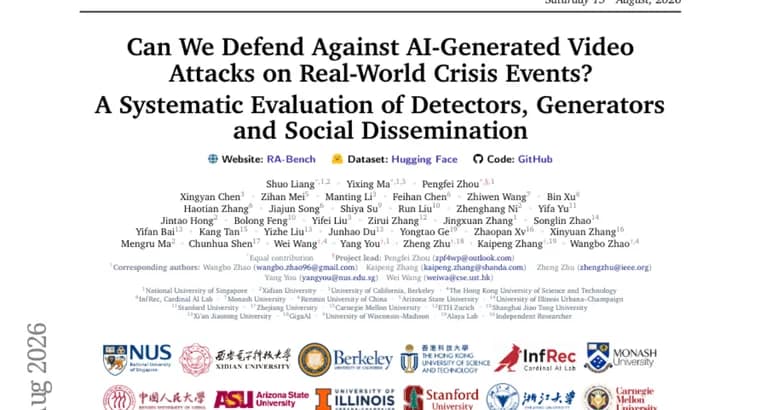
Researchers built RA-Bench, a benchmark for detecting AI-generated video of real-world crisis events such as wars, disasters and public emergencies, because they say existing benchmarks offer little evidence on how detectors and generators actually behave in this setting. RA-Bench anchors its evaluation on real footage: it contains 17,886 videos in total, made up of 1,830 real-video anchors spread across 10 social-risk categories, plus 16,056 generated clips produced by four open-source and five closed-source video generators. Using this set, the researchers ran the evaluation along three axes. First, they tested how well detectors generalize, covering seven traditional detectors, ten zero-shot multimodal models assessed under three different review settings, and two multimodal large language models (MLLMs) specifically fine-tuned for AI-generated video detection. None of these three detector families generalized consistently across the benchmark's instances. Second, they examined how detectability shifts with generation quality, the conditioning information given to a generator, and the random sampling seed used; generation properties affected the detector families differently from one another, while detection patterns tied to the source generator stayed stable across different seeds. Third, they studied how well humans judge whether crisis videos are real, and whether detectors keep working once content spreads through social channels. Videos that fooled human viewers were also the ones current detectors struggled with, and detection got harder once the videos underwent the kind of alteration that happens during social dissemination. The abstract does not name the paper's authors, institutions or affiliations, does not identify which specific detectors or generators were used, does not propose any defense or mitigation, gives no timeline for the benchmark or its results, and reports no numeric accuracy or detection-rate figures for any individual method.
Key facts
- RA-Bench pairs 1,830 real-video anchors across 10 social-risk categories with 16,056 generated clips from four open-source and five closed-source video generators, for 17,886 videos total.
- Detector generalization was tested across seven traditional detectors, ten zero-shot multimodal models under three review settings, and two MLLMs fine-tuned specifically for AI-generated video detection.
- None of the three detector families generalized consistently across RA-Bench's test instances.
- Generation properties affect the three detector families differently, but a generator's source-level detection pattern stays stable regardless of the sampling seed used.
- Videos that successfully mislead human viewers are also the ones current detectors struggle with, and detection gets harder once videos have gone through social dissemination.
Why it matters
Video generators are now capable of producing realistic-looking footage of wars, disasters and public emergencies, which the researchers frame as a real misinformation risk. They argue that existing detection benchmarks give little insight into how detectors and generators actually perform in this specific, high-stakes setting, including how easy a fabricated video is to catch depending on how it was generated, how convincing it looks to an ordinary viewer, and whether a detector that works in a lab still works once the video has been shared and re-shared online. RA-Bench is built to close that gap by testing directly against real crisis footage rather than generic video content.
Who it affects
The direct audience is researchers and engineers building or evaluating AI-generated video detectors, plus platforms and organizations that need to flag fabricated crisis footage before it spreads. Indirectly, it concerns anyone who might encounter a convincing fake video of a war, disaster or emergency online, since the paper's findings suggest such footage is both good at fooling people and hard for current automated tools to catch. The abstract names no specific authors or institutions behind the work.
How to use it
RA-Bench is a benchmark and dataset rather than a product: it supplies 17,886 videos (1,830 real anchors across 10 social-risk categories, 16,056 generated clips from four open-source and five closed-source generators) for anyone evaluating detection methods. The paper structures its own use of the benchmark around three evaluation axes: detector generalization across seven traditional detectors, ten zero-shot multimodal models under three review settings, and two fine-tuned MLLMs; how detectability changes with generation quality, conditioning information and sampling seed; and how human judgment and detector reliability hold up once videos are disseminated socially. No pricing, license or release timeline is stated in the source.
How solid is it
The benchmark is large and structured for this specific problem: nearly 18,000 videos spread across 10 risk categories, with generated clips drawn from nine different generators (four open-source, five closed-source) rather than a single model family. The detector evaluation is similarly broad, spanning three distinct families of method. That said, the abstract gives no numeric accuracy or detection-rate figures for any individual detector or setting, so the size of the generalization failure, and which specific methods hold up better or worse, cannot be assessed from the source alone. No authors or institutions are named, which limits independent verification of the claims.
Risks and caveats
The source text does not identify which specific detectors, generators or MLLMs were used or tested, so it is not possible to say which existing tools are the weakest. No defense or mitigation method against AI-generated crisis video is proposed; the paper is an evaluation, not a fix. No numeric detection-rate or accuracy figures are given, and no timeline for the benchmark's release or the study's completion is stated, so the currency and availability of RA-Bench cannot be confirmed from this abstract alone.