Recuris memory architecture lifts Claude Opus 5 to 87.9% on tau-bench
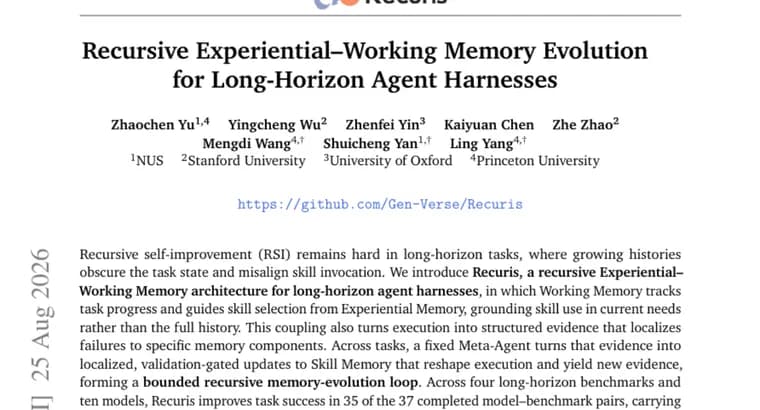
Researchers have introduced Recuris, a recursive Experiential-Working Memory architecture built for long-horizon agent harnesses, the kind of AI agents that must complete tasks spanning many steps with a growing history of actions. In such settings, the accumulating history tends to obscure the actual state of the task and misalign which skills the agent invokes, which is what makes recursive self-improvement hard over long horizons.
Recuris splits memory into two parts. A Working Memory tracks a task's current progress and uses that to select relevant skills from a separate Experiential Memory, grounding skill use in what the task needs right now rather than in the agent's full history. This coupling also turns execution itself into structured evidence that can localize failures to a specific memory component, instead of treating a failure as one undifferentiated event. A fixed Meta-Agent reads that evidence and makes localized, validation-gated updates to a Skill Memory, which reshapes how the agent executes and produces new evidence in turn, forming a bounded recursive loop of memory evolution.
The authors tested Recuris across four long-horizon benchmarks and ten models. It improved task success in 35 of the 37 completed model-benchmark pairs. On tau-bench, Recuris added 17.8 points to GPT-5.6 Sol and 15.6 points to Claude Opus 5, taking Opus 5's task success rate to 87.9%. On SkillFlow, it added 16.6 points for Qwen3.6-27B and 13.5 points for Qwen3.6-35B. The advantage grows with task length: on the longest tasks tested, the gain widens to 32.2 points, and common long-horizon failure modes drop by as much as 80%. The authors position recursively evolving memory as a scalable foundation for recursive self-improvement, letting agents continuously turn accumulated experience into more effective long-horizon behavior. Code for Recuris is published on GitHub.
Key facts
- Recuris improved task success in 35 of the 37 completed model-benchmark pairs, tested across four long-horizon benchmarks and ten models.
- On tau-bench, Recuris added +17.8 points to GPT-5.6 Sol and +15.6 points to Claude Opus 5, lifting Opus 5 to 87.9% task success.
- On SkillFlow, Qwen3.6-27B gained +16.6 points and Qwen3.6-35B gained +13.5 points.
- The advantage widens as task length grows, reaching +32.2 points on the longest tasks tested.
- Common long-horizon failure modes fell by up to 80%, and the code is released on GitHub.
Why it matters
Long-horizon agent tasks, ones that stretch across many steps and accumulate a long action history, are a known bottleneck for recursive self-improvement: the growing history obscures the actual task state and misaligns which skills an agent reaches for. Recuris addresses this by separating a Working Memory that tracks task progress from an Experiential Memory that stores skills, so skill selection is grounded in current need rather than the entire history. Execution then becomes structured evidence that a Meta-Agent uses to make targeted, validation-gated updates to Skill Memory, closing a bounded loop of memory evolution rather than an unconstrained one.
Who it affects
The results are demonstrated on frontier models, including GPT-5.6 Sol, Claude Opus 5, and two sizes of Qwen3.6, which makes this relevant to anyone building or evaluating long-horizon agent harnesses, such as coding agents, task automation agents, or other multi-step agent systems that rely on accumulated experience across a session.
How to use it
The authors have published the code for Recuris on GitHub, at the Gen-Verse/Recuris repository. No pricing, licensing terms, or product packaging are mentioned; this is a research architecture released alongside its implementation, not a commercial product.
How solid is it
The evaluation spans four long-horizon benchmarks and ten models, with Recuris improving 35 of 37 completed model-benchmark pairs, including large, specific gains on named frontier models like GPT-5.6 Sol and Claude Opus 5. The source text does not describe what tau-bench or SkillFlow actually measure beyond citing these success-rate deltas, nor does it name the baseline method Recuris is compared against beyond the general Working Memory, Experiential Memory, and Meta-Agent framing.
Risks and caveats
The source does not say which two of the 37 model-benchmark pairs failed to improve, or by how much. No information is given on compute cost, training data, or reproducibility beyond the code link, and no author names or institutions appear in the text itself.