Redis City visualizes Redis internals in an interactive 3D model
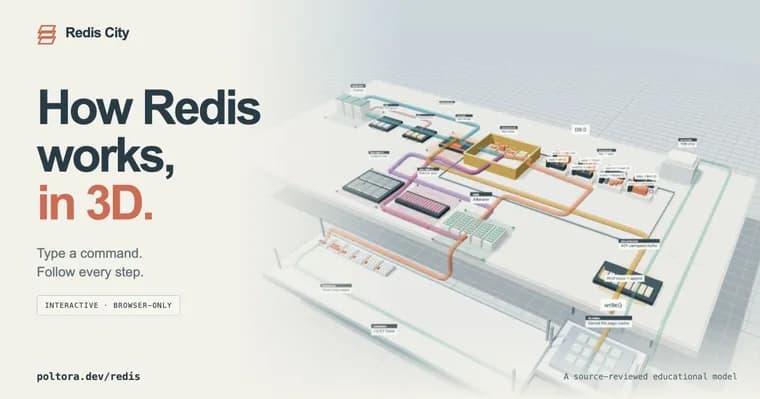
A project called Redis City, hosted at poltora.dev/redis, presents a single Redis instance as an interactive 3D scene rather than a diagram in a manual. According to the site's own description, a visitor types a command and follows every step it takes through Redis inside a browser-only 3D model: command parsing and key lookup, the data structures a key can live in, the memory allocator, the operating system's memory pages, and the two persistence mechanisms, RDB snapshots and the append-only file (AOF). The site frames the scope explicitly as one Redis instance, not a cluster or a replicated setup. The project was posted to Hacker News as a Show HN submission and, roughly two and a half days after posting, had collected 95 points and 16 comments. Because the page is a client-rendered single-page application, most of its content, including the 3D visualization itself and any in-app labels or explanations, runs as JavaScript and is not present as readable text; the only text available ahead of running the app is the page's title and its meta description, Open Graph, and Twitter Card tags. Those tags do not name a creator or team behind the project, do not say what 3D or rendering technology it is built on, and do not give a launch date.
Key facts
- Redis City is a browser-only interactive 3D visualization of a single Redis instance.
- A visitor types a Redis command and follows it through the command path and key lookup, the data structures, the allocator, and OS memory pages.
- It also covers persistence, showing both RDB snapshots and the append-only file (AOF).
- The project was shared on Hacker News as a Show HN post and had reached 95 points and 16 comments within about 63 hours.
- The site's own meta tags name no creator, no underlying 3D technology, and no launch date.
Why it matters
Redis internals, the command pipeline, the allocator, memory pages, RDB and AOF, are normally taught through prose and static diagrams in the manual or in blog posts. Redis City turns the same material into something a person moves through: you type a command and watch it travel across the pieces the site names, from parsing down to how the data ultimately gets written to disk. That is a different medium for the same subject rather than new information about Redis itself, and its value is in making an already-documented pipeline easier to hold in your head.
Who it affects
The audience is developers and infrastructure engineers who already use Redis or are learning how it works internally, the kind of reader who would otherwise reach for the Redis documentation or a systems-design write-up. The reception on Hacker News, a Show HN post with 95 points and 16 comments in its first few days, points to interest from that same backend and infrastructure crowd rather than a broader consumer audience.
How to use it
Redis City is reached directly at poltora.dev/redis; nothing in the site's description mentions a signup, an account, or a price. The described interaction is simple: type a Redis command and follow it through the visualization as it moves from parsing to the allocator to memory pages to persistence.
How solid is it
The page is a client-rendered single-page app, so the only text readable without running its JavaScript is the document's title and its meta, Open Graph, and Twitter Card tags; the 3D scene itself, including whatever labels or explanations it contains once it loads, could not be read as text. That also means the site's own text does not say who built the project, what rendering or 3D technology powers it, or when it launched. What can be reported here rests on that limited meta description plus the project's reception on Hacker News.
Risks and caveats
The site explicitly scopes itself to one Redis instance, so it appears not to address clustering, replication, or multi-node behavior, only the internals of a single node. It is hosted on an independent personal domain rather than on Redis Inc.'s own site, and nothing in the available text indicates any review or endorsement by Redis Inc. Whether the visualization is kept current as Redis itself changes is not stated.
“Type a command. Follow every step through Redis in an interactive, browser-only 3D model.”
— Redis City site description