RSIAgent helps open-source models like Kimi-K3 and GLM-5.3 outperform GPT-6
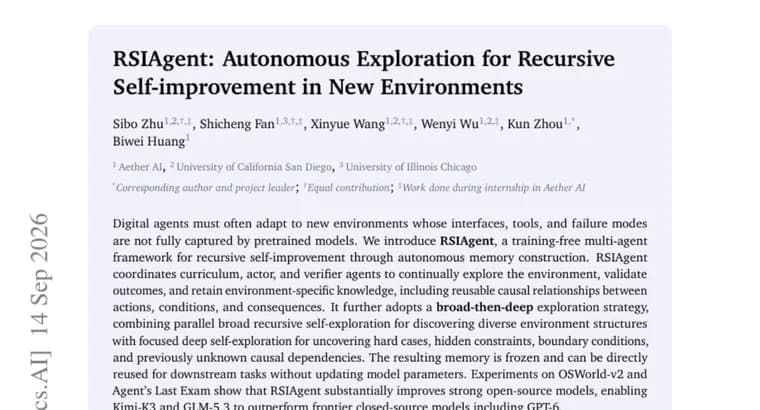
Researchers have introduced RSIAgent, a training-free multi-agent framework designed to let digital agents adapt to new environments whose interfaces, tools and failure modes were never covered during pretraining. Instead of retraining the underlying model, RSIAgent coordinates three roles: a curriculum agent, an actor agent and a verifier agent. Together they continually explore an environment, check whether their actions produced the intended outcome, and store what they learn as environment-specific knowledge, including reusable causal relationships between actions, conditions and consequences. The framework explores in two phases, described as broad-then-deep: a parallel broad phase maps out the diverse structures of the environment, followed by a focused deep phase that hunts for hard cases, hidden constraints, boundary conditions and causal dependencies that were not obvious at first pass. Once built, this memory is frozen. It can be handed directly to a model for downstream tasks in that same environment without any further training or parameter updates. The authors report testing RSIAgent on two benchmarks, OSWorld-v2 and Agent's Last Exam, and say it substantially improves strong open-source models. Specifically, they state that RSIAgent lets Kimi-K3 and GLM-5.3 outperform frontier closed-source models, including GPT-6. The paper does not give the underlying accuracy scores or the size of the gap, so the claim of outperformance is stated qualitatively rather than backed by numbers in the available text.
Key facts
- RSIAgent is a training-free multi-agent framework built from curriculum, actor and verifier agents that explore an environment, validate outcomes and retain what they learn.
- It uses a broad-then-deep exploration strategy: parallel broad exploration to map environment structure, then focused deep exploration for hard cases, hidden constraints and causal dependencies.
- The knowledge it builds is stored as a frozen memory that can be reused directly for downstream tasks without updating any model parameters.
- On OSWorld-v2 and Agent's Last Exam, the authors say RSIAgent lets open-source models Kimi-K3 and GLM-5.3 outperform frontier closed-source models including GPT-6.
- No quantitative scores, benchmark margins or release timeline are given in the available text.
Why it matters
Most gains in agent capability still come from retraining or fine-tuning a model on new tasks, which is expensive and has to be redone for every new environment. RSIAgent's pitch is that an agent can instead explore an unfamiliar environment once, keep what it learns as a separate, frozen memory, and reuse that memory on later tasks without touching the model's weights at all. If the approach generalizes, it offers a cheaper path to closing the gap between open-source and closed frontier models: rather than needing a better-trained model, an open one can be paired with accumulated, task-specific memory.
Who it affects
The work targets developers and researchers building digital agents that operate in environments not fully covered by pretraining, such as unfamiliar software interfaces or desktop tasks, which is the kind of setting the OSWorld-v2 benchmark tests. It is also relevant to teams choosing between open-source models like Kimi-K3 and GLM-5.3 and closed frontier systems like GPT-6, since the paper's central claim is that the right agent framework can shift that comparison in favor of the open models.
How to use it
RSIAgent is described as training-free: it adds a coordination layer of curriculum, actor and verifier agents on top of an existing model rather than modifying the model itself. The memory it produces during exploration is frozen and reusable for downstream tasks in the same environment, so the exploration cost is paid once rather than on every task. The available text gives no details on licensing, release status, code availability or computational cost of the exploration phase, so none of that can be stated here.
How solid is it
The claims come from a single paper posted to Hugging Face's papers listing, with no named authors or affiliations appearing in the text itself. The authors report evaluating RSIAgent on two benchmarks, OSWorld-v2 and Agent's Last Exam, and state that it lets Kimi-K3 and GLM-5.3 outperform frontier closed-source models including GPT-6. However, the source text gives no accuracy scores, pass rates or percentage-point margins for either benchmark, so the strength of 'substantially improves' and 'outperform' cannot be independently checked from what is available.
Risks and caveats
Without published numbers, it is not possible to judge how large the reported improvement is or how it was measured. The paper is not yet described as peer-reviewed in the available text, and there is no information on reproducibility, compute cost of the broad-then-deep exploration phase, or how RSIAgent performs in environments very different from the two benchmarks tested. The comparison to GPT-6 rests entirely on the authors' own account.
“The resulting memory is frozen and can be directly reused for downstream tasks without updating model parameters.”
— RSIAgent paper