RoboArchitect lets a coding model rebuild a robot's control harness, lifting unseen-scene success from 9.7% to 43.3%
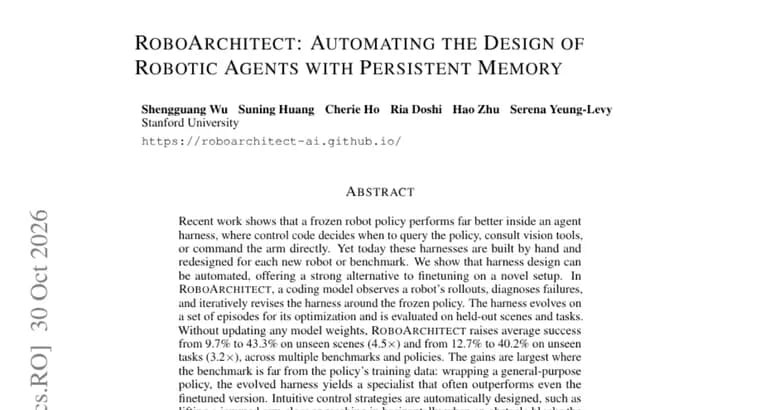
A paper listed on Hugging Face Papers presents RoboArchitect, a system that automates the design of the "agent harness" around a robot policy. The harness is the control code that decides when to query the policy, when to consult vision tools, and when to command the arm directly.
The authors start from a claim they attribute to recent work: a frozen robot policy performs far better inside such a harness. The catch, they say, is that harnesses are built by hand today and redesigned for each new robot or benchmark. Their answer is to automate the design, and they present this as a strong alternative to finetuning on a novel setup.
In RoboArchitect, a coding model observes a robot's rollouts, diagnoses failures, and iteratively revises the harness around the frozen policy. The harness evolves on a set of episodes used for optimization and is then evaluated on held-out scenes and tasks. No model weights are updated at any point.
The reported results, across multiple benchmarks and policies: average success rises from 9.7% to 43.3% on unseen scenes (4.5x), and from 12.7% to 40.2% on unseen tasks (3.2x).
The authors say the gains are largest where the benchmark is far from the policy's training data. When the system wraps a general-purpose policy, the evolved harness yields a specialist that often outperforms even the finetuned version of that policy.
The system also designs control strategies on its own, and the authors call them intuitive. Examples are lifting a jammed arm clear, or reaching in horizontally when an obstacle blocks the way from above. The harness also evolves its own persistent memory, which carries learned experience, such as effective grasp depths, into later decisions.
From this the authors conclude that substantial headroom in robotic manipulation lies in the agent harness, and that its design can be effectively automated and optimized without weight updates.
Key facts
- RoboArchitect uses a coding model to watch a robot's rollouts, diagnose failures and iteratively revise the harness (control code) around a frozen robot policy.
- No model weights are updated; the harness is evolved on one set of episodes and tested on held-out scenes and tasks.
- Average success rises from 9.7% to 43.3% on unseen scenes (4.5x) and from 12.7% to 40.2% on unseen tasks (3.2x), across multiple benchmarks and policies.
- The authors say gains are largest where the benchmark is far from the policy's training data, and that the evolved harness often outperforms even the finetuned version of a general-purpose policy.
- The harness evolves its own persistent memory, carrying lessons such as effective grasp depths into later decisions.
Why it matters
Today, the authors say, robot harnesses are written by hand and redone for every new robot or benchmark. If a coding model can do that work from observed failures, adapting a robot to a new setup no longer needs finetuning. The paper frames this as a shift in where the remaining headroom in robotic manipulation sits: in the harness around the policy, not in the policy's weights. Persistent memory in the harness is part of the pitch, since lessons such as grasp depth carry over into later decisions.
Who it affects
Robotics researchers and teams who adapt general-purpose robot policies to new robots, scenes or benchmarks, and who now do so by hand-building harnesses or by finetuning. It is also relevant to people working on coding-model agents, since the coding model here acts as the designer of the control layer.
How to use it
The abstract describes the method, not a release, so there is nothing to install from it. The idea it offers: keep the robot policy frozen, let a coding model read rollouts and failures, and have it revise the control code and memory around the policy. Evolve the harness on one set of episodes and judge it on held-out scenes and tasks.
How solid is it
This is a preprint listing with an abstract only, and the claims are the authors' own. The headline numbers are averages across multiple benchmarks and policies, and the evaluation is on held-out scenes and tasks, which is the right test for the claim. The abstract names no authors or institutions. It does not name the benchmarks, the robot policies, or the coding model used. It gives no counts of benchmarks, policies, episodes or trials. It does not say whether the average is a mean over benchmarks and policies or pooled over episodes. The claim that the harness "often outperforms even the finetuned version" comes with no figures or list of cases.
Risks and caveats
The 4.5x and 3.2x multiples start from low baselines (9.7% and 12.7%), and the absolute success rates after the harness are 43.3% and 40.2%. The abstract gives no compute cost, number of revision iterations or time needed to evolve a harness. It does not state a split between real robots and simulation. It mentions no code or release. The authors' conclusion is worded as "these results suggest", not as a proven result.