RoboScript reaches 83.4% on RoboTwin 2.0 from one demo, no training
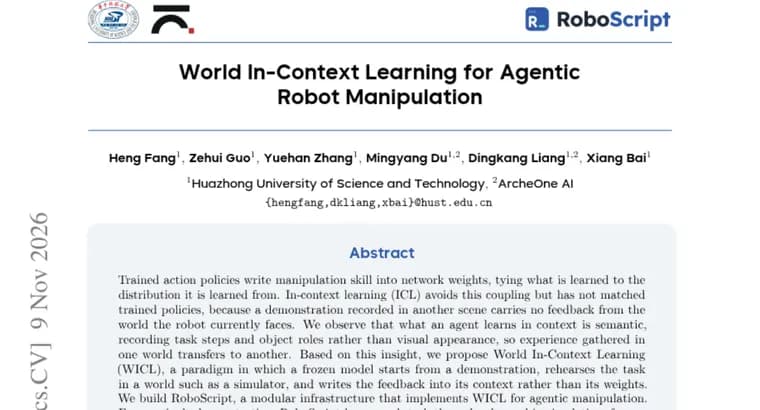
A preprint listed on Hugging Face Papers proposes World In-Context Learning (WICL), a different way to teach robots manipulation tasks. The authors start from a problem with trained action policies: they write manipulation skill into network weights, which ties what is learned to the distribution it was learned from. In-context learning avoids that coupling, but the authors say it has not matched trained policies, because a demonstration recorded in another scene carries no feedback from the world the robot currently faces.
Their observation is that what an agent learns in context is semantic. It records task steps and object roles, not visual appearance, so experience gathered in one world can transfer to another. Building on that, WICL is a paradigm in which a frozen model starts from a demonstration, rehearses the task in a world such as a simulator, and writes the feedback into its context rather than its weights.
The authors build RoboScript, a modular infrastructure that implements WICL for agentic manipulation. From a single demonstration, RoboScript learns each task through rehearsal in simulation and freezes the learned knowledge as a Task Memory. It then deploys that frozen memory on new scenes, with data isolation meant to ensure that every input used at deployment is available on a real robot.
On all 50 tasks of RoboTwin 2.0, RoboScript reaches 83.4% mean success across clean and randomized settings, with one demonstration per task and no gradient updates. The authors say this exceeds the strongest trained action policy by over 20 points. They also report that the method generalizes across visual distributions, improves through reflection, scales with the foundation model, and transfers to a physical dual-arm robot through cross-embodiment memory adaptation. Their closing claim is that with a world in the loop, a robot can learn a manipulation task in its context as well as it learns one in its weights. All code is published on GitHub under the ArcheOne-AI organization.
Key facts
- World In-Context Learning (WICL): a frozen model starts from a demonstration, rehearses the task in a world such as a simulator, and writes feedback into its context, not its weights.
- The authors' RoboScript system learns each task from a single demonstration through simulated rehearsal and freezes the result as a Task Memory.
- Reported result: 83.4% mean success across clean and randomized settings on all 50 RoboTwin 2.0 tasks, with one demonstration per task and no gradient updates.
- The authors say this exceeds the strongest trained action policy by over 20 points.
- They also report transfer to a physical dual-arm robot through cross-embodiment memory adaptation, and publish the code on GitHub.
Why it matters
The paper targets a trade-off in robot learning. Trained policies bake skill into weights and stay tied to the data distribution they saw. Learning in context avoids that, but by the authors' account it has lagged behind trained policies. WICL tries to close the gap by giving the in-context learner feedback from a world, such as a simulator, instead of relying on a demonstration from a different scene. The authors' claim that a robot can learn a task in its context as well as in its weights, if borne out, would make task learning a matter of memory rather than retraining.
Who it affects
Robotics researchers working on manipulation and benchmarks such as RoboTwin 2.0 are the direct audience. Teams that train action policies are the ones the result is measured against. The physical dual-arm robot transfer is aimed at people who care about moving from simulation to hardware.
How to use it
The authors say all code is available at github.com/ArcheOne-AI/RoboScript. The workflow they describe is: give the system one demonstration of a task, let it rehearse in simulation, freeze the result as a Task Memory, and deploy that memory on new scenes. The paper describes cross-embodiment memory adaptation for moving to a different robot body.
How solid is it
This is a preprint-style paper page with a single headline number: 83.4% mean success on all 50 RoboTwin 2.0 tasks, averaged across clean and randomized settings. The code is public, which allows others to check the result. The comparison with the strongest trained action policy is stated as a margin of over 20 points, but that policy is not named and its own score is not given. The separate clean and randomized rates are not given, and neither is a success rate for the physical dual-arm robot. The foundation model used is not named, and no numbers are given for the claims about reflection or scaling with the foundation model. No peer-review status is stated.
Risks and caveats
Much of the evidence is in simulation, and the real-robot claim comes without a reported success rate. The 83.4% figure is a mean over two settings, which can hide differences between them. The method depends on having a world, such as a simulator, in which to rehearse; the authors address deployment with data isolation so that every deployment input is available on a real robot. The claims that the method improves through reflection and scales with the foundation model are stated without numbers on the page, so readers cannot gauge their size.