Sage-Taiyi, a metacognitive AI co-scientist, beats AI Scientist-v2 on Taiyi-Bench
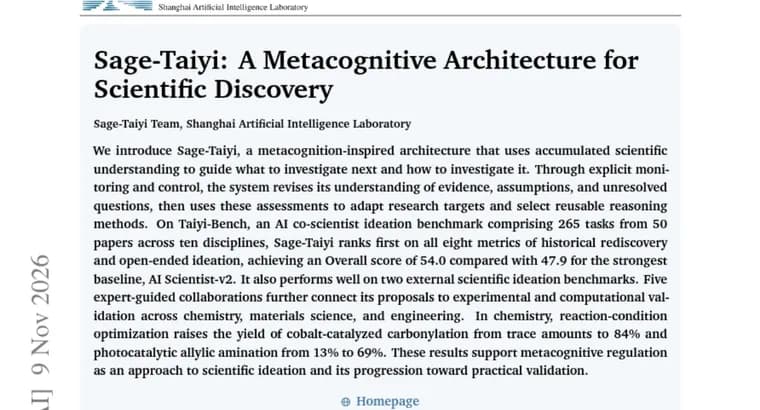
The paper introduces Sage-Taiyi, an architecture for scientific ideation inspired by metacognition. Its core idea is that the system uses accumulated scientific understanding to guide what to investigate next and how to investigate it. Through explicit monitoring and control, it revises its understanding of evidence, assumptions and unresolved questions. It then uses those assessments to adapt its research targets and to select reusable reasoning methods.
The headline evaluation is on Taiyi-Bench, described as an AI co-scientist ideation benchmark with 265 tasks drawn from 50 papers across ten disciplines. Sage-Taiyi ranks first on all eight metrics covering historical rediscovery and open-ended ideation. Its Overall score is 54.0, against 47.9 for the strongest baseline, AI Scientist-v2. The scale and unit of that score are not stated. The authors add that the system also performs well on two external scientific ideation benchmarks, without giving figures for them.
The second part of the evidence is practical. Five expert-guided collaborations connect the system's proposals to experimental and computational validation across chemistry, materials science and engineering. The two numbers reported come from chemistry, where reaction-condition optimization raised the yield of a cobalt-catalyzed carbonylation from trace amounts to 84%, and the yield of a photocatalytic allylic amination from 13% to 69%.
The authors conclude that these results support metacognitive regulation as an approach to scientific ideation and to its progression toward practical validation. The source is the paper's abstract as listed on Hugging Face.
Key facts
- Sage-Taiyi is a metacognition-inspired architecture: it revises its understanding of evidence, assumptions and unresolved questions, then adapts research targets and picks reusable reasoning methods.
- On Taiyi-Bench (265 tasks from 50 papers across ten disciplines) it ranks first on all eight metrics, with an Overall score of 54.0 versus 47.9 for AI Scientist-v2.
- The authors say it also performs well on two external scientific ideation benchmarks, with no figures given.
- Five expert-guided collaborations link its proposals to experimental and computational validation in chemistry, materials science and engineering.
- In chemistry, reaction-condition optimization raised a cobalt-catalyzed carbonylation yield from trace amounts to 84% and a photocatalytic allylic amination yield from 13% to 69%.
Why it matters
This paper pushes a particular design idea: the system keeps track of what it knows and does not know, and uses that to decide what to investigate next. If that holds up, it is a concrete alternative to simply generating more ideas. The reported chemistry yields also connect the ideation work to lab results, which ideation benchmarks alone cannot show.
Who it affects
Researchers building AI co-scientist and ideation systems are the direct audience, since AI Scientist-v2 is the baseline they would compare against. Chemists, materials scientists and engineers are the fields named in the expert-guided collaborations.
How to use it
The abstract gives no usage route. It does not say whether code or data are released, or which underlying language models Sage-Taiyi uses. For now the practical takeaway is the design pattern: explicit monitoring and control of evidence, assumptions and open questions, feeding the choice of research targets and reasoning methods.
How solid is it
The main benchmark result is the authors' own report: first place on all eight Taiyi-Bench metrics, 54.0 against 47.9. The scale and unit of the Overall score are not stated, nor how it is computed or which judge scores it. The eight metrics are not listed individually, and per-metric figures are not given. The two external benchmarks are not named. The authors word their conclusion as results that "support" the approach, not as proof.
Risks and caveats
The abstract does not say whether the yield improvements came from the system alone or through expert-guided work with human chemists beyond the phrase "expert-guided collaborations". It also does not say how many proposals were validated or how many failed, so two successful chemistry cases cannot be read as a success rate. It is not stated whether Taiyi-Bench is public. The abstract names no authors or institutions and gives no date.