RotaryCell turns a stock rotary phone into a portable LTE handset
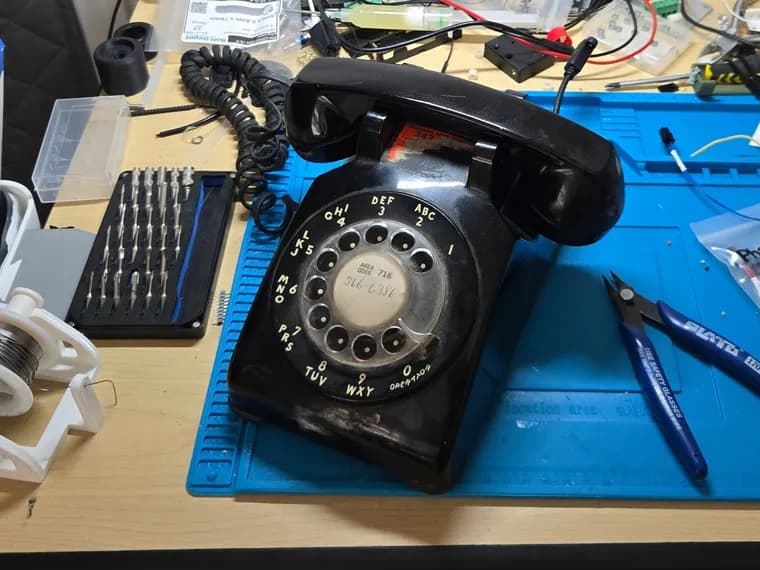
RotaryCell is a GitHub repository documenting a hardware project that converts a traditional rotary telephone into a self-contained, battery-powered, portable cellular phone without modifying the original telephone. The rotary dial, switch-hook, mechanical ringer, network block and existing jacks all keep working as they did originally; the added electronics mount reversibly inside the case, so no original part has to be drilled, cut or permanently altered. The result can be carried away from any fixed line and used wherever cellular coverage reaches, for instance at meetings or demonstrations.
The electronics center on a LilyGO T-A7670G-S3 board, which supplies the ESP32-S3 controller, the A7670 cellular modem, battery charging and the cellular audio interface. A Silvertel AG1171 subscriber-line interface chip runs the telephone-line side: it senses the switch-hook and drives the mechanical ringer. A custom Audio and Reset A4 board handles transmit and receive audio conditioning and adds a hardware power-cycle circuit for when a software-only modem reset is not enough. Power comes from a single protected 21700 cell wired into the LilyGO's battery pads in place of the phone's original 18650 holder; that cell also feeds the AG1171 directly. The phone's own RJ11 line jack is repurposed only to bring in a regulated 5V charging feed for the LilyGO, and is explicitly not used as a telephone-line interface.
The repository, as it stood on August 28, 2026, describes a working hand-wired prototype running firmware v0.10.4, which supports rotary pulse dialing, switch-hook detection, incoming and outgoing cellular calls, physical bell ringing, North American dial/reorder/receiver-off-hook tones, adjustable bidirectional audio, battery monitoring, a USB diagnostic interface, a temporary maintenance Wi-Fi dashboard, an AT-command terminal with an event log, and cellular-network clock sync with OTA updates. Two new integrated PCBs, an Audio and Reset A4 board and an AG1171 Carrier Through-Hole board, were ordered from JLCPCB on August 27 and 28, 2026 respectively; both are archived exactly as submitted and have not yet been assembled or validated. Dialing service code 0000 starts the maintenance Wi-Fi access point, and code 9999 triggers modem diagnostics and a software recovery routine, though the project notes that this recovery did not fix a field-observed modem lockup described in its status notes. The author frames the project explicitly as a working engineering archive rather than a finished construction kit, meant to preserve a reproducible baseline and let other builders reproduce the proven hand-wired version while the newer PCB-based build is still being validated. The code and original documentation are released under the MIT License.
Key facts
- RotaryCell wires an ESP32-S3-based LilyGO T-A7670G-S3 cellular board and a Silvertel AG1171 line-interface chip into an unmodified rotary telephone, adding no drilling or permanent changes to the original hardware.
- The hand-wired prototype, running firmware v0.10.4, already handles rotary pulse dialing, cellular calls, physical bell ringing, dial tones, and adjustable audio, powered by a single protected 21700 cell.
- Two newly designed PCBs, an Audio and Reset A4 board and an AG1171 Carrier Through-Hole board, were ordered from JLCPCB on August 27 and 28, 2026 but are not yet assembled or validated.
- Dial code 9999 triggers a modem diagnostics and recovery routine that, per the project's own notes, failed to fix a field-observed modem lockup.
- The project is released as a public engineering archive under the MIT License, explicitly not a finished construction kit.
Why it matters
RotaryCell is a case study in preserving old hardware rather than replacing it: it lets a decades-old rotary telephone keep its original mechanism, look and feel while gaining a modern cellular radio, instead of being retired once landlines disappear. The build's emphasis on reversibility (no drilling, no cutting, no permanent alteration) is itself the notable engineering choice, since it means the donor phone can be restored to stock at any time.
Who it affects
The project is aimed at hobbyist hardware builders and retrocomputing or vintage-telephone enthusiasts who want to recreate the build themselves; the repository is explicitly published as a reproducible reference for other builders rather than as a product for general buyers.
How to use it
The repository provides a full point-to-point wiring diagram and component reference, distributed as a printable PDF, for hand-wiring the proven prototype using the LilyGO board, a protected 21700 cell, passive audio components, the AG1171 chip and the original Model 500 phone's circuitry, without needing the newer PCBs. Builders who want the PCB-based version are directed to the project's status notes, wiring guide, bill of materials, and assembly and build documentation instead. The maintenance Wi-Fi access point ships with the development password rotarycell, which the documentation instructs builders to change before use around untrusted people.
How solid is it
The hand-wired prototype is described as tested and operating, covering pulse dialing, calls, ringing, tones and audio. The two new PCB designs, by contrast, are only as-ordered fabrication files from JLCPCB with no assembly or test date given, so the more integrated version of the build remains unverified. The project's own status notes also record a modem lockup in the field that its built-in recovery code (9999) did not resolve.
Risks and caveats
The documentation warns never to connect the prototype's Tip/Ring wiring or the repurposed charging jack to the public telephone network or energized premises telephone wiring, and to verify the charging jack's voltage, polarity and pin assignment before use. It also flags that the lithium-ion 21700 cell needs proper protection, charging, fusing, insulation and mechanical restraint. The repository itself cautions that it should not be mistaken for a finished construction kit or production release, and that the August 2026 PCB files are unproven prototypes rather than a validated design.
“This is a working engineering archive rather than a finished construction release.”
— RotaryCell repository