RouteWeaver trains one LLM to pick both routing mode and models
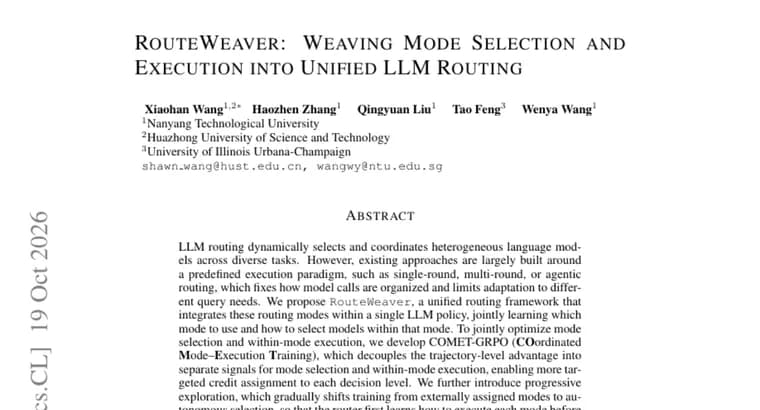
LLM routing means dynamically choosing and coordinating different language models for different tasks. The authors of this paper say most existing routing approaches are built around one predefined execution paradigm: single-round, multi-round or agentic routing. That choice fixes how model calls are organized and limits how well the system adapts to what a given query needs.
They propose RouteWeaver, a unified routing framework that folds all three modes into a single LLM policy. The policy learns two things together: which mode to use, and how to select models within that mode.
To train both decisions at once, the authors develop COMET-GRPO (COordinated Mode-Execution Training). It decouples the trajectory-level advantage into separate signals for mode selection and for within-mode execution, which the authors say allows more targeted credit assignment to each decision level. They add a second technique, progressive exploration. Training starts with modes assigned externally and gradually shifts to autonomous selection, so the router first learns how to execute each mode before it decides when to use it.
RouteWeaver is evaluated on five domains: mathematics, coding, knowledge, logical reasoning and factual recall. It reaches an average accuracy of 61.4%, an 11.03% relative improvement over the strongest baseline, and outperforms all compared baselines in each of the five domains.
Ablations show that both COMET-GRPO and progressive exploration are important for adaptive routing. Without progressive exploration, the routing policy collapses entirely to single-round execution.
Key facts
- RouteWeaver combines single-round, multi-round and agentic routing in one LLM policy that learns which mode to use and how to select models within it.
- COMET-GRPO splits the trajectory-level advantage into separate signals for mode selection and within-mode execution.
- Progressive exploration moves training from externally assigned modes to autonomous selection, so the router learns to execute each mode before choosing when to use it.
- Average accuracy is 61.4% across mathematics, coding, knowledge, logical reasoning and factual recall, an 11.03% relative improvement over the strongest baseline.
- In ablations, removing progressive exploration makes the policy collapse entirely to single-round execution.
Why it matters
Routing systems usually commit to one way of organizing model calls. This work treats the choice of execution mode as something the router should learn per query, alongside the choice of which model to call. The paper's own argument is that a fixed paradigm limits adaptation to different query needs.
Who it affects
The work is aimed at people building systems that coordinate several language models across varied tasks, where routing decides which model handles a query and how calls are organized. The evaluation spans mathematics, coding, knowledge, logical reasoning and factual recall.
How to use it
The source describes the method and its results but does not mention a code or model release, so there is nothing to apply directly yet. The ideas that carry over are training mode selection and within-mode execution with separate advantage signals, and starting training with externally assigned modes before moving to autonomous choice.
How solid is it
The claims come from the paper's own abstract. The headline result is 61.4% average accuracy, with an 11.03% relative gain over the strongest baseline and wins in all five domains. The ablations back the authors' claim that both COMET-GRPO and progressive exploration matter. The strongest baseline is not named, and per-domain figures, benchmarks and routed models are not given in the source text, so the size of the gain cannot be checked from it.
Risks and caveats
The 11.03% figure is relative, not a percentage-point gain, and the source does not name the baseline it is measured against. The source reports no cost, latency or token-usage results. The ablation finding shows how fragile training can be: without progressive exploration the policy falls back entirely to single-round execution.