Rufus-Air recreates GLM-4.5-Air's post-training in eight open stages
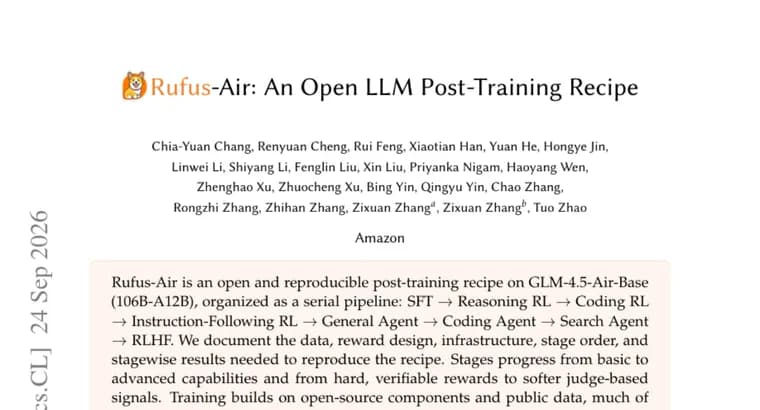
A report describes Rufus-Air, an open and reproducible post-training recipe applied to GLM-4.5-Air-Base, a 106B-A12B mixture-of-experts model. The recipe is organized as a serial pipeline of eight stages: supervised fine-tuning (SFT), Reasoning RL, Coding RL, Instruction-Following RL, General Agent, Coding Agent, Search Agent, and RLHF. The authors document the data, reward design, infrastructure, stage ordering, and stagewise results needed to reproduce the pipeline. Stages are arranged to progress from basic to advanced capabilities, and from hard, verifiable rewards early on to softer, judge-based reward signals later in the pipeline. The training relies on open-source components and public data, much of it used as released, without collecting new human annotations or using an in-house distillation teacher model. The authors report four main findings: diverse, high-quality SFT establishes a strong capability floor before reinforcement learning begins; difficulty filtering keeps RL prompts within a productive learning range rather than too easy or too hard; reward reliability offers a practical principle for deciding the order of stages, moving from more reliable to less reliable reward signals; and infrastructure and engineering choices are treated as part of the recipe itself rather than as background implementation detail. The report states that Rufus-Air improves over the official post-trained release of GLM-4.5-Air and is competitive with similarly sized open models, though it does not give specific benchmark scores or numeric comparisons to support that claim.
Key facts
- Rufus-Air is a post-training recipe built on GLM-4.5-Air-Base, a 106B-A12B model
- The pipeline has eight serial stages: SFT, Reasoning RL, Coding RL, Instruction-Following RL, General Agent, Coding Agent, Search Agent, and RLHF
- Stages move from hard, verifiable rewards to softer, judge-based reward signals as capabilities advance
- Training uses open-source components and public data as released, with no new human annotation or in-house distillation teacher
- The authors say Rufus-Air improves on the official GLM-4.5-Air post-trained release and is competitive with similarly sized open models, without citing specific scores
Why it matters
Post-training recipes for large open models are usually described only in broad strokes, leaving the data, reward design, and stage ordering that actually determine performance undocumented. Rufus-Air instead lays out a full eight-stage pipeline on top of GLM-4.5-Air-Base with the explicit goal of being reproducible, turning what is normally a proprietary process into a documented recipe others can check and repeat.
Who it affects
The work is aimed at researchers and engineers who fine-tune or post-train open-weight models such as GLM-4.5-Air, particularly teams trying to reproduce or improve on RLHF-style pipelines without access to proprietary data or distillation teachers.
How to use it
The recipe is presented as a reference pipeline: SFT first to build a capability floor, then task-specific RL stages (reasoning, coding, instruction-following), then agent-oriented stages (general, coding, search agents), and RLHF last. Teams can apply the same stage ordering and reward-reliability principle, that is, sequencing stages from more reliable to less reliable reward signals, to their own post-training runs using open-source components and public data.
How solid is it
The account comes from the report itself, which states its own findings and pipeline design directly rather than through independent benchmarking cited in the text; it does not give specific benchmark scores or numeric results comparing Rufus-Air to the official GLM-4.5-Air release or to other open models, so the claimed improvement over the baseline model rests on the authors' own description rather than reported figures.
Risks and caveats
No authors or institutions are named in the material, and no publication or release date is given. The report describes the eight stages by name and states four general findings about SFT, difficulty filtering, reward reliability, and infrastructure, but gives no further methodological detail on how each individual stage was implemented, and no quantitative results substantiate the claimed gains over the official GLM-4.5-Air release.
“Training builds on open-source components and public data, much of it used as released, without new human annotation or an in-house distillation teacher.”
— Rufus-Air report