RGBD20K: a 20,000-pair RGB-D segmentation benchmark with 160 categories
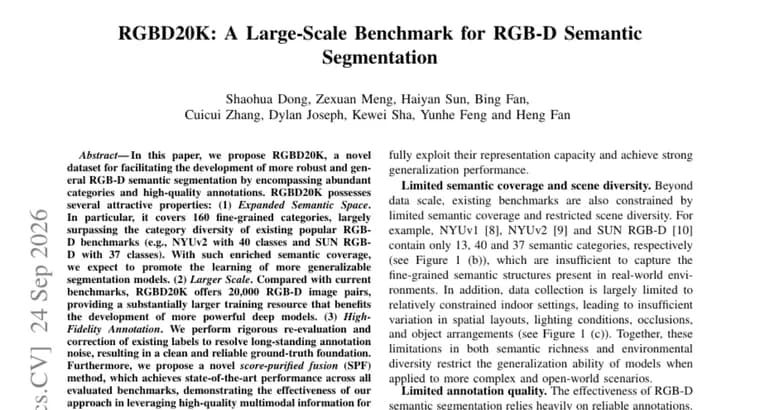
A paper proposes RGBD20K, a new dataset for RGB-D (color plus depth) semantic segmentation, aimed at training more robust and general-purpose segmentation models. The authors describe three main properties. First, an expanded semantic space: RGBD20K covers 160 fine-grained categories, which the authors say largely surpasses the category diversity of existing popular RGB-D benchmarks such as NYUv2 (40 classes) and SUN RGB-D (37 classes). Second, a larger scale: the dataset offers 20,000 RGB-D image pairs, which the authors describe as a substantially larger training resource than current benchmarks provide. Third, high-fidelity annotation: the authors say they performed a rigorous re-evaluation and correction of existing labels to resolve what they call long-standing annotation noise, producing what they describe as a clean and reliable ground-truth foundation. Alongside the dataset, the paper introduces a new method called score-purified fusion (SPF), which the authors say achieves state-of-the-art performance across all evaluated benchmarks, demonstrating the effectiveness of their approach in combining high-quality multimodal (RGB plus depth) information for segmentation. The paper does not give specific numeric performance metrics such as accuracy or mIoU for SPF or the benchmarks it was tested on. The dataset is made available on GitHub at ShaohuaDong2021/RGBD20K.
Key facts
- RGBD20K covers 160 fine-grained categories, compared with 40 classes in NYUv2 and 37 in SUN RGB-D.
- The dataset provides 20,000 RGB-D image pairs, described as a substantially larger training resource than existing benchmarks.
- The authors re-evaluated and corrected existing labels to address what they call long-standing annotation noise.
- A new score-purified fusion (SPF) method is proposed, which the authors say reaches state-of-the-art performance across all evaluated benchmarks.
- The dataset is released on GitHub at ShaohuaDong2021/RGBD20K.
Why it matters
RGB-D semantic segmentation, labeling every pixel of a scene using both color and depth information, has long relied on benchmarks like NYUv2 and SUN RGB-D that cover only a few dozen categories. RGBD20K expands that category space to 160 and adds far more image pairs, which the authors argue helps push the field toward more general and robust segmentation models rather than ones narrowly tuned to a small label set.
Who it affects
Researchers and engineers building RGB-D perception systems, such as those used in robotics and indoor scene understanding, are the main audience: a bigger, cleaner benchmark changes what models can be trained and evaluated on.
How to use it
The dataset and associated code are published on GitHub at ShaohuaDong2021/RGBD20K, where researchers can access the RGB-D image pairs and annotations described in the paper. The paper does not state a license or specific access terms beyond that link.
How solid is it
The claims come directly from the paper itself: the category count, image pair count, and the comparison against NYUv2 and SUN RGB-D are stated explicitly. However, the paper does not provide specific numeric performance metrics, such as accuracy or mIoU scores, for the SPF method or for the benchmarks it was evaluated on, so the state-of-the-art claim cannot be independently checked against figures in this text. No author names, institutional affiliations, or publication date are given in the source.
Risks and caveats
The state-of-the-art claim for the SPF method and the annotation-quality claims for RGBD20K are the authors' own characterizations, not independently verified figures; without published metrics or third-party benchmarking, the scale of improvement over existing methods and datasets remains unconfirmed in this text.