Runway open-sources Praxis-1, a robot control model built on video AI
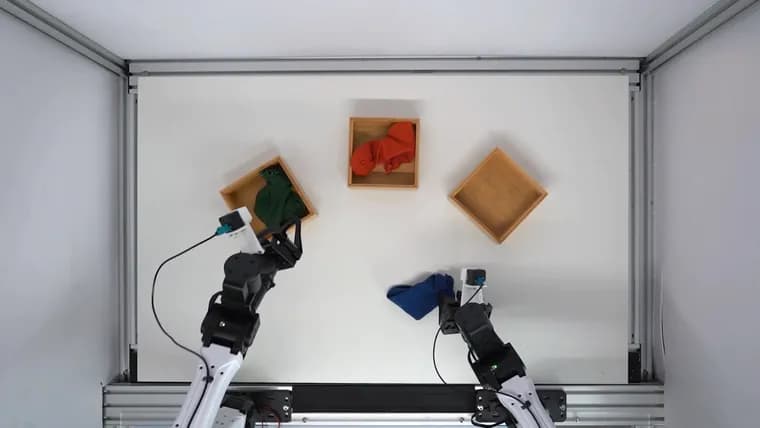
Runway, the AI company best known for generative video models like Gen-4.5, has released its robot model Praxis-1 with open weights and source code under the Apache 2.0 license, which allows commercial use. The company first introduced the model in late September but initially gave access only to select partners. Alongside the release it published a detailed research report with new performance tests.
Praxis-1 takes camera images, text instructions and information about a robot's position. From those inputs it predicts how the environment will change and calculates the matching robot movements, adjusting its control continuously as new camera frames arrive. Runway calls it a World Action Model. It builds on a video model that learned how objects move and interact from ordinary footage, which Runway then fine-tuned with videos of human actions and robot data. The approach could reduce the need for expensive robot-specific datasets, though whether it needs less robot data overall than comparable models without general video pretraining is still an open question. Since September, the robotics companies Standard Bots, Noble Machines and Ultra have been testing the model on different systems, including a humanoid robot, an industrial robot arm and a dual-arm warehouse robot.
The model still needs specialized robot data. To adapt it to a Franka robot arm, Runway used about 277 hours of recordings from the public DROID research dataset. For a dual-arm robot it used between 1,400 and 2,600 hours of training material. Runway had already used DROID data and data from other robot systems in earlier training stages.
On Nvidia's RoboLab-120 leaderboard, which tests how reliably robot models can sort, grasp or stack objects across 120 tasks in simulation, Praxis-1 scores a 46.2 percent success rate. FLUX 3 Action, also built as a World Action Model, scores 42.9 percent under the same test conditions. That puts Praxis-1 at the top of the World Action Model category. On the overall leaderboard it ranks fifth, behind two AI agents and two robot models with different architectures.
After DROID fine-tuning, Runway tested the model on a real Franka arm. Both models had to complete the same ten tasks, such as placing a banana on a plate or closing a drawer. With ten attempts per task, Praxis-1 succeeded 88 times and FLUX 3 Action 80 times.
Runway also tested transfer to a robot type the model had never seen: a mobile platform with a gripper arm that Google had used to develop RT-1. Recordings from this robot were not part of Praxis-1's earlier training. After fine-tuning on about 95 hours of robot data, the model reached an average success rate of 80 percent in simulated tests, according to Runway. The tests covered four task types, including grabbing soda cans, opening and closing drawers, and placing an apple in a drawer. Google's original RT-1 model scored 52.4 percent on the same benchmark.
The limits are clear. According to Runway's research report, the model sometimes confuses similar-looking objects and struggles with vague instructions. For longer tasks, individual steps have to be spelled out, because Praxis-1 cannot yet reliably plan complex action sequences on its own. Runway sees it primarily as a system for fast execution of robot movements, one that could in future work alongside general-purpose AI models that break complex tasks into steps. Runway ran all the tests itself, and the results have not been independently verified.
Key facts
- Runway released Praxis-1 with open weights and source code under Apache 2.0, which allows commercial use; it was first shown in late September to select partners only.
- On Nvidia's RoboLab-120 (120 simulated tasks) it scores 46.2 percent versus 42.9 percent for FLUX 3 Action, the top result among World Action Models, but fifth on the overall leaderboard.
- On a real Franka arm after DROID fine-tuning, Praxis-1 succeeded 88 times to FLUX 3 Action's 80, over ten tasks with ten attempts each.
- On an unseen mobile robot platform, about 95 hours of fine-tuning gave an 80 percent average success rate in simulation, against 52.4 percent for Google's original RT-1.
- All tests were run by Runway and are not independently verified; the model confuses similar-looking objects and cannot reliably plan long action sequences.
Why it matters
Praxis-1 carries a video model's knowledge of how objects move into robot control, and it is released with open weights under a license that allows commercial use. If the approach holds up, it could reduce the need for expensive robot-specific datasets, which have traditionally been collected just to train such systems. The article notes that this is still an open question: whether the model needs less robot data overall than comparable models without general video pretraining has not been settled. Runway, known for video generation, is using the release to move its video research into robotics.
Who it affects
Robotics developers and companies that want a base model they can adapt to their own hardware. Standard Bots, Noble Machines and Ultra have been testing it since September on a humanoid, an industrial arm and a dual-arm warehouse robot. Teams competing with FLUX 3 Action or building on Google's RT-1 line now have a published comparison, which is Runway's own.
How to use it
Developers can download Praxis-1 from Hugging Face after signing up and agreeing to the access terms; the code is on GitHub. The weights and code are under Apache 2.0. The base model needs additional training before it works with a new robot system, but Runway says pre-adapted versions for different robots are already available alongside it. The adaptation data in Runway's own cases ranged from about 95 hours of robot data for the mobile platform and about 277 hours of DROID recordings for a Franka arm to between 1,400 and 2,600 hours for a dual-arm robot. The standard version needs a GPU with 80 GB of memory. A compressed version should fit on an RTX 5090 with 32 GB of VRAM based on Runway's memory estimates, but the GitHub docs say actual peak memory has not been measured yet. For longer tasks, the individual steps need to be spelled out in the instructions. The article gives no pricing.
How solid is it
Treat the numbers as the vendor's. Runway ran all the tests itself, and the results have not been independently verified. The 46.2 versus 42.9 percent gap on RoboLab-120 is simulation only, and overall the model ranks fifth, behind two AI agents and two robot models with different architectures. The real-arm comparison is small: ten tasks with ten attempts each, 88 successes against 80. The 80 percent on the unseen mobile robot was measured in simulated tests across four task types, and is described as Runway's result.
Risks and caveats
According to Runway's research report, the model sometimes confuses similar-looking objects and struggles with vague instructions. It cannot yet reliably plan complex action sequences, so longer tasks need each step spelled out. It still needs specialized robot data, and the base model cannot work with a new robot system without extra training. Hardware demands are real: 80 GB of GPU memory for the standard version, with the 32 GB compressed option not yet measured. The data-efficiency benefit over models without video pretraining remains unproven.
“Runway ran all the tests itself, and the results haven't been independently verified yet.”
— The Decoder