Ropedia Xperience 2 dataset pairs 1,589 3D scans with 4,230 egocentric recordings
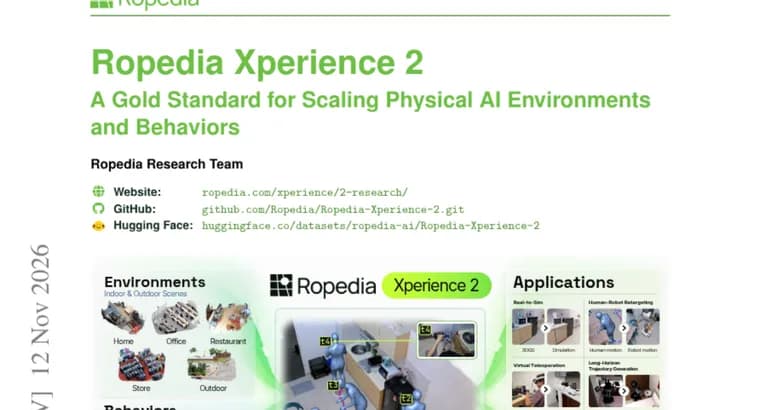
The paper starts from a gap in robotics. Large foundation models such as GPT-6 Astra and Claude Fable 5.1 have recently been shown to control robots directly from visual observations. They still remain brittle on long-horizon, contact-rich tasks in real-world environments. The authors say further progress depends on two complementary resources: demonstrations of human behavior that supervise how tasks are performed, and interactive environments in which policies can be rolled out, evaluated and improved in closed loop.
They draw a parallel with language models, which have advanced along well-characterized scaling laws. The matching question for physical AI is how capability scales with environments and behaviors. Answering it first requires working out which data to scale, and how to produce and reuse that data continuously.
To address this, the authors introduce Ropedia Xperience 2. It comprises 1,589 released metric-scale 3D scans and a collection of 4,230 egocentric recordings of 74 tasks (131 hours).
The paper also shows that each capture can be repurposed for robot learning. Scenes are converted into physically interactive simulation environments. Human motion is retargeted to whole-body robot trajectories. Additional robot behaviors come from virtual teleoperation and automated long-horizon trajectory generation.
The authors propose this joint capture of environments and behaviors as a gold standard for physical AI data collection. They describe it as laying a data foundation for establishing scaling laws over environments and behaviors. That is the stated aim of the work, not a finding: the abstract reports no scaling-law results.
Key facts
- Ropedia Xperience 2 comprises 1,589 released metric-scale 3D scans and 4,230 egocentric recordings of 74 tasks (131 hours).
- Each capture can be repurposed for robot learning: scenes become interactive simulation environments, and human motion is retargeted to whole-body robot trajectories.
- Further robot behaviors come from virtual teleoperation and automated long-horizon trajectory generation.
- The authors say foundation models such as GPT-6 Astra and Claude Fable 5.1 can control robots from visual observations but remain brittle on long-horizon, contact-rich real-world tasks.
- The authors propose joint capture of environments and behaviors as a gold standard for physical AI data, as a foundation for establishing scaling laws.
Why it matters
The paper frames physical AI as lacking what language models had: a clear way to study how capability scales with data. The authors say that question first requires identifying which data to scale and how to produce and reuse it continuously. Their answer is to capture the environment and the human behavior in it together, so one recording can serve as both a demonstration and a simulation scene. They propose this as a gold standard for physical AI data collection.
Who it affects
Robot learning and physical AI researchers are the direct audience, especially those working on long-horizon, contact-rich tasks, where the authors say large foundation models remain brittle. Teams that need simulation environments or whole-body robot trajectories built from real-world captures are the other group the described pipeline speaks to.
How to use it
The paper describes four ways to reuse a capture for robot learning: convert scenes into physically interactive simulation environments, retarget human motion to whole-body robot trajectories, and generate more robot behaviors through virtual teleoperation and automated long-horizon trajectory generation. The abstract names 1,589 3D scans as released. It states no licence, download link, release date or availability terms beyond the word 'released' for the 3D scans, so check the paper page before planning around the data.
How solid is it
This rests on the paper's abstract alone, so the claims are the authors' own. The counts of scans, recordings, tasks and hours are stated clearly. The abstract gives no quantitative results for robot learning, such as success rates, benchmark scores or comparisons to baselines, and no counts of simulation environments or retargeted and teleoperated trajectories. The scaling-law goal is an aim, not a result. The 131 hours figure appears in parentheses after the recordings and tasks count.
Risks and caveats
The 'gold standard' label is the authors' proposal, not an established benchmark. No scaling laws are reported; the dataset is described as a foundation for establishing them. The abstract does not say which robots, sensors or capture hardware were used. GPT-6 Astra and Claude Fable 5.1 are named only as examples of models shown to control robots, and the source does not say the authors tested them.
“We propose this joint capture of environments and behaviors as a gold standard for physical AI data collection”
— From the paper's abstract