S^2VOPD lifts Qwen3.5-4B accuracy above GPT-5.4
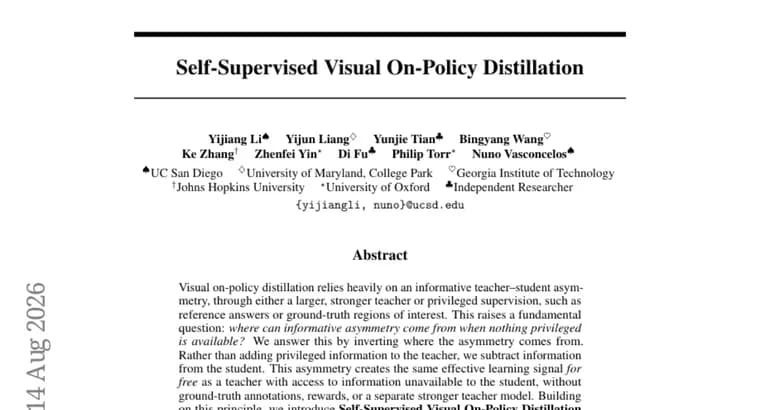
On-policy visual distillation normally depends on an asymmetry between teacher and student: either a larger, stronger teacher model, or privileged supervision such as reference answers or ground-truth regions of interest. Researchers behind a new method ask where that asymmetry can come from when neither option is available, and answer by inverting its source: rather than giving the teacher extra information, they take information away from the student. The teacher processes the original image; the student processes a strongly augmented view of the same image. That mismatch produces the same kind of learning signal a privileged teacher would supply, without ground-truth annotations, rewards, or a separate stronger model. They call the method Self-Supervised Visual On-Policy Distillation (S^2VOPD).
The authors systematically explored a broad range of visual augmentations and report three findings. Asymmetry matters: all four augmentation families they tested improved performance, while symmetric self-distillation, where teacher and student see the same unaugmented image, made performance worse. Strength matters too: performance peaks at a moderate augmentation strength rather than the strongest settings. And the gap has to stay task-consistent: augmentations that completely remove the question-relevant evidence from the image create a large but uninformative discrepancy instead of a useful one.
Across six fine-grained perception benchmarks, S^2VOPD raises Qwen3.5-4B's accuracy from 70.7% to 77.4%. That result tops every open-source model the authors compared it against, up to Qwen3-VL at 235B parameters, and it also surpasses GPT-5.4. With training data held the same, S^2VOPD recovers 96% of the improvement that methods using privileged information achieve. A project website is available at williamium3000.github.io/s2vopd.
Key facts
- S^2VOPD trains a student model on strongly augmented views of the same image its teacher sees, manufacturing a teacher-student asymmetry without a larger teacher model or privileged supervision.
- All four tested augmentation families improved performance, while symmetric self-distillation with no asymmetry made results worse.
- Performance peaks at moderate augmentation strength rather than the strongest augmentations tested.
- The augmentation gap must stay task-consistent: removing question-relevant evidence entirely produces a large but uninformative gap rather than a useful signal.
- On six fine-grained perception benchmarks, S^2VOPD raises Qwen3.5-4B's accuracy from 70.7% to 77.4%, above every open-source model tested up to Qwen3-VL at 235B parameters, surpasses GPT-5.4, and recovers 96% of the gain privileged-information methods achieve with the same training data.
Why it matters
On-policy distillation usually depends on having something the student lacks: a bigger teacher model or privileged supervision such as reference answers or ground-truth regions of interest. Neither is always available. S^2VOPD shows the needed asymmetry can be manufactured for free by degrading what the student sees rather than enriching what the teacher knows, removing the dependency on owning or renting a stronger model.
Who it affects
Teams training smaller vision-language models without access to a larger teacher model or to privileged, ground-truth supervision for their data. The method is demonstrated on Qwen3.5-4B, a 4B-parameter model, and compared against far larger open-source alternatives.
How to use it
The method builds on-policy learning signals from asymmetric augmented views: the teacher processes the original image while the student processes a strongly augmented version of the same image, and the student is distilled toward the teacher's distribution. Performance peaks at moderate augmentation strength rather than the strongest settings, and the augmentation must not erase the parts of the image the question depends on. A project website is available at williamium3000.github.io/s2vopd.
How solid is it
The method is evaluated across six fine-grained perception benchmarks, where it raises Qwen3.5-4B's accuracy from 70.7% to 77.4%, above every open-source model compared including the far larger Qwen3-VL at 235B parameters, and above GPT-5.4. Holding training data constant, it recovers 96% of the improvement achieved by methods that do use privileged information. These design choices, asymmetry, moderate strength, and task-consistency, were validated through a systematic exploration of a broad design space of visual augmentations.
Risks and caveats
The source text does not name individual authors or institutions, state a publication venue or peer-review status, describe the specific techniques used inside the four augmentation families, or give the training compute, hardware, or dataset size behind these results.