ACID-compliant agent framework beats Claude Code by 10.6%
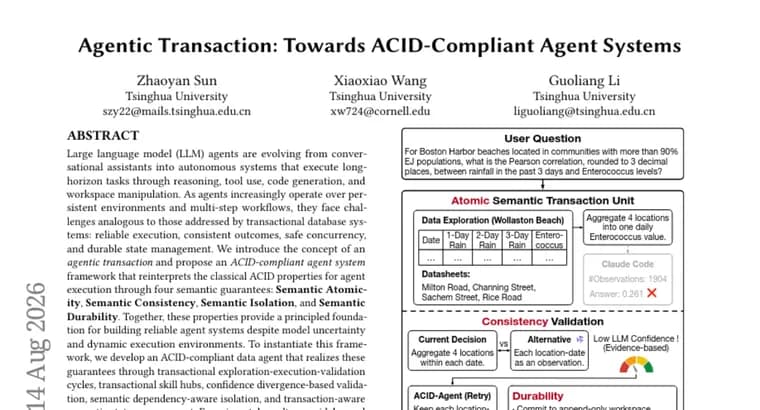
Large language model agents are moving past chat into autonomous work: reasoning through multi-step tasks, calling tools, generating code, and manipulating files and workspaces over long horizons. A new paper argues that once agents operate this way, over persistent state and multi-step workflows, they hit problems transactional database systems already solved: how to keep execution reliable, outcomes consistent, concurrent actions safe, and state durable. The authors introduce the concept of an 'agentic transaction' and propose a framework that reinterprets the four classical ACID database properties for agent execution as four semantic guarantees: Semantic Atomicity, Semantic Consistency, Semantic Isolation, and Semantic Durability. Together, they argue, these give agent builders a principled foundation for reliability despite an uncertain underlying model and a dynamic execution environment.
To test the idea, the authors built an ACID-compliant data agent that instantiates the four guarantees through five named mechanisms: transactional exploration-execution-validation cycles, transactional skill hubs, confidence divergence-based validation, semantic dependency-aware isolation, and transaction-aware semantic state management. The source names each mechanism but does not explain how any of the five actually works internally.
On what the paper calls widely used benchmarks, without naming them, the resulting system scored 10.6% higher than state-of-the-art agents, including Claude Code, which the text cites as one comparison baseline; no other competing agents are named. The abstract carries no author names, institutional affiliations, publication venue, or date; the listing credits the paper to Zhaoyan Sun. The authors describe the work as a first step, saying it opens a broader research agenda on extending transactional principles and system architectures toward agent systems that are trustworthy, scalable, and self-evolving.
Key facts
- The paper introduces 'agentic transaction' and a framework that reinterprets the four ACID database properties as four semantic guarantees for AI agents: Semantic Atomicity, Semantic Consistency, Semantic Isolation, and Semantic Durability.
- The authors build an ACID-compliant data agent implementing those guarantees through five named mechanisms, including transactional exploration-execution-validation cycles and confidence divergence-based validation; the source does not explain how the mechanisms work internally.
- The system scores a 10.6% improvement over state-of-the-art agents, including Claude Code, on benchmarks the text calls 'widely used' without naming them.
- No author names, institutional affiliations, publication venue, or date appear in the source text.
Why it matters
As agents move from single replies to long, multi-step execution over files, tools and workspaces, they run into failure modes database engineers already have vocabulary for: a task interrupted partway through can leave state half-done, concurrent actions can clash, and a result an agent 'commits to' is not guaranteed to survive a changing environment. Borrowing the ACID framing that transactional databases use (atomicity, consistency, isolation, durability) is an attempt to give agent builders a rigorous checklist for reliability instead of ad hoc retries and error handling.
Who it affects
The framework targets people building agent systems that operate autonomously over persistent state, rather than end users of a single chat assistant. The comparison explicitly includes Claude Code as one of the state-of-the-art baselines the new data agent is measured against, which makes this relevant to anyone evaluating coding and data agents on reliability, not just raw task success.
How to use it
The source does not say whether the ACID-compliant data agent's code, weights, or benchmark harness are released, or under what terms. Nothing in the text describes pricing, licensing, or availability, so there is nothing here yet to install or try; this is a research proposal and a proof-of-concept evaluation, not a shipped product.
How solid is it
The evidence is a single paper's self-reported result: a 10.6% improvement over state-of-the-art agents on benchmarks the text describes only as 'widely used' without naming them, and Claude Code is the only named comparison baseline. The abstract gives no affiliations, venue, or publication date, and beyond the listing credit to Zhaoyan Sun there is no way from the text alone to check who did the work, where it was reviewed, or whether the result has been independently reproduced.
Risks and caveats
The 10.6% figure is a single aggregate number with no breakdown by task type or benchmark, and the benchmarks themselves are unnamed, which limits how much can be verified from the text. Without institutional information, provenance and any conflicts of interest cannot be assessed. And because no mechanism detail is given for the five components behind the ACID guarantees, the framework's real workings remain a claim to be taken on the paper's word rather than something that can be inspected here.