S-Agent 2.0 gives a general coding agent a 3D perception toolkit
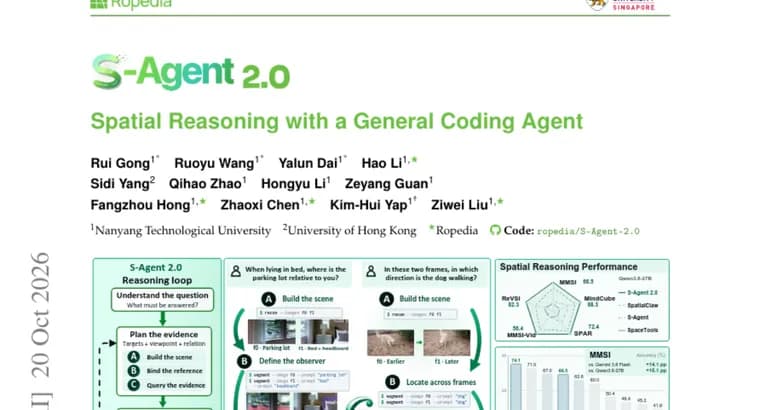
Spatial reasoning asks a model to work out where objects are in 3D space, how they relate to one another and how they move. Agentic vision-language models (VLMs) have recently made large gains on such tasks by gathering evidence with 3D perception tools instead of answering in a single pass. The authors of a new Hugging Face-listed paper point to a remaining problem: on many questions the tools return the right evidence and the model still does not reach the correct answer. The gap between model and tools, where raw readings have to become usable conclusions, is left unfilled.
Their answer is S-Agent 2.0, a spatial reasoning agent that equips an off-the-shelf general coding agent with a command-line perception toolkit. The interface is built around one principle: help the VLM close the evidence loop. The agent acquires scene evidence, remembers it in a persistent scene memory, and interprets each reading in plain spatial language. According to the authors, this keeps the full flexibility of a coding agent while every reading it acts on stays grounded in the tools' geometry.
Results are reported on two benchmarks, MMSI-Bench and ReVSI. Against the same agent without tools, the toolkit improves the open-source Qwen3.8-27B by +13.9 points on MMSI-Bench and +20.5 on ReVSI, and the closed-source Gemini-3.8-Flash by +11.2 and +9.6.
The comparison with the specialized system SpatialClaw is on the same backbones. With Qwen3.8-27B, S-Agent 2.0 reaches 66.5 on MMSI-Bench and 82.3 on ReVSI, against SpatialClaw's 62.6 and 74.5. With Gemini-3.8-Flash it reaches 74.1 and 90.5, against 67.0 and 79.7.
Both tool gains shrink as the backbone grows more capable. SpatialClaw's shrinks far more on ReVSI, from +13.2 to +2.7, while S-Agent 2.0's stays at +9.6. The authors also say S-Agent 2.0 works across different general coding agent harnesses, such as Codex and Claude Code.
Key facts
- S-Agent 2.0 equips an off-the-shelf general coding agent with a command-line perception toolkit built around an evidence loop: acquire scene evidence, store it in a persistent scene memory, and interpret each reading in plain spatial language.
- Over the same agent without tools, the toolkit adds +13.9 (MMSI-Bench) and +20.5 (ReVSI) points for Qwen3.8-27B, and +11.2 and +9.6 for Gemini-3.8-Flash.
- With Qwen3.8-27B, S-Agent 2.0 scores 66.5 and 82.3 on MMSI-Bench and ReVSI, against SpatialClaw's 62.6 and 74.5; with Gemini-3.8-Flash it scores 74.1 and 90.5, against 67.0 and 79.7.
- Tool gains shrink as the backbone gets stronger, but on ReVSI SpatialClaw's gain falls from +13.2 to +2.7 while S-Agent 2.0's stays at +9.6.
- The authors say the system also works across coding agent harnesses such as Codex and Claude Code.
Why it matters
Agents that use 3D perception tools still stumble in a specific place: the tools return the right evidence and the model fails to turn it into the right answer. This paper targets that gap rather than the tools themselves. Its approach is to hand the job to a general coding agent and give it a perception toolkit with a persistent scene memory and plain-language spatial readings, instead of building a specialized system. The reported result is that this beats the specialized SpatialClaw on both benchmarks and on both backbones tested.
Who it affects
Mainly researchers working on spatial reasoning and agentic vision-language models, who can compare a general-agent approach against specialized systems like SpatialClaw. It is also relevant to people building on coding agent harnesses, since the authors say S-Agent 2.0 works with harnesses such as Codex and Claude Code.
How to use it
The source gives no usable entry point. No code, model release, license or availability of the toolkit is mentioned. For now the paper is something to read for its design principle (acquire evidence, keep it in a persistent scene memory, interpret each reading in plain spatial language) and for its benchmark comparisons.
How solid is it
This is a preprint listed on Hugging Face Papers, and the numbers are the authors' own. The reported comparisons are internally consistent: the Gemini-3.8-Flash gain on ReVSI (+9.6) matches the figure given for S-Agent 2.0's stable gain. Against SpatialClaw on the same backbone, S-Agent 2.0 is ahead by 3.9 points on MMSI-Bench and 7.8 on ReVSI with Qwen3.8-27B, and by 7.1 and 10.8 with Gemini-3.8-Flash. The source names no authors or institutions, and it does not name the metric behind the scores; it says only "points".
Risks and caveats
The authors themselves note that tool gains shrink as the backbone grows more capable, so the advantage may narrow with stronger models. The source does not say which coding agent harness produced the headline numbers, and it does not say whether Codex and Claude Code were benchmarked with numbers; it only says the system works across them. The source does not describe the individual tools in the toolkit or how the persistent scene memory is implemented, so the results cannot be tied to specific components.