Sage-A1.5 report describes a 35B MoE agent that delegates and verifies
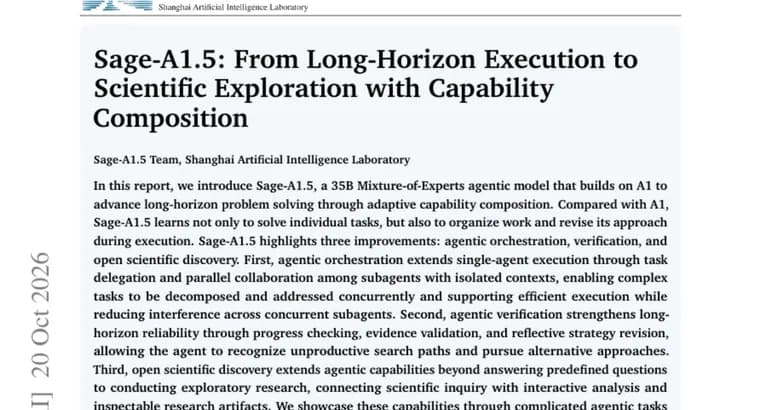
A report on Hugging Face Papers introduces Sage-A1.5, a 35B Mixture-of-Experts agentic model that builds on an earlier model called A1. The stated goal is better long-horizon problem solving through what the report calls adaptive capability composition. The 35B figure is given without saying whether it counts total or active parameters.
The authors say the main change from A1 is that Sage-A1.5 learns not only to solve individual tasks but also to organize work and revise its approach during execution. They highlight three improvements.
First, agentic orchestration. This extends single-agent execution through task delegation and parallel collaboration among subagents, each with an isolated context. Complex tasks can be decomposed and handled concurrently, and the isolated contexts are meant to keep execution efficient while reducing interference between concurrent subagents.
Second, agentic verification. This is meant to strengthen reliability on long tasks through progress checking, evidence validation and reflective strategy revision. In practice, the report says, the agent can recognize unproductive search paths and pursue alternative approaches.
Third, open scientific discovery. This extends the agent beyond answering predefined questions to conducting exploratory research. It connects scientific inquiry with interactive analysis and inspectable research artifacts.
The authors say they showcase these capabilities through complicated agentic tasks and multidisciplinary scientific applications. They also say they hope Sage-A1.5 gives the community an accessible foundation for open scientific discovery, a practical path from long-horizon task execution to collaborative, verifiable and inspectable scientific exploration.
Key facts
- Sage-A1.5 is a 35B Mixture-of-Experts agentic model that builds on A1, aimed at long-horizon problem solving through adaptive capability composition.
- Agentic orchestration lets subagents with isolated contexts take delegated tasks and work in parallel.
- Agentic verification combines progress checking, evidence validation and reflective strategy revision so the agent can drop unproductive search paths.
- Open scientific discovery targets exploratory research with interactive analysis and inspectable research artifacts, not just predefined questions.
- The capabilities are showcased on complicated agentic tasks and multidisciplinary scientific applications, not presented as benchmark results.
Why it matters
The report reflects a push to move agent models from finishing single tasks to organizing work: splitting it among subagents, checking progress and changing course. The framing of the third improvement is also notable. It aims at exploratory research with artifacts a person can inspect, rather than only answering fixed questions.
Who it affects
Researchers and developers building agent systems for long, multi-step work are the intended audience. The authors also address the scientific community, hoping the model can serve as a foundation for open scientific discovery.
How to use it
The report describes the model's capabilities but gives no usage instructions. It does not say whether the weights are released or under what license, despite calling the foundation 'accessible'. Anyone interested should look at the full report for access details.
How solid is it
This is the authors' own description of their model. It gives no benchmark scores and no comparisons with other models. The capabilities are showcased through complicated agentic tasks and multidisciplinary scientific applications, with no specific examples named in the text. No authors or organization behind Sage-A1.5 are named in the text, and it does not describe A1 or give A1 numbers.
Risks and caveats
Without numbers, the claims about orchestration, verification and discovery cannot be judged against other systems. The 35B size is stated without saying whether it is total or active parameters. No training method, data or compute details are given. The scientific discovery claims in particular come with no named results.