ScaleVLA puts a 552B DeepSeek-V4.1-Flash backbone into a robot policy
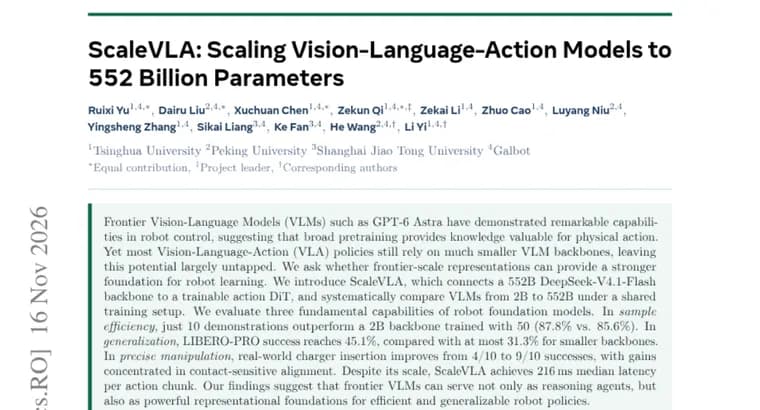
A paper on the Hugging Face papers page introduces ScaleVLA, a Vision-Language-Action (VLA) robot policy. It connects a 552B DeepSeek-V4.1-Flash backbone to a trainable action DiT. The motivation is stated up front: frontier Vision-Language Models such as GPT-6 Astra have shown remarkable capabilities in robot control, which suggests that broad pretraining holds knowledge useful for physical action. Yet most VLA policies still rely on much smaller VLM backbones, so that potential is largely untapped. The authors ask whether frontier-scale representations can give robot learning a stronger foundation.
To answer, they compare VLM backbones from 2B to 552B under a shared training setup and evaluate three capabilities of robot foundation models.
Sample efficiency: ScaleVLA with just 10 demonstrations outperforms a 2B backbone trained with 50, scoring 87.8% against 85.6%. The abstract does not name the metric behind these two figures.
Generalization: success on LIBERO-PRO reaches 45.1%, compared with at most 31.3% for smaller backbones.
Precise manipulation: real-world charger insertion improves from 4/10 to 9/10 successes, with gains concentrated in contact-sensitive alignment. The abstract does not say which backbone or setup produced the 4/10.
Despite its scale, ScaleVLA achieves a median latency of 216 ms per action chunk. The authors conclude that their findings suggest frontier VLMs can serve not only as reasoning agents but also as powerful representational foundations for efficient and generalizable robot policies.
Key facts
- ScaleVLA connects a 552B DeepSeek-V4.1-Flash backbone to a trainable action DiT and compares VLM backbones from 2B to 552B under a shared training setup.
- Sample efficiency: 10 demonstrations with the large backbone beat a 2B backbone trained with 50 (87.8% vs. 85.6%).
- Generalization: LIBERO-PRO success reaches 45.1%, against at most 31.3% for smaller backbones.
- Real-world charger insertion rises from 4/10 to 9/10 successes, with gains concentrated in contact-sensitive alignment.
- Median latency is 216 ms per action chunk despite the model's size.
Why it matters
Most VLA robot policies are built on much smaller VLM backbones, even though frontier VLMs have shown strong capabilities in robot control. This paper tests the other direction: what happens when a 552B backbone is used and compared against models from 2B upward under one training setup. The reported results point the same way across three tests, and the authors suggest that frontier VLMs can be representational foundations for robot policies, not only reasoning agents.
Who it affects
Robotics researchers building VLA policies are the direct audience, since the paper argues for much larger backbones than most current work uses. Teams working on manipulation with few demonstrations may care most about the sample-efficiency result, and anyone deploying large models on robots will look at the 216 ms median latency per action chunk.
How to use it
The abstract describes the recipe at a high level: a 552B DeepSeek-V4.1-Flash backbone connected to a trainable action DiT, compared against backbones from 2B to 552B under a shared training setup. The abstract does not state the number of parameters of the action DiT. No release of code, weights or data is mentioned, so there is nothing to run from the text alone.
How solid is it
This is a preprint abstract, and the figures are the authors' own; no independent verification is reported. The abstract names three evaluated capabilities and gives concrete numbers for each. The wording is cautious: the authors say their findings suggest, not prove, that frontier VLMs can serve as foundations for robot policies. The 87.8% vs. 85.6% gap is small, and the metric and task behind it are not named. The real-world result is 9/10 against 4/10 on a single charger insertion task.
Risks and caveats
The baseline for the 4/10 charger-insertion result is not stated, and the 10-trial scale is small. The abstract does not say whether 45.1% on LIBERO-PRO is state of the art, only that it beats smaller backbones in the same comparison (at most 31.3%). The hardware used for the 216 ms latency is not stated. The abstract also does not state whether the 552B figure is an active-parameter or total-parameter count.
“Our findings suggest that frontier VLMs can serve not only as reasoning agents, but also as powerful representational foundations for efficient and generalizable robot policies.”
— ScaleVLA paper abstract