Self-organizing AI agent teams learn to reason together, beat solo models on math
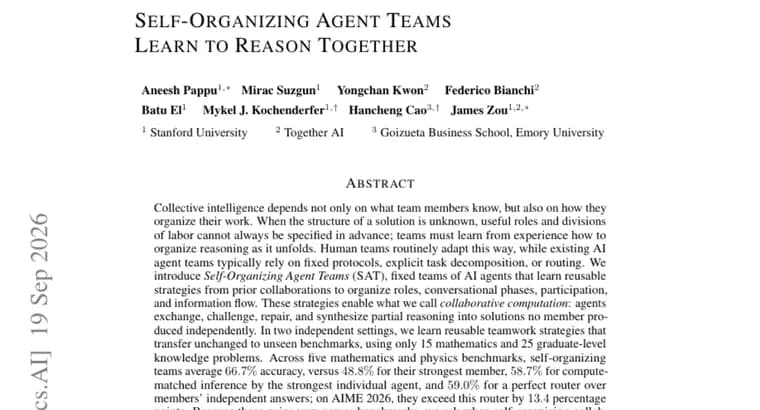
Researchers introduce Self-Organizing Agent Teams (SAT), fixed teams of AI agents that learn reusable strategies for organizing roles, conversational phases, participation, and information flow from prior collaborations, rather than following a fixed protocol or a pre-set division of tasks. The idea is that when the structure of a problem is not known in advance, useful roles cannot be specified ahead of time, so the team has to learn on the fly how to organize its reasoning, the way human teams do. These learned strategies produce what the authors call collaborative computation: agents exchange, challenge, repair, and synthesize each other's partial reasoning into solutions no single member produced on its own. The strategies were learned using only 15 mathematics problems and 25 graduate-level knowledge problems, and in two independent test settings they transferred unchanged to benchmarks the teams had not trained on. Across five mathematics and physics benchmarks, the self-organizing teams averaged 66.7% accuracy. That beat 48.8% for the team's strongest individual member working alone, 58.7% for that same strongest member given a compute-matched amount of extra inference, and 59.0% for a theoretical perfect router that always picks the best of the members' independent answers. On the AIME 2026 benchmark specifically, the self-organizing teams beat the perfect-router baseline by 13.4 percentage points. Because the size of the gains varied by benchmark, the authors also studied when self-organizing collaboration actually helps. Across eight benchmarks, they found that a factor from organizational psychology called demonstrability, meaning whether a team can recognize correct reasoning once it sees it, strongly tracks how much the team improves over its strongest individual member (Spearman correlation of 0.90, p=0.005). In other words, teams gain the most when correct answers are easy to verify once proposed, even if they are hard to produce alone. The authors conclude that organizing how a team reasons together can itself become a learned capability of AI agents, not just something imposed on them from outside.
Key facts
- Self-Organizing Agent Teams (SAT) learn reusable strategies for roles, conversational phases, participation, and information flow from just 15 math problems and 25 graduate-level knowledge problems, then reuse those strategies unchanged on unseen benchmarks
- Across five mathematics and physics benchmarks, self-organizing teams average 66.7% accuracy versus 48.8% for their strongest individual member, 58.7% for compute-matched inference by that same member, and 59.0% for a perfect router over members' independent answers
- On AIME 2026, self-organizing teams beat the perfect-router baseline by 13.4 percentage points
- Across eight benchmarks, a team's ability to recognize correct reasoning once it appears (demonstrability) strongly predicts how much the team improves over its best solo member (Spearman rho=0.90, p=0.005)
- The authors describe the result as agents exchanging, challenging, repairing, and synthesizing each other's partial reasoning into solutions no member could reach alone
Why it matters
Most multi-agent AI systems today rely on protocols designers set in advance: fixed roles, hand-built task decomposition, or a router that picks the best answer after the fact. This work shows a team can instead learn, from a small number of practice problems, how to organize its own roles and conversation, and then carry that organizational skill over to entirely new problems unchanged. The authors frame this as evidence that organization itself, not just individual model skill, can be learned and transferred as an agent capability.
Who it affects
The result is aimed at researchers and engineers building multi-agent AI systems for reasoning-heavy tasks such as math and graduate-level knowledge questions, where a single model's answer is often wrong but a team can catch and fix errors collectively.
How to use it
The learned strategies were trained on a small set of 15 math and 25 graduate-level knowledge problems and then applied without modification to five mathematics and physics benchmarks plus a further set of eight benchmarks used to study when the approach helps, suggesting the method could generalize with relatively little training data. No pricing, licensing, or release details are given in the source.
How solid is it
The figures come directly from the paper: a 66.7% average accuracy for self-organizing teams against 48.8%, 58.7%, and 59.0% for the three baselines across five benchmarks, a 13.4-point margin on AIME 2026, and a Spearman correlation of 0.90 (p=0.005) between demonstrability and improvement across eight benchmarks. The source text does not give author names, an affiliated institution, or a publication date, and it does not name the eight benchmarks individually beyond AIME 2026.
Risks and caveats
The authors themselves note that gains vary across benchmarks, and their own analysis finds the benefit depends heavily on demonstrability, meaning teams gain the most only when correct reasoning can be recognized once it is proposed; on tasks where correctness is hard to verify even after the fact, the advantage over a strong solo agent may be much smaller. The source text does not describe how the learned strategies are represented or stored between collaborations.