SemanTok video tokenizer: 201M model matches one 3.4x larger
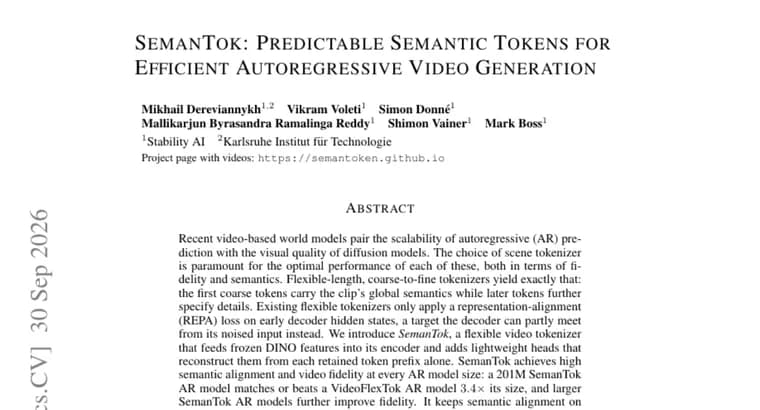
Video world models increasingly pair the scalability of autoregressive (AR) prediction with the visual quality of diffusion models. The paper behind this story starts from the point that the choice of scene tokenizer is paramount for both, in terms of fidelity and semantics.\n\nIt focuses on flexible-length, coarse-to-fine tokenizers. In these, the first coarse tokens carry the clip's global semantics, while later tokens specify details. The authors argue that existing flexible tokenizers only apply a representation-alignment (REPA) loss on early decoder hidden states. That is a weak target, because the decoder can partly meet it from its noised input instead of from the tokens.\n\nThe proposed fix is SemanTok. It feeds frozen DINO features into the encoder and adds lightweight heads that reconstruct those features from each retained token prefix alone. So every prefix, however short, is pushed to carry semantics.\n\nThe headline result is about model size. According to the abstract, SemanTok achieves high semantic alignment and video fidelity at every AR model size. A 201M SemanTok AR model matches or beats a VideoFlexTok AR model that is 3.4 times its size, and larger SemanTok AR models improve fidelity further.\n\nThe authors also report that SemanTok keeps semantic alignment on out-of-distribution classes. It gives the decoder higher semantic alignment at every noise level, including pure noise. It performs well in both reconstruction and generation. Its short token prefixes are cheaper to predict and give better generation fidelity, with pixel detail deferred to later tokens.
Key facts
- SemanTok is a flexible-length, coarse-to-fine video tokenizer that feeds frozen DINO features into its encoder.
- Lightweight heads reconstruct those DINO features from each retained token prefix alone, so short prefixes carry semantics.
- The authors say existing flexible tokenizers apply a REPA loss only on early decoder hidden states, which the decoder can partly satisfy from its noised input.
- Reported result: a 201M SemanTok AR model matches or beats a VideoFlexTok AR model 3.4 times its size.
- SemanTok is said to keep semantic alignment on out-of-distribution classes and at every noise level, including pure noise.
Why it matters
Tokenizers set the ceiling for autoregressive video generation and video world models, since the model predicts tokens rather than pixels. The paper's claim is that a smarter tokenizer can substitute for raw model size: a 201M SemanTok AR model matches or beats a VideoFlexTok AR model 3.4 times larger. It also argues that short token prefixes are cheaper to predict while giving better generation fidelity, with pixel detail left to later tokens.
Who it affects
Researchers building video generators and world models, particularly those working on flexible-length, coarse-to-fine tokenizers and on autoregressive or diffusion-based decoding. The abstract names no products or deployments.
How to use it
The abstract mentions no code, model or data release, so there is nothing to run yet. Practitioners can take the idea: inject frozen DINO features into the tokenizer encoder and add lightweight heads that reconstruct them from each token prefix, rather than relying on a REPA loss on early decoder hidden states alone.
How solid is it
The material is the paper's abstract, so every claim is the authors' own. It gives no benchmark names, datasets, metrics or numeric scores, so the 3.4x comparison cannot be checked from the text. The size of the VideoFlexTok AR model is given only relative to the 201M SemanTok model, and the sizes of the larger SemanTok models are not stated.
Risks and caveats
The efficiency claim is a single comparison against one baseline, VideoFlexTok, and rests on the abstract alone. That short prefixes are "cheaper to predict" is stated only qualitatively, with no compute, speed or inference cost figures. Out-of-distribution robustness is asserted without numbers.
“a 201M SemanTok AR model matches or beats a VideoFlexTok AR model 3.4times its size”
— SemanTok paper abstract