SGF+ gives autoregressive video models separate parameters for context and denoising
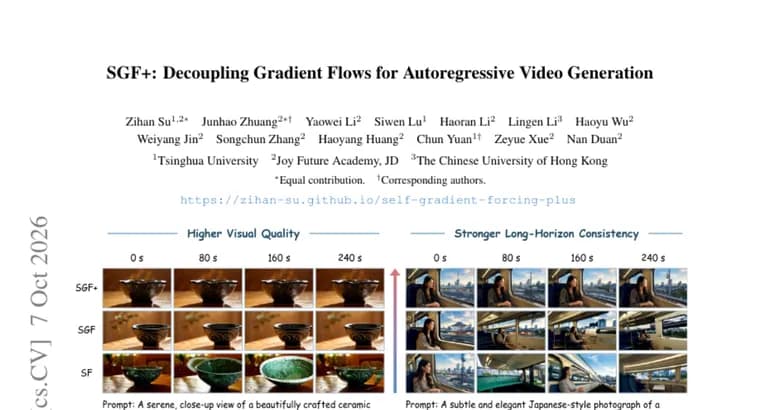
A paper introduces Self Gradient Forcing Plus (SGF+), a method for autoregressive video generation. In this setup a model has to do two jobs at once: denoise the frames it is currently producing, and write the key-value representations of those frames so they can serve as context for future predictions. Normally both jobs share the same parameters.
The authors find that this sharing is a problem. The gradients of the two roles show distinct patterns and what the paper calls systematic negative alignment, which in the authors' words hinders the joint optimization of visual quality and temporal consistency.
SGF+ responds by assigning separate parameters to context writing and to denoising, while keeping the two connected through causal attention. Both roles are still trained together using the original generation objective, with no auxiliary losses. Context writing is supervised through its contribution to future predictions.
The authors say this simple change improves visual quality and long-horizon consistency over the evaluated baselines, in both framewise and chunkwise generation. It does so without additional video training data and without a longer training horizon.
The headline result is about length. Trained on only 5s rollouts, SGF+ supports continuous generation for up to 24 hours without long-video fine-tuning. The authors conclude that role-specific parameterization is an effective design principle for high-quality autoregressive video generation and native long-horizon extrapolation.
Key facts
- SGF+ (Self Gradient Forcing Plus) gives context writing (key-value representations) and denoising their own parameters in autoregressive video generation.
- The authors say the two roles' gradients show distinct patterns and systematic negative alignment when parameters are shared, which hinders joint optimization of visual quality and temporal consistency.
- The two roles still interact through causal attention and are trained jointly with the original generation objective, with no auxiliary losses.
- The authors report better visual quality and long-horizon consistency than the evaluated baselines, in both framewise and chunkwise generation, with no extra video training data or longer training horizon.
- Trained on only 5s rollouts, SGF+ supports continuous generation for up to 24 hours without long-video fine-tuning.
Why it matters
Autoregressive video models build a clip piece by piece, so what they store as context shapes everything that follows. The paper's claim is that one set of parameters pulling in two directions (clean current frames versus useful context for later frames) is a bottleneck, and that a plain split removes it. If the finding holds, long, consistent video would not need extra training data, auxiliary losses or longer training rollouts. The reported jump from 5s training rollouts to up to 24 hours of continuous generation is the striking part of that claim.
Who it affects
The paper concerns autoregressive video generation, so it is most relevant to researchers and engineers building or studying such models, both framewise and chunkwise. The source text does not tie the work to any specific product or company.
How to use it
The idea itself is simple to state: keep separate parameters for context writing and for denoising, let them interact through causal attention, and train both with the original generation objective, with no added losses. Context writing is supervised through how it helps future predictions. The source does not mention any code or model release.
How solid is it
This is a paper's own account of its results, summarized from the abstract-level text. The authors attribute the gradient finding and the improvements to their own experiments. No benchmark names, metric values or percentage improvements are given. The baselines are not named. The 24-hour figure is a claim of support for continuous generation; no quality measurements at that length are given.
Risks and caveats
The improvements are stated relative to the evaluated baselines, not to all existing methods, and the baselines are not named. No model size, parameter count or compute cost is given, so the cost of separate parameters cannot be judged from the text. Being able to generate for 24 hours is not the same as the output staying good for 24 hours, and the source gives no quality numbers at that length.
“Trained on only 5s rollouts, SGF+ supports continuous generation for up to 24 hours without long-video fine-tuning.”
— Paper abstract