sheets.works collects 356 processor die photos from 1972 to 2024
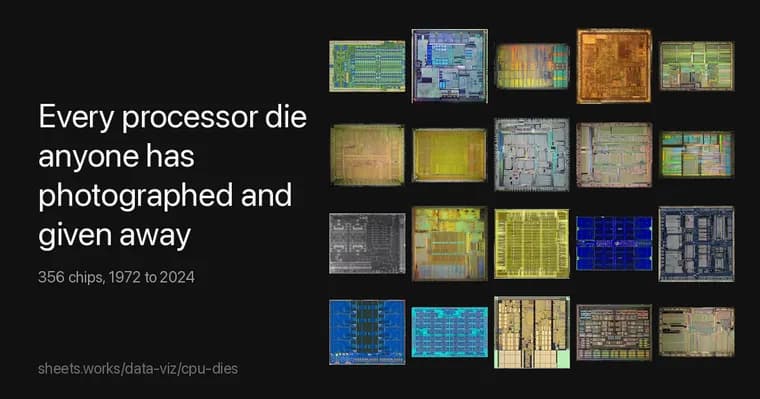
sheets.works has published an interactive data visualisation of processor dies: the bare silicon inside a chip, usually smaller than a fingernail. To see a die, the page explains, you have to sand or dissolve the package away and photograph what is left through a microscope. Only a handful of people do this and give the pictures away.
The page names four who do it most: Pauli Rautakorpi, ZeptoBars in Moscow, John McMaster, and a photographer who posts as Fritzchens Fritz. Together with others, they account for the 356 processors in the collection, which span 1972 to 2024.
The credit list is explicit. Pauli Rautakorpi is credited with 162 photos, Fritzchens Fritz with 68, John McMaster with 36, Martijn Boer with 20, Cole L with 16 and ZeptoBars with 10. Sean Riddle and Antoine Bercovici have 4 each. Ken Shirriff, Mister rf, Epop, InfoSecDJ and Nick V. Chernyy have 3 each. A further 21 photos come from 18 other photographers. Those figures add up to 356.
You click a chip to see it large. A "True scale" view draws the 114 chips whose size is known at the same scale, so a 1970s chip shows up as a speck next to a modern one.
Every photo keeps its own licence, which is shown when you open a chip, and links back to where it was published. The sources are Wikimedia Commons, Flickr, ZeptoBars, Siliconpr0n and the CPU Graveyard wiki. Die sizes come from the photographers' own notes and Wikipedia's transistor count tables. If a chip is missing, the page says, nobody has released a free photo of it yet.
The page also carries a plug for the publisher's daily word game, Long Story Short.
Key facts
- The collection holds 356 processors photographed from 1972 to 2024, all shown as die photos released for free by photographers.
- Pauli Rautakorpi is credited with 162 photos, Fritzchens Fritz with 68, John McMaster with 36 and ZeptoBars with 10; 18 other photographers account for 21 photos.
- A "True scale" view draws the 114 chips whose die size is known at one scale, so a 1970s chip looks like a speck beside a modern one.
- Each photo keeps its own licence, shown when a chip is opened, and links back to its original home, such as Wikimedia Commons, Flickr, ZeptoBars, Siliconpr0n or the CPU Graveyard wiki.
- Die sizes come from the photographers' own notes and Wikipedia's transistor count tables.
Why it matters
A processor die is the silicon that does the computing, and few people ever see one. Getting a picture means sanding or dissolving the package away and photographing the remains through a microscope, and only a handful of people do that and share the results. This page puts 356 of those photos, covering 1972 to 2024, in one place. The true-scale view makes the change in chip size across the decades visible at a glance: a 1970s chip is a speck next to a modern one.
Who it affects
Anyone curious about what is inside a processor, and anyone who wants die photos that come with a stated licence and a link to the original. The page also credits the people who made the images: Pauli Rautakorpi, Fritzchens Fritz, John McMaster, Martijn Boer, Cole L, ZeptoBars and others. Most of the collection rests on a few photographers, since Rautakorpi alone has 162 of the 356.
How to use it
Open the page and click any chip to see its photo large. Switch to the "True scale" view to compare the 114 chips whose size is known at the same scale. When a chip is open, its licence is shown and a link leads back to where the photo was originally published, whether Wikimedia Commons, Flickr, ZeptoBars, Siliconpr0n or the CPU Graveyard wiki.
How solid is it
The numbers come from the page itself, and the photographer counts add up to the stated 356. Die sizes are taken from the photographers' own notes and Wikipedia's transistor count tables, so they are only as good as those sources. The page is a presentation of other people's photos, each credited and linked to its original publication.
Risks and caveats
The collection is not a full census of processors. The page says that if a chip is missing, nobody has released a free photo of it yet. Only 114 of the 356 chips have a known size, so most of the collection cannot be compared at true scale. Licences vary photo by photo, so anyone reusing an image should check the licence shown for that chip and follow the link to the original. The page also promotes the publisher's own word game, Long Story Short.
“so a 1970s chip is a speck next to a modern one”
— sheets.works, on the true-scale view