Shin Jin-seo beats KataGo 2-1, first Go win under handicap
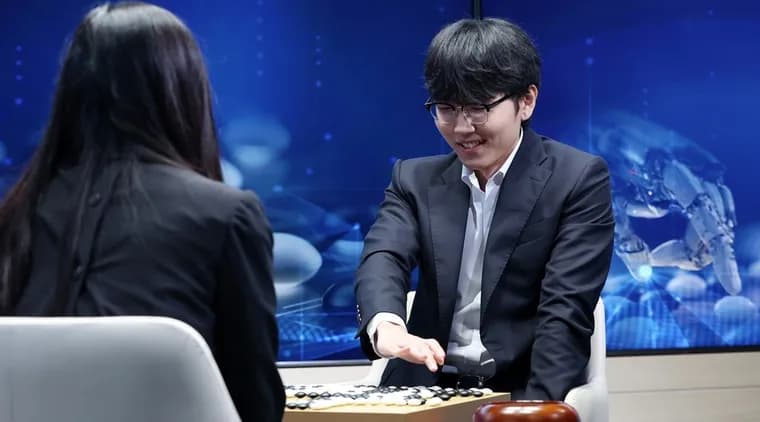
Shin Jin-seo, the world's top-ranked Go player, beat the AI engine KataGo 2-1 in a three-game series played under a two-stone handicap, becoming the first human to win an official series against a state-of-the-art Go engine at that handicap level, which the article describes as the absolute boundary for human competition against modern AI. Shin, a 26-year-old South Korean grandmaster who holds Go's highest achievable rank of nine-dan, came back from a loss in the first game to take the series.
The deciding third game, completed on a Tuesday, ran three hours and five minutes across 221 moves. Playing black, Shin held an 18.5-point lead by focusing on defense and territory rather than tactical fighting through the middle stages, then launched a measured attack on move 80 that grew into a framework spanning from the upper board to the center. Converting that framework into territory, he held a 99% win probability from the middle of the game through to the final move, and won by 11.5 points.
Shin said his approach changed over the course of the series: "Early on, I simply copied AI moves, which led to heavy fighting and frequent, easy losses. This series taught me that rather than trying to imitate AI, it is far more important to build the board according to my own style." In the finale he also deliberately avoided KataGo's preferred opening point: "I noticed KataGo tends to match moves if I open on the opposite komoku, but I didn't want to win that way. I knew even a one-space difference could be significant, so I started on the opposite side from KataGo. Even so, I was satisfied with how the opening developed." Komoku is the Japanese term for the three-to-four point on a Go board.
The series was played under handicap because of what the article calls a widely acknowledged skill gap between modern AI and human professionals: in a Go handicap, the weaker player takes black and places two to nine preset stones on the board before play starts, and Shin placed two stones before each of the three games. No human had defeated an AI Go engine in an official series before this result. In 2016, Google DeepMind's AlphaGo beat Korean Go legend Lee Sedol 4-1, and in May 2017, at the Future of Go Summit in Wuzhen, China, an upgraded AlphaGo Master swept then-world No. 1 Ke Jie 3-0, with even the closest game decided by only 0.5 points; the article calls that sweep a definitive moment at which AI surpassed humanity at the game. Shin placed his own win in that context: "My victory may fall short when compared to the single win achieved by master Lee Sedol."
Hong Beom-jun, CEO of Truebook Sinsago, which co-sponsored the series with The Korea Economic Daily, said the win was a turning point for confidence that AlphaGo's 2016 victory had damaged, and located the lesson in Shin's adjustment rather than in the scoreline itself: "There was a problem with the method in the first match, but the goal itself was not wrong. Shin shifted his strategy in the second and third matches toward a defensive, disciplined style, and ultimately prevailed. That is the true lesson of this series." Hong said organizers plan to hold the same event again next year and are working to further level the playing field between human players and machine intelligence; Shin himself said he wants to try starting under even more disadvantageous conditions at future events. For the series win, Shin received 250 million won (about $170,000) in match fees and prize money, along with a Genesis G90 luxury sedan as a performance award.
Key facts
- Shin Jin-seo, a 26-year-old nine-dan grandmaster, beat the AI engine KataGo 2-1 in a three-game series played under a two-stone handicap, the first official series win by a human against a state-of-the-art Go engine at that handicap level.
- He won the deciding third game by 11.5 points in 221 moves over three hours and five minutes, after holding an 18.5-point lead through defense and then attacking from move 80 onward.
- From the middle of that final game through to the last move, Shin held a 99% win probability.
- The win brought Shin 250 million won (about $170,000) in match fees and prize money, plus a Genesis G90 sedan; organizers plan to hold the event again next year.
- It is the first human series win against elite Go AI since Google DeepMind's AlphaGo beat Lee Sedol 4-1 in 2016 and AlphaGo Master swept Ke Jie 3-0 in 2017.
Why it matters
Since Google DeepMind's AlphaGo beat Lee Sedol 4-1 in 2016, and an upgraded AlphaGo Master swept then-world No. 1 Ke Jie 3-0 in 2017 in what the article calls a definitive moment when AI surpassed humanity at Go, the game has stood as one of the clearest examples of AI overtaking elite human play. Shin Jin-seo's 2-1 series win over KataGo breaks that run: no human had won an official series against a state-of-the-art Go engine before, even under the two-stone handicap the article describes as the outer limit of fair competition against modern AI. It is offered in the piece as a concrete, if narrow, sign that elite humans have not been made wholly obsolete by today's strongest game-playing AI.
Who it affects
The result lands most directly on elite competitive Go and the people who run it: Truebook Sinsago and The Korea Economic Daily, which co-sponsored the series and, per Truebook Sinsago CEO Hong Beom-jun, plan to hold the same event again next year while working to further level the playing field between humans and AI. It also bears on KataGo itself and on how any AI game engine's dominance gets framed and tested going forward. Shin, for his part, said he wants future events to push him under even more disadvantageous conditions against AI.
How to use it
There is no product here, only the format that made the result possible: a Go handicap, in which the weaker side takes black and places two to nine preset stones on the board before play to offset a skill gap. Organizers set it at two stones, citing the widely acknowledged skill gap between modern AI and human professionals, and Shin placed two stones before each of the three games. Shin's account of his own adjustment doubles as a playbook for future challengers: rather than copying KataGo's moves, which he said led to heavy fighting and easy losses, he built the board in his own style and deliberately opened on the point opposite KataGo's preferred komoku.
How solid is it
The account rests on a single article, built around on-the-record quotes from Shin Jin-seo and from Hong Beom-jun, CEO of Truebook Sinsago, one of the series' two co-sponsors together with The Korea Economic Daily. The numbers for the deciding game are specific and consistent with one another: 221 moves, three hours and five minutes, an 18.5-point mid-game lead, a move-80 turning point, a 99% win probability from mid-game on, and an 11.5-point final margin, though the article does not say how that win-probability figure was calculated. It gives no score or detail for games one and two beyond Hong's remark that "there was a problem with the method in the first match," names no venue, gives no version or hardware detail for KataGo, and does not name the "Go experts" quoted on how hard it is to hold a lead against a near-flawless AI.
Risks and caveats
The "official series" framing rests on the two named co-sponsors rather than any outside Go federation or certifying body, and the article itself runs on Kedglobal, tied to The Korea Economic Daily, one of those two co-sponsors, so this is not arms-length coverage of an event its own publisher helped stage. The two-stone handicap was chosen specifically because a state-of-the-art Go engine is still considered stronger than any human without it, so the result shows a win within a margin organizers judged fair, not a win on level terms. Shin made the same point himself, ranking his result below Lee Sedol's lone 2016 win over the original AlphaGo: "My victory may fall short when compared to the single win achieved by master Lee Sedol."
“I believe this series holds immense significance because it clearly demonstrated that humans can still hold their own against AI”
— Shin Jin-seo, the world's top-ranked Go player