SiFive's BigSky SF-2U870 brings RVA23 support to RISC-V servers
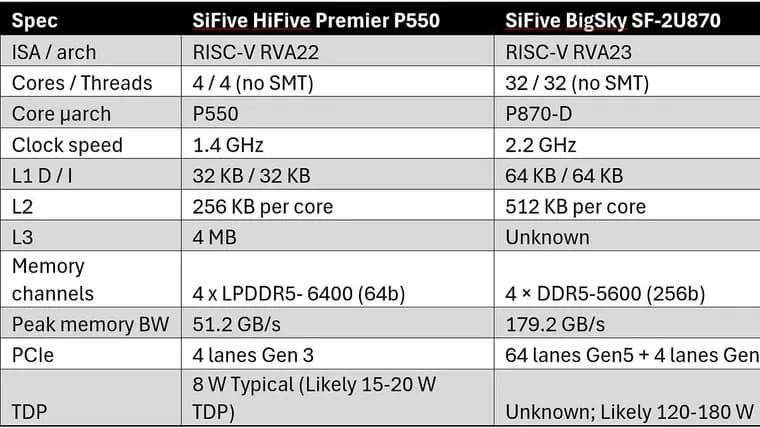
SiFive has introduced the BigSky SF-2U870, its first server development platform, and a review on chipsandcheese.com walks through its specs and how it stacks up against rival chips. The platform is a standard 19 inch 2U server built around 32 of SiFive's P870-D cores running at 2.2 GHz, with 256 GB of DDR5-5600 memory, 64 lanes of PCIe 5.0 plus 4 lanes of PCIe Gen 3.0, support for a double-wide GPU drawing up to 450W, a 10/25 GbE OCP 3.0 network card, a 960 GB SATA SSD for the OS, and 3.84 TB of U.2 NVMe SSD for data storage.
Compared with SiFive's earlier HiFive Premier P550 development board, the review says the biggest upgrade is not the core count, the memory bandwidth or the more than sixtyfold jump in PCIe bandwidth, but support for the RVA23 profile. RVA23 support means BigSky includes RISC-V Vector extension (RVV) support and can run Ubuntu 26.04 out of the box, since that release requires RVA23.
Against x86 and Arm rivals, the review finds the closest match is Intel's Xeon 6532P-B, which shares BigSky's core count, base clock and memory subsystem, but adds SMT2, a 3.9 GHz boost clock and a wider core, while BigSky counters with more PCIe lanes and likely lower power draw. Against the AMD EPYC 8325P, the review says BigSky has few, if any, specification advantages, aside from possibly lower power draw. The most direct comparison is with the Ampere Altra Q32-17, since Altra chips have filled the same development-system role BigSky now targets: BigSky has higher clock speeds, a wider core and PCIe Gen 5, while the Altra has more lanes, more memory bandwidth and a lower TDP. The review notes that the Q32-17 is the bottom of the Altra line, and that the top SKU, the 80-core, 3.3 GHz, 250W TDP Ampere Altra Q80-33, would beat BigSky in an apples-to-apples performance comparison.
The review places BigSky against a wider RISC-V backdrop of acquisitions and exits, including Qualcomm's acquisition of Ventana in December of the prior year and Condor Computing winding down operations, alongside newly taped-out silicon such as SpacemiT's K3 SoC, Tenstorrent's Atlantis SoC and a test chip from Akeana. Its take is that RISC-V has lacked exactly this kind of unglamorous, RVA23-capable platform that developers can just run CI on without fighting immature firmware, and that BigSky is meant to fill that gap. The review also flags that SiFive's own product page is inconsistent at the time of writing, quoting both a 2.0 GHz and a 2.2 GHz operating frequency in different sections, and listing the data storage two different ways, once as 3.84 TB and elsewhere as 2x 7.68 TB U.2 NVMe SSD. No price or firm release date is given; the review says only that the platform should hopefully be available to developers soon.
Key facts
- BigSky SF-2U870 packs 32 SiFive P870-D cores at 2.2 GHz, 256 GB of DDR5-5600, 64 lanes of PCIe 5.0 plus 4 lanes of PCIe Gen 3.0, and support for a double-wide GPU up to 450W in a standard 19 inch 2U server.
- RVA23 profile support is the platform's key upgrade over SiFive's prior HiFive Premier P550 board, since it brings RVV support and lets BigSky run Ubuntu 26.04 out of the box.
- Against the AMD EPYC 8325P the review finds BigSky has few, if any, spec advantages beyond possibly lower power draw; the top Ampere Altra SKU, the 80-core Q80-33, would beat BigSky in an apples-to-apples comparison.
- SiFive's own product page is inconsistent, listing both 2.0 GHz and 2.2 GHz clock speeds and two different data-storage configurations (3.84 TB versus 2x 7.68 TB U.2 NVMe).
- No price or firm release date is given; BigSky arrives against a backdrop of RISC-V consolidation, including Qualcomm's acquisition of Ventana and Condor Computing's shutdown.
Why it matters
The review's argument is that BigSky's value is not in beating x86 or Arm on raw specs, but in being an unglamorous, reliable platform that developers can just build and run CI on. RVA23 support is the mechanism: it brings RISC-V Vector extension support and lets the platform run Ubuntu 26.04 out of the box, since that Ubuntu release requires RVA23. The review frames the lack of exactly this kind of boring, RVA23-capable hardware as one of the RISC-V ecosystem's biggest gaps, following a stretch of consolidation that included Qualcomm's acquisition of Ventana and the wind-down of Condor Computing, alongside newly taped-out chips from SpacemiT, Tenstorrent and Akeana.
Who it affects
RISC-V software developers and toolchain teams get a standard, off-the-shelf 2U server to target instead of assembling a development system from less mature parts. SiFive positions BigSky as a successor to its own HiFive Premier P550 board rather than a challenger to Intel, AMD or Ampere Altra server chips, all of which the review benchmarks it against on paper.
How to use it
BigSky is a standard 19 inch 2U rack server: 32 P870-D cores at 2.2 GHz, 256 GB of DDR5-5600, 64 PCIe 5.0 lanes plus 4 PCIe Gen 3.0 lanes, room for a double-wide GPU up to 450W, a 10/25 GbE OCP 3.0 network card, a 960 GB SATA SSD for the OS and 3.84 TB of U.2 NVMe SSD for data. No price is stated, and the review does not say whether the platform is shipping yet, only that it should hopefully reach developers soon.
How solid is it
The review is a specification-by-specification comparison against SiFive's own prior board and against named competing chips (Intel Xeon 6532P-B, AMD EPYC 8325P, Ampere Altra Q32-17 and Q80-33), rather than an independent benchmark of physical hardware. The reviewer also flags, and publicly calls out, that SiFive's own product page contradicts itself: one section states a 2.0 GHz clock and another 2.2 GHz, and the storage listing switches between 3.84 TB and 2x 7.68 TB U.2 NVMe SSD depending on where on the page you look.
Risks and caveats
On paper, BigSky trails rather than leads: it has few clear spec advantages over the AMD EPYC 8325P, and the review says the top-end Ampere Altra Q80-33, with 80 cores at 3.3 GHz and a 250W TDP, would beat it in a like-for-like comparison. The Intel Xeon 6532P-B also counters with SMT2, a higher boost clock and a wider core. Add the unresolved inconsistencies on SiFive's own product page over clock speed and storage capacity, plus the absence of any confirmed price or release date, and the picture is of a platform still being finalized for launch.
“This platform is boring, and that is a good thing.”
— chipsandcheese.com review