SimLoss trains image captioners to get fine detail in a single pass
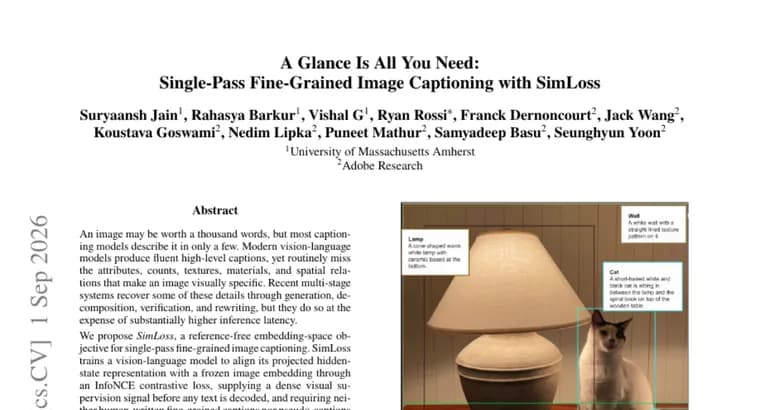
Researchers propose SimLoss, a training method that closes a long-standing gap in image captioning: fluent models routinely produce high-level descriptions of a picture but miss the fine-grained details, attributes, counts, textures, materials, and spatial relations that make an image visually specific. Existing fixes recover this detail through multi-stage pipelines that generate a caption, decompose it, verify it against the image, and rewrite it, but each of those extra steps adds inference latency.
SimLoss instead trains a vision-language model directly, using a reference-free, embedding-space objective. During training it aligns the model's projected hidden-state representation with a frozen image embedding through an InfoNCE contrastive loss. This supplies a dense visual supervision signal before any text is decoded, and it needs neither human-written fine-grained captions nor the pseudo-captions a multi-stage pipeline would otherwise have to generate as training data.
The authors built two variants. SimLoss FFT backpropagates through a locally available embedding model during fine-tuning. SimLoss GRPO instead treats that embedding model as a black-box reward signal. Both keep the model's inference behavior single-pass: no decomposition, verification, or rewriting step is added at generation time.
Against single-pass, multi-stage verification, reward-optimized, and perception-aware baselines, SimLoss FFT achieves the highest precision of the compared methods while nearly matching the F1 score of the multi-stage pipeline, all while keeping single-pass inference and running roughly 20 times faster than that multi-stage baseline. SimLoss GRPO, the reward-based variant, attains the strongest recall among the methods compared. The authors read the combined result as evidence that embedding-space supervision during training can recover the caption quality of multi-stage verification at the inference latency of a plain single-pass captioner.
Key facts
- SimLoss is a reference-free, embedding-space training objective for single-pass fine-grained image captioning.
- It uses an InfoNCE contrastive loss to align a model's hidden-state representation with a frozen image embedding before any text is decoded.
- It needs no human-written fine-grained captions and no pseudo-captions from a multi-stage pipeline.
- SimLoss FFT (backpropagation through a local embedding model) gets the highest precision and nearly matches multi-stage F1, running roughly 20 times faster than the multi-stage baseline.
- SimLoss GRPO (embedding model used as a black-box reward) attains the strongest recall among the compared methods.
Why it matters
Captioning models have long faced a tradeoff: fast single-pass models produce fluent but generic descriptions, while accurate fine-grained detail has required slow multi-stage pipelines that generate, decompose, verify, and rewrite a caption. SimLoss targets that tradeoff directly by moving the extra supervision into training rather than inference, so the fine detail is learned once and then produced in a single pass at generation time.
Who it affects
The result is aimed at anyone building or relying on image captioning and vision-language systems, including applications like accessibility description, image search and retrieval, and dataset labeling, where the accuracy of fine-grained detail matters but multi-stage inference latency and cost are a practical barrier.
How to use it
SimLoss is a training-time objective with two variants: SimLoss FFT, which requires backpropagating through a locally available embedding model during fine-tuning, and SimLoss GRPO, which instead uses an embedding model as a black-box reward and so does not require access to its internals. Neither variant needs human-written fine-grained captions or pipeline-generated pseudo-captions as training data. The source text gives no pricing, license, or release details for code or trained models.
How solid is it
The claims come from the paper's own comparison against single-pass, multi-stage verification, reward-optimized, and perception-aware baselines, reported only in relative terms (highest precision, nearly matching F1, strongest recall, roughly 20 times faster) rather than as specific precision, recall, or F1 numbers. The text does not name the benchmark dataset, evaluation setup, publication venue, or the authors and their affiliation.
Risks and caveats
Because the source gives no absolute scores, no benchmark name, and no author or venue information, the strength of the improvement cannot be independently sized from this text alone; the reported figures are the authors' own relative comparisons rather than externally verified or peer-reviewed numbers as described here.