Simon Willison says Claude Opus 5.5 can now vibe code fun games
On 28 October 2026 Simon Willison wrote that a new inflection point has arrived, this time for vibe coding computer games. He compares it with November 2025, which he calls the point when Opus 4.5 and GPT-5.1 made coding agents reliable daily drivers for software engineers.
His central claim is that Claude Opus 5.5 improves in three areas a compelling game needs: 3D modeling, music generation and game design. The last matters most to him. Models could already produce something that looks like a game; the hard part was making it fun to play, and he says he did not think models could do it. Then he told Claude Opus 5.5 to 'Make it a LOT more fun', and by his account it did. In the past few weeks he vibe coded four games, in the classic sense of never looking at the code, and says he genuinely enjoyed playing them. At Foo Camp in Berkeley over the weekend he met several people with similar experiences. His summary: building games that play well is shockingly easy now, and the new challenge is coming up with concepts that are novel and wouldn't exist without AI. All four games are built in HTML and JavaScript and run entirely in the browser.
Tree Appreciator is the smallest. He built it in regular Claude chat, without Claude Code, on a whim while driving along Skyline Boulevard looking at trees. The prompt asked for a three.js game in which you see two algorithmically generated trees and appreciate the differences between them, and told the model to think hard about making it both fun and beautiful. It needed no iteration or follow-up prompting: a mobile-friendly spot-the-difference game arrived in a single shot, with a 'herbarium' where completed trees are collected.
Emberwick was more ambitious, again built in regular Claude chat. He started with a prototype engine for a top-down fantasy RPG in three.js, where walls turn transparent when the player enters a building. Follow-up prompts added uneven terrain, basements joined by tunnels, and a mountain with a cave holding a sleeping troll. A final prompt asked for an actual game: a quadrupled play area, fun mechanics, a plot that isn't too cliche, twists and a magic system. Unlike Tree Appreciator, this needed quite a bit of playtesting and prompting, mainly to fix gameplay problems such as a character being in the wrong place to complete a quest after another story element moved them. The result has a full story of about 15 minutes and an experimental level editor. He found himself emotionally affected by the ending, which he admits is a little embarrassing, because the graphics, plot, characters, music and dialog all came from the model; his input was roughly 'a fantasy village and there's a troll asleep in a cave'. He fed the same opening prompts to ChatGPT GPT-6 Pro. That game looks great, he writes, but he doesn't think it plays nearly as well.
Battle Drones, which he wrote about the previous week, is his most successful project: a Command & Conquer-style real-time strategy game in which two robot armies (four as of Saturday) build units, harvest scrap and fight over territory. The first versions were built in July with Claude Fable 5 and gave a workable 2D game that wasn't great to play. After he prompted Opus 5.5 to 'Make it a LOT more fun' and later to port it to three.js, the game was transformed. It now has 2-4 player multiplayer through a vibe coded WebSockets relay server, medals, replays, seven maps, a random map generator and 'mutators' that change the rules. An LLM-vs-LLM mode advances the game five seconds, then pauses so models can read the new state and line up commands; he links a replay of Claude Haiku 5.5 against GPT-6 Luna. He released the game under the Apache 2.0 License last Tuesday, and on Wednesday Gabriel Turpin released Panache, a fork reimagined for steampunk 1900s Belle Epoque France with new models, music and an animated intro.
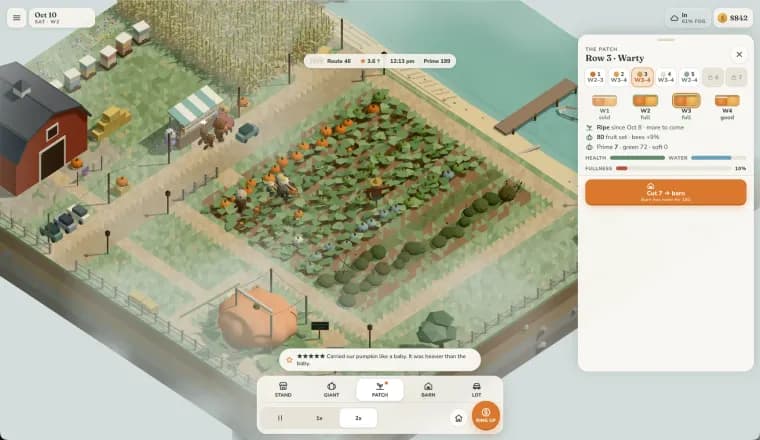
Quarter Sun Cove, also called Pumpkin Farmer, comes from his home of Half Moon Bay, California, which hosts a giant pumpkin weigh-off. He wanted a game that was not a cheap imitation of an existing one. It is a cosy farming simulator: tend a giant pumpkin all year, plant regular pumpkins to sell in October, then enter the weigh-off. Every character is a vegetarian animal (the mayor is a pelican; the player can be a pelican, skunk, raccoon, possum, beaver, coyote, fox, owl, sea otter or harbor seal). After a brainstorming session produced a spec file, Opus 5.5 Ultracode burned millions of tokens and nearly two days building it. He told Claude to 'surprise and delight the user frequently', which produced details such as mischievous raccoons, an elephant seal running the weigh-off and a wandering goat. He admits it isn't his best game yet and is less fun than Battle Drones, and he is not convinced by its mechanics, which require timing plantings so pumpkins ripen on busy October weekends.
He also compares vendors. His current impression, from no exhaustive study, is that GPT-6 Astra can build a game but its sense of fun doesn't match Opus 5.5, and he expects OpenAI to get there by the end of the year.
He acknowledges that vibe coded games combine AI-generated art, music, writing and code, which will offend people who object to any of them, and he says he respects that view. He points to the games community's existing aversion to AI assets, citing an IGN story on complaints about slop at Valve's Steam Next Fest. He expects a split, as with programming: some players will refuse such games, others may welcome a wider audience for game development, and he leans toward the latter. He won't enter his vibe coded games in traditional game jams or competitions, because he doesn't feel he has earned that right, and he expects new avenues for vibe game developers to compare projects.
He calls it both exciting and shameful that he got interesting results from so little creative input: no project took more than four hours of his own work, plus many more hours of Claude Code running by itself. He asks what someone who invests real creative time, applies better taste and playtests carefully could achieve, and says he wants to see games that wouldn't have existed without AI.
Key facts
- Simon Willison says October 2026 is an inflection point for vibe coding games, comparing it with November 2025 for coding agents.
- He credits Claude Opus 5.5 with gains in 3D modeling, music generation and game design, and says prompting it to 'Make it a LOT more fun' worked.
- He built four browser games in HTML and JavaScript: Tree Appreciator (one shot), Emberwick (about 15 minutes of story), Battle Drones (2-4 players, seven maps) and Quarter Sun Cove (nearly two days of Opus 5.5 Ultracode work).
- No project took more than four hours of his own work; Battle Drones is released under Apache 2.0 and has a fork, Panache, by Gabriel Turpin.
- His impression is that GPT-6 Astra and GPT-6 Pro games are not yet as fun; he expects OpenAI to catch up by year end.
Why it matters
Willison's argument is that the gap was never in making something that looks like a game, but in making one that is fun, and that Claude Opus 5.5 has started to close it. He ties this to an earlier claim that November 2025 made coding agents reliable daily drivers. If he is right, the scarce resource shifts from implementation to ideas: he says the new challenge is concepts that are novel and delightful and wouldn't exist without AI assistance.
Who it affects
Hobbyists and non-specialists who want to make games are the clear audience, since he describes producing a playable multiplayer RTS by prompting on his phone and expects game development to open to a much wider audience. Game developers and players are affected by the split he predicts: some players will refuse AI-built games, others will embrace them. Competing model vendors are also in view, as he says GPT-6 Astra and GPT-6 Pro are not yet as good at game fun.
How to use it
He shares the approach in his own words. Tell the model to use three.js, which he finds works really well. The regular Claude chat was enough for both Tree Appreciator and the more ambitious Emberwick. Plain-language prompts like 'Make it a LOT more fun', 'make it really good' and 'surprise and delight the user frequently' were enough in his experience. Expect playtesting and follow-up prompts for complex games, as with Emberwick. Battle Drones is open source under Apache 2.0, and the games can be played in a browser.
How solid is it
This is a first-hand essay with playable examples, chat transcripts and prompts, but the verdict on fun is the author's own judgment; no benchmark or player data is given. The comparison with OpenAI models is an impression, not an exhaustive study, and the end-of-year catch-up is only his expectation. He also notes his games vary: Tree Appreciator worked first time, Emberwick needed considerable iteration, and Quarter Sun Cove is less fun than Battle Drones.
Risks and caveats
Willison himself flags that AI-generated assets already draw hostility in the games community and that some players will refuse such games. He says he won't enter his games in traditional jams or competitions. Quarter Sun Cove has mechanics he isn't convinced by, and Emberwick had quest-logic bugs that took playtesting to fix. His results come from minimal creative input, so they say little about how such games compare with carefully crafted human-made ones.
“Building games that play well is shockingly easy now.”
— Simon Willison