SimpleOPD distills long-context reasoning into short-context models
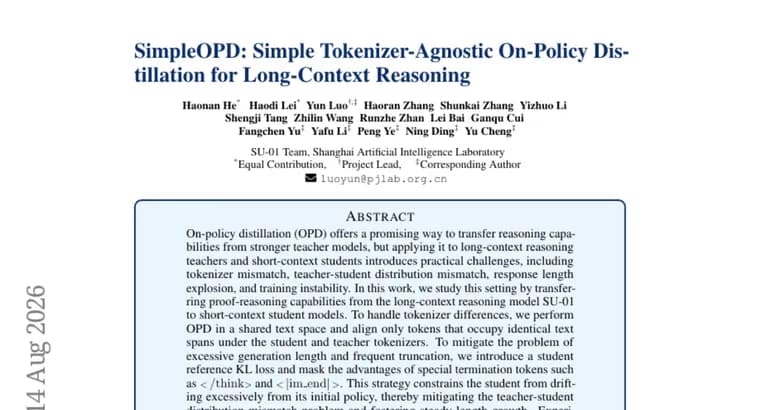
On-policy distillation (OPD) lets a smaller student model learn by generating its own responses and getting corrected against a stronger teacher, rather than just copying teacher outputs. The authors argue that applying OPD when the teacher is a long-context reasoning model and the student is short-context runs into four practical problems: tokenizer mismatch between teacher and student, distribution mismatch between the two, response length explosion, and training instability.
The paper studies this setting by transferring proof-reasoning capability from a long-context reasoning model called SU-01 to several short-context student models. To handle the tokenizer mismatch, the method performs OPD in a shared text space, aligning only the tokens that cover identical text spans under the student's and the teacher's tokenizers. To stop the student's responses from exploding in length and getting truncated, the authors add a student reference KL loss and mask the advantages of special termination tokens such as and <|im_end|>. The intent is to keep the student from drifting too far from its own starting policy, which both curbs the distribution mismatch and lets response length grow in a steady, controlled way rather than spiking.
The method, named SimpleOPD, was tested on both same-family and different-family student models: Qwen3, Qwen3.5, Intern-S2, GLM-4.7, and Gemma-4. The authors report consistent gains in mathematical reasoning across these students, with the largest effect in natural-language math proving. The one figure given in detail: Intern-S2-Preview improved by 21.2 points on ProofBench, reaching a score of 55.2 and surpassing Gemini-2.5-Pro on that benchmark. The paper also reports improvements on science benchmarks HLE and HiPhO, which the authors take as evidence that the reasoning capability transferred by OPD generalizes beyond the mathematical domain it was trained on.
Key facts
- SimpleOPD transfers proof-reasoning ability from long-context teacher model SU-01 to short-context student models via on-policy distillation.
- It aligns tokens in a shared text space to handle mismatched tokenizers between teacher and student.
- A student reference KL loss plus masking the advantages of special termination tokens (, <|im_end|>) curbs runaway response length and keeps training stable.
- Tested on Qwen3, Qwen3.5, Intern-S2, GLM-4.7 and Gemma-4, the method gives consistent math-reasoning gains, strongest in natural-language math proving.
- Intern-S2-Preview gained 21.2 points on ProofBench, reaching 55.2 and surpassing Gemini-2.5-Pro; it also improved on the HLE and HiPhO science benchmarks.
Why it matters
On-policy distillation is a promising way to hand reasoning ability down from a strong teacher model to a smaller one, but doing it across a long-context teacher and a short-context student breaks in specific ways: the two models tokenize text differently, their output distributions drift apart during training, student responses can balloon in length and get truncated, and training can become unstable. SimpleOPD is aimed squarely at fixing those four failure modes rather than proposing a new distillation objective from scratch.
Who it affects
The paper targets researchers and labs building compact, short-context reasoning models who want to draw on a stronger long-context reasoning teacher without inheriting its context length or its tokenizer. The student models tested span both the same model family as typical teachers and different families, covering Qwen3, Qwen3.5, Intern-S2, GLM-4.7 and Gemma-4.
How to use it
The text describes the method (shared-text-space token alignment, a student reference KL loss, and masking the advantages of termination tokens like and <|im_end|>) but does not state whether code or trained models are being released, so nothing here should be read as an announced release.
How solid is it
The one benchmark result given in full is Intern-S2-Preview's ProofBench score: a 21.2-point gain to 55.2, ahead of Gemini-2.5-Pro. For the other four student models (Qwen3, Qwen3.5, GLM-4.7, Gemma-4) the source states only that gains were consistent, without giving their numbers. The text also does not name the paper's authors, their institutions, a publication date, or any detail on training compute, dataset size or hyperparameters.
Risks and caveats
Beyond the single detailed ProofBench figure, the reported improvements on HLE, HiPhO and for the other four student models are described qualitatively rather than with numbers in the available text, so the size of the generalization effect outside ProofBench is not independently verifiable from what is stated here.