SLAC team reports proof of altermagnetism in manganese telluride
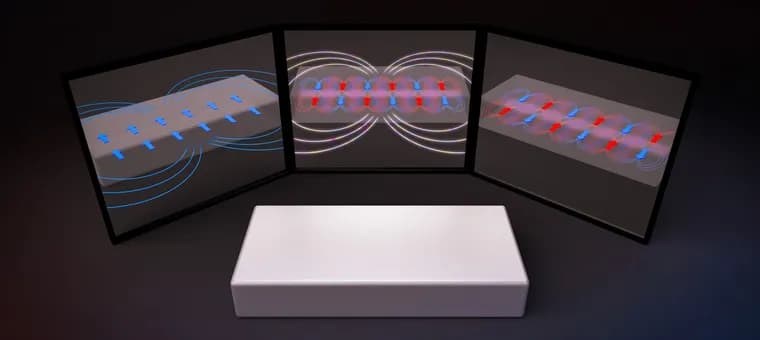
For decades, physicists recognised only two kinds of magnetism that arise in materials without outside influence. In ferromagnets, all electron spins point the same way, which creates a visible magnetic field. In antiferromagnets, discovered in 1933, the spins alternate (up-down-up-down) and cancel out, so there is no net magnetic effect. For nearly 90 years that two-category system dominated how magnetism was understood.
In recent years researchers noticed materials that fit neither box. They showed features of antiferromagnetism, such as alternating spins and no net magnetization, together with a ferromagnetic trait, the ability to use spin currents. These behaviours had been thought mutually exclusive. In 2022 researchers proposed the name "altermagnets" for this class. The theory is that an altermagnet has alternating spins like an antiferromagnet, but the crystal lattice around the "up" spins is rotated relative to the lattice around the "down" spins. That geometric twist breaks a symmetry and could explain the odd behaviour.
On 29 October 2026 a team led by the U.S. Department of Energy's SLAC National Accelerator Laboratory published its findings in Science (D. Jost et al., 10.1126/science.adv3196). SLAC describes them as conclusive experimental proof of altermagnetism. The lead author, Daniel Jost, an associate scientist at SLAC and the Stanford Institute for Materials and Energy Sciences, puts it more cautiously: "We believe our results provide robust experimental confirmation that this third phase, altermagnetism, is real."
The missing piece, Jost says, was experimental evidence of chirality in a candidate material. Chirality, or "handedness", means an object cannot be superimposed on its mirror image, like a left hand in a right-handed glove. An altermagnet's lattice twist should give its electronic and magnetic structure a handedness that conventional antiferromagnets lack. The team chose manganese telluride (MnTe), a material considered antiferromagnetic for decades until a few years ago, when it was suspected to be altermagnetic. They took it to the European Synchrotron Radiation Facility (ESRF) in France, to a beamline that produces highly controlled polarized X-ray beams. Jost explains that chiral materials scatter left-handed and right-handed polarized beams differently, while non-chiral materials scatter both the same way. Comparing the two, the team found a clear chiral signal that should not exist in a conventional antiferromagnet. The result is direct experimental evidence of chirality, an asymmetric magnetic structure akin to a spiral staircase or a screw, in the spins of the material.
The initial experiment was completed in 2024. The team repeated it in early 2025 and confirmed the earlier results. Rachel Nickel, a postdoctoral scientist with ESRF and a co-author who helped design and run the experiment on the ID32 beamline, said the technique helped confirm that manganese telluride really shows altermagnetic properties, and called the rapid progress in confirming these models incredible.
The practical interest is in spintronics, which uses an electron's spin as well as its charge to store and move information. SLAC says spintronic devices have the potential to be faster, more robust and to cut power use in computing and data centers. Jost explains the trouble with the existing classes: ferromagnets are too easily disturbed by magnetic fields (a permanent magnet in a pocket could flip bits in a nearby device), while antiferromagnets resist that but are practically invisible, so their data is hard to read and they are poor at driving spin currents. In his words, altermagnets combine the best of both: zero net magnetization, so they are stable, yet they can still generate the spin-polarized currents needed to extract information. SLAC says such materials could be used for advanced electronics, including quantum technologies, memory devices and data centers. Future work will look at influencing and controlling altermagnetic states with light and electricity. The research was supported in part by the DOE Office of Science.
Key facts
- A SLAC-led team reported in Science on 29 October 2026 direct evidence of chirality in the spins of manganese telluride (MnTe), which SLAC calls conclusive proof of altermagnetism.
- The team scattered circularly polarized X-rays at the ESRF in France and compared left- and right-handed responses; the chiral signal it found should not exist in a conventional antiferromagnet.
- The first run was completed in 2024 and repeated in early 2025 with the same results; the term altermagnet dates from 2022.
- Altermagnets are described as having zero net magnetization, so they are stable, while still able to generate spin-polarized currents, which makes them a candidate for spintronics.
- Applications named by SLAC (quantum technologies, memory devices, data centers) are potential uses; the next step is studying control of altermagnetic states with light and electricity.
Why it matters
Magnetism in materials had long been sorted into two classes, ferromagnetic and antiferromagnetic, a scheme that dominated for nearly 90 years. Altermagnetism was only proposed as a term in 2022, and the case for it had been building since. By 2024, Jost says, several factors favoured it, but experimental evidence of chirality in a candidate material was still missing. This result supplies that piece, and SLAC says it settles the question of a third phase. The appeal for electronics is the combination of traits: no net magnetization, which makes a device stable against stray fields, plus spin-polarized currents that make data readable.
Who it affects
Most directly, condensed-matter physicists and spintronics researchers, who now have an experimentally backed example of a third magnetic class and a technique for testing other candidates. In the longer run, SLAC points to quantum technologies, memory devices and data centers as areas that could use altermagnetic materials, with spintronic devices promising lower power consumption in computing.
How to use it
This is a physics result, not a product, and nothing here can be used off the shelf. For researchers, the method is the takeaway: scatter circularly polarized X-rays from a candidate material and compare the left- and right-handed responses to look for a chiral signal. The team did this on the ID32 beamline at the ESRF. SLAC says future research will explore how altermagnetic states can be influenced and controlled with light and electricity. No timescale is given for practical altermagnetic devices.
How solid is it
The result is published in Science, and the team ran the experiment twice, in 2024 and again in early 2025, with matching results. The account here comes from SLAC's own press release, whose wording ("conclusive experimental proof") is stronger than the lead author's, who says "we believe" the results give "robust experimental confirmation". The release builds on earlier studies and quotes only team members. No independent outside scientists comment on the result.
Risks and caveats
The applications are prospective: the release says altermagnetic materials "could be used" in advanced electronics and that spintronic devices have "the potential" to be faster, more robust and lower in power use. No quantitative figures for speed, power savings, temperatures or sample details are given. The evidence is for one material, MnTe, and the chiral signal is the basis for calling it an altermagnet. Controlling altermagnetic states with light and electricity is still future work.
“Altermagnets combine the best of both”
— Daniel Jost, lead author, associate scientist at SLAC and Stanford Institute for Materials and Energy Sciences