SpaceFlow generates 3D objects with per-part control levels, no training
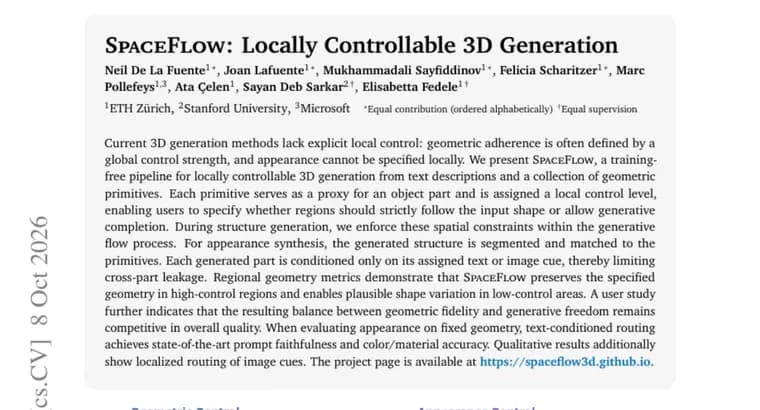
The paper starts from a gap in current 3D generation: methods lack explicit local control. Geometric adherence is often set by a single global control strength, and appearance cannot be specified for individual regions.
SpaceFlow is the authors' answer, described as a training-free pipeline for locally controllable 3D generation from text descriptions and a collection of geometric primitives. Each primitive acts as a proxy for one part of the object and is assigned a local control level. That level lets the user say whether a region should strictly follow the input shape or be left open to generative completion.
The pipeline works in two stages. During structure generation, the spatial constraints are enforced inside the generative flow process. For appearance synthesis, the generated structure is segmented and matched back to the primitives, and each generated part is conditioned only on its own assigned text or image cue. That, the authors say, limits cross-part leakage, so one part's description does not bleed into its neighbours.
On evaluation, regional geometry metrics show that SpaceFlow preserves the specified geometry in high-control regions and allows plausible shape variation in low-control areas. A user study indicates that the balance between geometric fidelity and generative freedom remains competitive in overall quality. When appearance is evaluated on fixed geometry, text-conditioned routing reaches state-of-the-art prompt faithfulness and color/material accuracy. Qualitative results also show localized routing of image cues. A project page is available at SpaceFlow3D.github.io.
Key facts
- SpaceFlow is a training-free pipeline for 3D generation from text descriptions plus a collection of geometric primitives.
- Each primitive stands in for an object part and carries a local control level: follow the input shape strictly, or allow generative completion.
- Appearance is generated per part, each conditioned only on its assigned text or image cue, which limits cross-part leakage.
- Regional geometry metrics show specified geometry is preserved in high-control regions and plausible variation is allowed in low-control areas.
- The state-of-the-art claim covers prompt faithfulness and color/material accuracy for text-conditioned routing on fixed geometry.
Why it matters
Many 3D generators give the user one dial: how closely to follow the input geometry, applied to the whole object. SpaceFlow replaces that single global setting with a control level per part, so a rigid structural region and a loosely specified decorative region can coexist in one object. It also moves appearance to the part level, so text or image cues apply to specific regions rather than to the object as a whole. And it does this without training.
Who it affects
The work is aimed at people who generate 3D assets from a rough layout and want some regions locked to the layout and others filled in by the model. It is a research contribution to locally controllable 3D generation, so its immediate audience is researchers and practitioners following that area.
How to use it
The inputs are a text description and a collection of geometric primitives, each assigned a local control level and, for appearance, its own text or image cue. A project page is available at SpaceFlow3D.github.io. No code release is mentioned beyond the project page.
How solid is it
This is a paper abstract, so the evidence is described rather than shown. The authors report regional geometry metrics, a user study and qualitative results, all supporting their method. No numeric results (metric values, user-study sample size, scores) are given, and no baseline methods or comparison systems are named. The user study is described only as showing the balance remains competitive in overall quality, not as a win over other methods. The state-of-the-art claim is limited to appearance evaluation on fixed geometry with text-conditioned routing.
Risks and caveats
With no figures, baselines or sample sizes in the abstract, the strength of the results cannot be judged from it. The state-of-the-art claim is narrow: it covers prompt faithfulness and color/material accuracy on fixed geometry, not 3D generation overall. The abstract names no underlying base model or generator for the training-free pipeline, and no authors or institutions.
“Each generated part is conditioned only on its assigned text or image cue, thereby limiting cross-part leakage.”
— SpaceFlow paper abstract