SPW-Nav world model streams 2K 360-degree video from language instructions
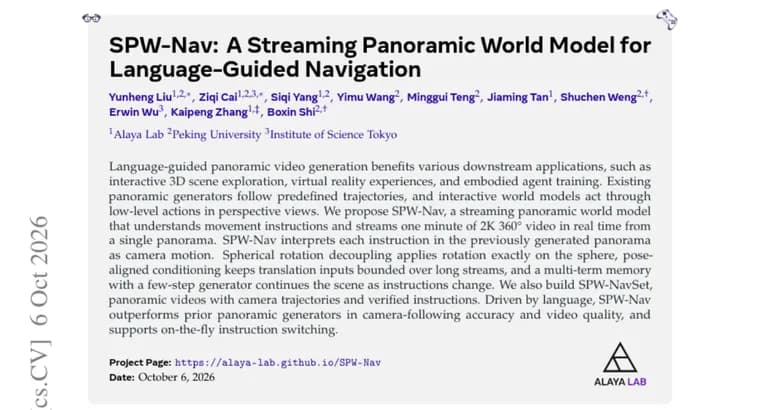
A paper on Hugging Face Papers proposes SPW-Nav, a streaming panoramic world model for language-guided navigation. The authors start from a gap they see in existing work: panoramic generators follow predefined trajectories, while interactive world models act through low-level actions in perspective views. Neither lets a user steer a 360-degree scene with plain language.
SPW-Nav takes a single panorama and streams one minute of 2K 360-degree video in real time. It treats each movement instruction as camera motion, interpreting the instruction in the previously generated panorama. The scene then continues from there as new instructions arrive, and the model supports on-the-fly instruction switching.
The abstract names three technical pieces. Spherical rotation decoupling applies rotation exactly on the sphere. Pose-aligned conditioning keeps translation inputs bounded over long streams. A multi-term memory combined with a few-step generator continues the scene as instructions change.
The authors also build SPW-NavSet, a dataset of panoramic videos with camera trajectories and verified instructions. Driven by language, they say, SPW-Nav outperforms prior panoramic generators in camera-following accuracy and video quality. They point to downstream uses such as interactive 3D scene exploration, virtual reality experiences and embodied agent training. All of these are claims made by the authors; the abstract gives no figures behind the comparison.
Key facts
- SPW-Nav is a streaming panoramic world model that understands movement instructions and streams one minute of 2K 360-degree video in real time from a single panorama.
- Each instruction is interpreted in the previously generated panorama as camera motion, so a user can switch instructions on the fly.
- Three components are named: spherical rotation decoupling, pose-aligned conditioning for bounded translation inputs over long streams, and a multi-term memory with a few-step generator.
- The authors build SPW-NavSet, panoramic videos with camera trajectories and verified instructions.
- The authors say SPW-Nav outperforms prior panoramic generators in camera-following accuracy and video quality; no quantitative results are given.
Why it matters
The authors argue that current tools leave a gap. Panoramic generators follow predefined trajectories, so the viewer cannot steer them. Interactive world models respond to low-level actions in perspective views, not to language in a full 360-degree scene. SPW-Nav aims to close that gap by letting a movement instruction written in language drive the camera through a panorama, with the video streamed in real time. The one-minute length, from a single starting panorama, is the headline capability.
Who it affects
The authors list interactive 3D scene exploration, virtual reality experiences and embodied agent training as the applications that benefit from language-guided panoramic video generation. That makes the work most relevant to researchers and builders in world models, VR content and agent simulation. For now it is a research proposal rather than a product.
How to use it
No release of code, weights or the dataset is mentioned. For practitioners, the value at this stage is the design: instructions are read as camera motion in the last generated panorama, rotation is applied exactly on the sphere, and a multi-term memory with a few-step generator keeps the scene coherent as instructions change. SPW-NavSet pairs panoramic videos with camera trajectories and verified instructions, which points to the kind of training data this approach needs.
How solid is it
This is a preprint abstract, and every claim is the authors' own. The abstract names no authors or institutions. No quantitative results are given: no accuracy, quality scores or margins over baselines. The prior panoramic generators used for comparison are not named, so the claim of outperforming them cannot be checked from the text. The same goes for the real-time claim, which comes with no hardware, frame rate or latency figures.
Risks and caveats
Treat the performance claims as unverified until the full paper and any released code or data can be examined. The size of SPW-NavSet (number of videos or hours) is not stated. The listed applications are the authors' expectations of which applications can benefit from language-guided panoramic generation, not demonstrated deployments. Whether the approach holds up beyond one minute of video is not addressed in the abstract.
“SPW-Nav interprets each instruction in the previously generated panorama as camera motion.”
— SPW-Nav paper abstract