Spanish museum builds a Cray-1 replica from 30 old Mac Minis
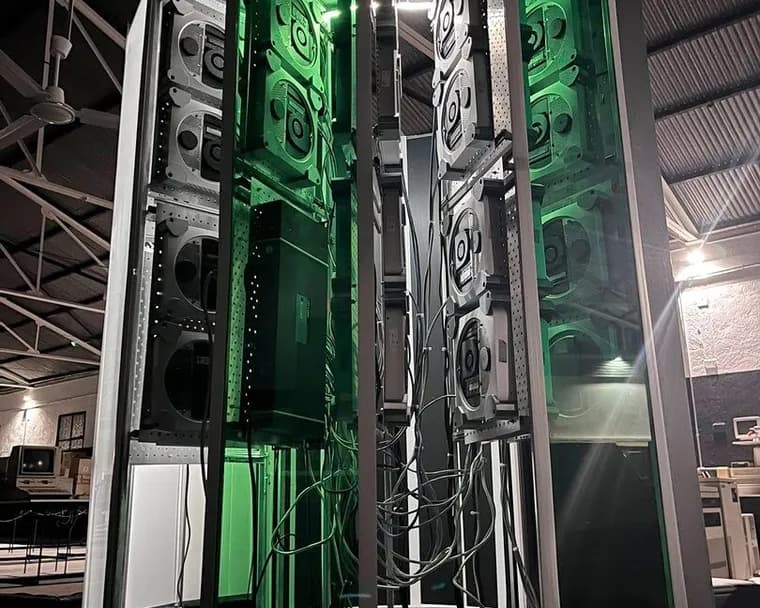
The Museo de Historia de la Computación in Spain has unveiled a 1:1 scale visual replica of the Cray-1 supercomputer from 1976. Rather than buy expensive, cutting-edge hardware to run it, the team powered the project with 30 Mac Minis from 2012. The work took 18 months and doubles as a 50th-anniversary tribute to the Cray-1 and to Apple's founding.
The machines are old, but networked together they add up. In the museum's most recent tests, the developers orchestrated 64 active processing cores into a combined 1.3 teraflops. The museum reportedly reached 1.5 teraflops earlier, using all 70 available cores, before one node went offline. Benchmarks came from a custom matrix-multiplication Python script. Of the 30 Mac Minis, five are quad-core i7 machines and the other 25 are dual-core i5 models. Two units date from 2014; the rest of the array is from 2012.
The replica is meant to help visitors grasp how computer architecture has shifted since 1976. The original Cray-1 used vector processing, applying a single instruction to multiple data elements at once. The replica instead spreads work across independent processors in a parallel cluster. The original's peak theoretical performance was about 160 megaflops, so a purpose-built research machine has been re-created with consumer hardware that is vastly more capable than the machine that inspired it.
On software, the team skipped a standard Linux distribution and chose macOS Mojave (10.14). Its built-in support for MPI (Message Passing Interface), the layer that lets the cluster's nodes pass tasks to one another, met the project's needs. Visitors can watch in real time as the system runs matrix algorithms, scaling from a single core up to the full set running in parallel.
Cooling was the other engineering problem. Instead of fans, the team used passive convection cooling through a steel rack chassis and aluminum tray mounts for each Mac Mini. The article describes the result as nearly inaudible, in contrast to the roar of a modern data center.
Key facts
- The Museo de Historia de la Computación in Spain unveiled a 1:1 scale visual replica of the 1976 Cray-1, built over 18 months as a 50th-anniversary tribute to the Cray-1 and Apple's founding.
- The cluster uses 30 Mac Minis: five quad-core i7 and 25 dual-core i5 models, all from 2012 except two units from 2014.
- Recent tests put 64 active cores at a combined 1.3 teraflops; an earlier run on all 70 cores reportedly reached 1.5 teraflops before one node went offline.
- The original Cray-1 peaked at about 160 megaflops in theory and used vector processing; the replica is a parallel cluster running MPI on macOS Mojave (10.14).
- Cooling is passive convection through a steel rack chassis and aluminum tray mounts, so the cluster is described as nearly inaudible.
Why it matters
The project makes a historical point with working hardware. The Cray-1 was a purpose-built research machine with an approximate peak of 160 megaflops, and a cluster of decade-old consumer Mac Minis now reaches 1.3 teraflops in the museum's recent tests. It also shows the architectural shift from vector processing, one instruction applied to many data elements, to a parallel cluster where independent processors share work by passing messages. It is a tribute piece for the 50th anniversary of the Cray-1 and of Apple's founding, not an industry milestone.
Who it affects
Mainly visitors to the Museo de Historia de la Computación, who can watch the system run matrix algorithms in real time and see performance scale from a single core to the full cluster. It will also interest anyone following computing history or building clusters from second-hand consumer hardware.
How to use it
This is an exhibit rather than a product, so there is nothing to install. Visitors to the museum can watch the cluster run matrix algorithms live. For builders, the article names the recipe: Mac Minis from 2012 and 2014, macOS Mojave (10.14) with its built-in MPI support instead of Linux, a custom matrix-multiplication Python script for benchmarking, and passive cooling through a steel rack with aluminum tray mounts for each machine.
How solid is it
The account comes from a single Ars Technica article and describes the museum's own test results. The 1.3 teraflops figure is from the most recent tests across 64 active cores, with a benchmark that is a custom matrix-multiplication Python script. The earlier 1.5 teraflops figure is reported as 'reportedly' and comes from a run on all 70 cores before one node went offline. The source does not state the floating-point precision of either figure, and it names no one on the museum team.
Risks and caveats
The replica is a visual copy, and the source does not say it emulates the Cray-1 instruction set, so the comparison with the original is about performance, not behaviour. The 160 megaflops figure is the original's peak theoretical performance, while the cluster's numbers come from a custom benchmark script, and the source states no precision for them, so the two are not a like-for-like comparison. The latest test used 64 active cores, against 70 available in the earlier run, and the source does not say why a node went offline. No cost or power consumption figures are given, and the 'nearly inaudible' description is the author's, not a measurement.
“What was originally a purpose-built research machine has been re-created with consumer hardware that’s vastly more capable than the machine that inspired it.”
— Ars Technica