Sparse Readout Prism decomposes readouts into sparse features
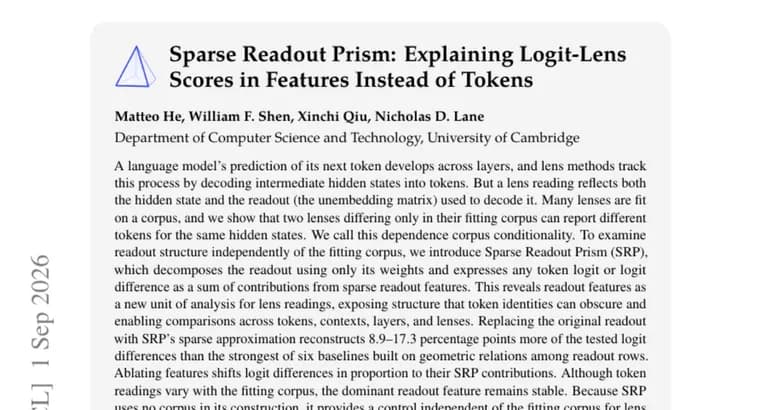
A language model builds its prediction of the next token gradually across layers, and interpretability researchers use lens methods to peek at that process by decoding intermediate hidden states into tokens partway through. The paper shows that this decoding is not neutral: a lens reading depends both on the hidden state itself and on the readout, the unembedding matrix used to turn that state into token probabilities. Many lenses are fit on a text corpus, and the authors demonstrate that two lenses differing only in which corpus they were fit on can report different tokens for the exact same hidden state. They name this problem corpus conditionality: the lens's answer partly reflects its training data, not just the model's internal state.
To separate readout structure from any particular fitting corpus, the authors introduce Sparse Readout Prism (SRP). SRP decomposes the readout using only its own weights, with no corpus involved, and expresses any token logit or logit difference as a sum of contributions from a set of sparse readout features. This gives researchers a new unit of analysis, the readout feature, that sits below individual token identities and exposes structure that token-level readings can obscure. Because features rather than tokens are compared, SRP supports comparisons across different tokens, contexts, layers and lenses on common ground.
The authors tested how well SRP's sparse feature approximation of the readout reconstructs measured logit differences, against six baseline methods built on geometric relations among readout rows. SRP's approximation reconstructed 8.9 to 17.3 percentage points more of the tested logit differences than the strongest of those six baselines. Ablating individual SRP features shifted logit differences in proportion to each feature's contribution, indicating the decomposition tracks real causal structure rather than a post hoc fit. The authors also found that while token-level lens readings shift depending on the fitting corpus, the single dominant readout feature identified by SRP stays stable across corpora. Because SRP's construction uses no corpus at all, the authors position it as a corpus-independent control for lens-based interpretability work going forward.
Key facts
- Sparse Readout Prism (SRP) decomposes a language model's readout (unembedding matrix) into sparse features using only the readout's own weights, with no fitting corpus involved.
- The paper identifies 'corpus conditionality': two lenses that differ only in their fitting corpus can report different tokens for the same hidden state.
- SRP's sparse approximation reconstructs 8.9 to 17.3 percentage points more of the tested logit differences than the strongest of six baseline methods built on geometric relations among readout rows.
- Ablating individual SRP features shifts logit differences in proportion to each feature's own contribution.
- The dominant readout feature stays stable across different fitting corpora even though token-level lens readings shift with the corpus.
Why it matters
Lens-based interpretability tools (logit lens and its variants) are a standard way researchers peek inside a model mid-computation, but this work shows the readings those tools produce are partly an artifact of which corpus the lens happens to be fit on, not a pure reflection of the model's internal state. That undermines comparisons between studies that used different fitting corpora. SRP addresses the problem by decomposing the readout itself, using no corpus at all, so it exposes structure in the readout that is independent of any particular fitting choice.
Who it affects
Interpretability researchers who use lens methods to decode hidden states, and anyone comparing lens-based findings across different papers, models, layers or fitting corpora. The text names no specific model or dataset used in the reported tests, and the abstract does not name the paper's authors or institution.
How to use it
SRP is presented as an analysis method, not a released tool or product: it works by decomposing an existing readout matrix into sparse features using only the readout's weights, then expressing any token logit or logit difference as a sum of feature contributions. This lets a researcher compare readings across tokens, contexts, layers and lenses on a common, corpus-independent footing rather than relying on raw token identities.
How solid is it
The central quantitative result is a reconstruction comparison: SRP's sparse approximation of the readout recovers 8.9 to 17.3 percentage points more of the tested logit differences than the strongest of six baseline methods based on geometric relations among readout rows. The authors add a causal check: ablating individual SRP features shifts logit differences in proportion to each feature's measured contribution, which supports the features tracking real structure rather than being a curve-fit artifact. They also show the dominant feature is stable across fitting corpora, directly contrasting with the corpus-dependent token readings the paper opens with.
Risks and caveats
The source text gives no application domain or downstream use case for SRP beyond the reconstruction tests, no timeframe, venue or publication date, and no named model or dataset for the experiments, so the generality of the 8.9-17.3 percentage point improvement beyond the tested setting is not established by the text available here.