Spatial-Interactor trains vision-language models to track physical state changes
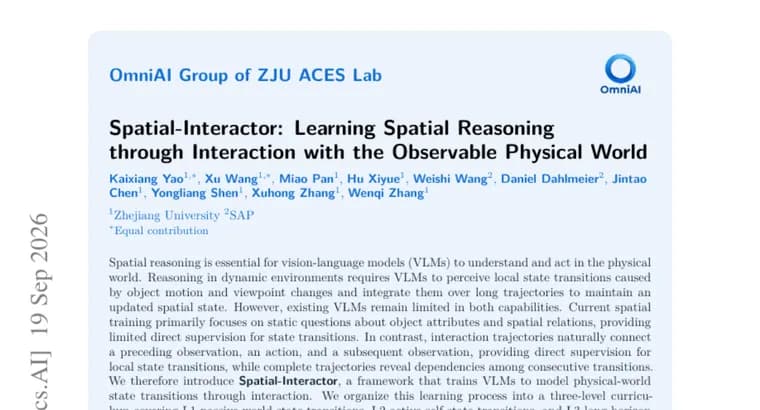
Researchers have introduced Spatial-Interactor, a training framework aimed at a gap in how vision-language models (VLMs) handle spatial reasoning. The authors argue that current spatial training mostly relies on static questions about object attributes and spatial relations, which gives models limited direct supervision for state transitions, that is, how a scene changes as objects move or a viewpoint shifts. Interaction trajectories, by contrast, naturally link a preceding observation, an action, and the resulting observation, giving direct supervision for these local transitions, while full trajectories also reveal how consecutive transitions depend on one another over time.
To address this, Spatial-Interactor organizes learning into a three-level curriculum: L1 covers passive world-state transitions, L2 covers active self-state transitions, and L3 covers long-horizon interaction trajectories. To support this curriculum, the team built the Learning from Spatial Interaction dataset (LSI-108K), containing 108,000 examples drawn from both simulated and real interaction trajectories, with tasks matched to the goal of each curriculum level.
Training follows a two-stage strategy. Supervised Fine-Tuning (SFT) is applied to the L1 and L2 levels to build local transition modeling. Then On-Policy Distillation (OPD) is used for the harder L3 stage, applying what the authors call privileged self-distillation: a teacher branch that is given segment-level descriptions of transitions supervises the student model's own on-policy chain-of-thought reasoning, helping the student learn to integrate a sequence of transitions across long interaction trajectories.
The authors report that experiments across multiple VLMs and spatial benchmarks show consistent gains in both local transition modeling and long-horizon integration, though the source text does not name the specific benchmarks used or give numeric results.
Key facts
- Spatial-Interactor is a framework that trains VLMs to model physical-world state transitions through interaction, rather than through static spatial questions alone.
- Training is organized into a three-level curriculum: L1 passive world-state transitions, L2 active self-state transitions, and L3 long-horizon interaction trajectories.
- The team built the LSI-108K dataset, 108,000 examples from simulated and real interaction trajectories, with tasks aligned to each curriculum level.
- A two-stage strategy combines Supervised Fine-Tuning for L1/L2 with On-Policy Distillation, using a teacher branch given transition descriptions to supervise the student's chain-of-thought on long L3 trajectories.
- The authors report consistent gains across multiple VLMs and spatial benchmarks in both local transition modeling and long-horizon integration.
Why it matters
Existing spatial training for VLMs leans on static questions about object attributes and relations, which the authors say provides only limited supervision for how a scene actually changes over time. Interaction trajectories, linking an observation, an action, and the resulting observation, offer direct supervision for these transitions and expose how consecutive changes depend on each other, which is what Spatial-Interactor is built to exploit.
Who it affects
The work is aimed at researchers and developers building vision-language models that need to reason about dynamic physical scenes, where objects move or the viewpoint changes, rather than only answering static questions about a fixed image.
How to use it
Spatial-Interactor is a research training framework built around the LSI-108K dataset and a two-stage SFT-then-OPD training recipe; the source text does not state whether the dataset or code is being released, so there is no way to say how or whether others can obtain them.
How solid is it
The source text does not name the authors, their institutions, a publication date, or a venue, and it does not give the specific benchmarks used or numeric gain figures for the reported experiments, so the claimed improvements cannot be independently checked from what is available here.
Risks and caveats
The three curriculum levels are named but not described in further detail, and the reported gains are stated only in general terms ('consistent gains') without benchmark names or numbers, so the scale and significance of the improvement are unclear from the source alone.