SpeakerMem-R1 tops multi-party dialogue memory benchmarks
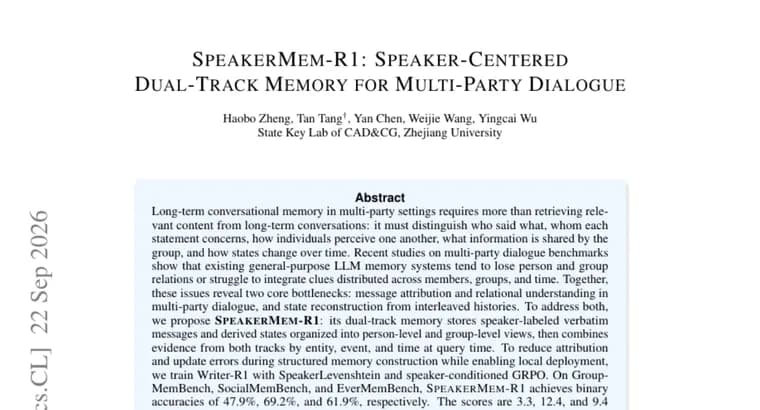
Researchers describe SpeakerMem-R1, a memory system built for long-term conversations that involve more than two people. The paper argues that existing general-purpose LLM memory systems tend to lose track of who said what to whom, and struggle to combine clues scattered across different speakers, groups, and points in time. SpeakerMem-R1 addresses this with a dual-track design: one track stores speaker-labeled verbatim messages, and the other stores derived states organized into person-level and group-level views; at query time the system combines evidence from both tracks by entity, event, and time. To build this structured memory with fewer attribution and update errors, and to allow the system to run locally, the authors train a companion model called Writer-R1 using two techniques they name SpeakerLevenshtein and speaker-conditioned GRPO (the paper does not detail how either mechanism works beyond naming them). On three benchmarks, SpeakerMem-R1 reaches binary accuracies of 47.9% on GroupMemBench, 69.2% on SocialMemBench, and 61.9% on EverMemBench. On the publicly reported EverMemBench leaderboard maintained by EverMind-AI, it scores 62.33%, which the authors describe as the best reported result among the latest state-of-the-art frameworks. As a further test, they run the system on all 1,986 questions from LoCoMo, a benchmark of two-person long-term conversations used here as a boundary case, reaching 70.85% accuracy. In a separate controlled evaluation of 305 questions, the authors compare a Writer trained only with supervised fine-tuning against one further trained with reinforcement learning: mean accuracy rises from 57.38% to 68.20% after the RL stage. The authors also report ablations showing that the verbatim and structured memory tracks, as well as the person-level and group-level views, each contribute complementary information under their standardized evaluation setup.
Key facts
- SpeakerMem-R1 stores speaker-labeled verbatim messages alongside derived person-level and group-level states, combining both at query time by entity, event, and time
- Binary accuracy: 47.9% on GroupMemBench, 69.2% on SocialMemBench, 61.9% on EverMemBench
- 62.33% on the public EverMemBench leaderboard from EverMind-AI, described by the authors as the best reported result among recent frameworks
- 70.85% accuracy on all 1,986 LoCoMo questions, used as a two-person long-term conversation test
- In a controlled 305-question evaluation, reinforcement learning raised the companion Writer-R1 model's mean accuracy from 57.38% to 68.20%
Why it matters
Multi-party, long-running conversations are a known weak spot for LLM memory systems: general-purpose approaches tend to lose track of who said what and struggle to merge clues spread across different speakers, groups, and time. SpeakerMem-R1 targets those two failure modes directly with a dual-track memory design, and reports the top score on the public EverMemBench leaderboard among the state-of-the-art frameworks it compares against.
Who it affects
The work is aimed at researchers and engineers building conversational agents that need to hold long-term, multi-person context, such as group chat assistants or long-running social simulations, rather than the simpler two-person chat memory that most existing systems target.
How to use it
SpeakerMem-R1 combines a stored memory (verbatim speaker-labeled messages plus derived person- and group-level states) with a separately trained model, Writer-R1, that constructs and updates that memory using techniques the authors call SpeakerLevenshtein and speaker-conditioned GRPO. The authors state this training approach is meant to reduce attribution and update errors while enabling the system to be deployed locally, though the paper does not spell out licensing, availability, or the internal mechanics of the two training methods.
How solid is it
The paper reports concrete accuracy figures across four benchmarks (GroupMemBench, SocialMemBench, EverMemBench, and LoCoMo) plus a controlled 305-question comparison isolating the effect of reinforcement learning, and includes ablations attributing gains to specific components of the design. The source text available here does not name the authors, their institutions, or a publication date, and does not give the numeric scores of the competing frameworks it claims to beat, aside from its own leaderboard placement.
Risks and caveats
The reported results are self-reported by the paper's authors on benchmarks they largely reference by name rather than describe in detail, and no independent replication or third-party comparison numbers are given here. The mechanics behind SpeakerLevenshtein and speaker-conditioned GRPO are not explained beyond their names, so it is not possible to assess from this material how the claimed error reduction is achieved.