SPOT drafter speeds up diffusion language model decoding by up to 3.4x
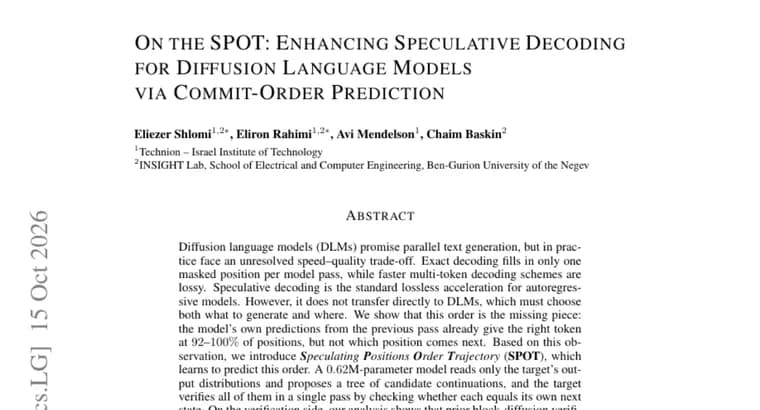
Diffusion language models (DLMs) promise parallel text generation, but the paper says they still face an unresolved speed-quality trade-off. Exact decoding fills in only one masked position per model pass, while faster multi-token decoding schemes are lossy. Speculative decoding is the standard lossless way to speed up autoregressive models, but the authors say it does not transfer directly to DLMs, because a DLM must choose both what to generate and where.
Their argument is that the decoding order is the missing piece. The model's own predictions from the previous pass already give the right token at over 90% of positions, but they do not say which position comes next. The paper's answer is Speculating Positions Order Trajectory (SPOT), a 0.62M-parameter model that reads only the target model's output distributions, predicts that order, and proposes a tree of candidate continuations. The target model then verifies the whole tree in a single pass by state equality. A technique called coupled-noise match, which shares Gumbel noise between the drafter and the target, keeps this verification exact at any temperature.
The approach also led to a variant, SPOT-Sets, built for dynamic threshold decoding, where one pass commits several positions. SPOT-Sets drafts whole commit sets together with their tokens.
On results, the authors report that SPOT cuts target passes by up to 6.8x and reaches up to 3.4x the throughput of standard decoding on SDAR-8B. They say it matches or beats the calibrated and training-free drafting baselines in every task and budget at T=0 and T=1. The learned drafter also transfers across models: the paper reports successful transfer across six different DLMs, and with a light calibration the SPOT-Sets drafter transfers as well. On top of dynamic threshold decoding, SPOT-Sets improves the throughput of SDAR-8B by 59% on average over the threshold decoder alone. A project page is linked at https://eliezer318.github.io/SPOT-dLLM/.
Key facts
- SPOT (Speculating Positions Order Trajectory) is a 0.62M-parameter drafter that predicts the order in which a diffusion language model commits positions and proposes a tree of candidates for the target to verify in one pass.
- The motivating observation: the model's own predictions from the previous pass already give the right token at over 90% of positions, but not which position comes next.
- On SDAR-8B, SPOT cuts target passes by up to 6.8x and reaches up to 3.4x the throughput of standard decoding.
- SPOT-Sets, a variant for dynamic threshold decoding, improves SDAR-8B throughput by 59% on average over the threshold decoder alone.
- The learned drafter is reported to transfer across six different DLMs; SPOT-Sets transfers too, with a light calibration.
Why it matters
Diffusion language models are pitched as a route to parallel text generation, yet exact decoding still fills in one masked position per pass, and faster schemes lose quality. Speculative decoding is the standard lossless speed-up for autoregressive models but does not carry over directly, since a DLM must decide both what to write and where. SPOT targets that gap by predicting the commit order, with verification kept exact. The reported gains are up to 6.8x fewer target passes and up to 3.4x throughput on SDAR-8B.
Who it affects
Researchers and engineers working on diffusion language models and on faster decoding for them are the direct audience. The claim that one learned drafter transfers across six different DLMs matters to anyone who would rather not train a drafter for every target model.
How to use it
The abstract points to a project page at https://eliezer318.github.io/SPOT-dLLM/. The drafter is tiny at 0.62M parameters and reads only the target's output distributions. For dynamic threshold decoding, where a pass commits several positions, the paper offers SPOT-Sets, which drafts whole commit sets with their tokens. Moving the drafter to another model is described as working directly for SPOT and with a light calibration for SPOT-Sets.
How solid is it
This is the authors' own account in a paper abstract; the figures are self-reported. The 6.8x and 3.4x numbers are maxima ('up to'), not averages, and the conditions under which they occur are not given. The 59% SPOT-Sets gain is an average over the threshold decoder alone and is stated for SDAR-8B only. The six DLMs are not named, nor are the tasks and benchmarks. Quality or accuracy numbers are not given; the paper claims exact verification and matching or better results than the drafting baselines.
Risks and caveats
The headline speed-ups are best-case figures on one named model, SDAR-8B, and should not be read as typical gains. No authors or institutions are named in the abstract. Transfer to other models is claimed, but without the names of those models it is hard to judge how broad it is. SPOT-Sets needs a light calibration to transfer.
“the model's own predictions from the previous pass already give the right token at over 90% of positions, but not which position comes next”
— SPOT paper abstract