Steering vectors transfer between text and image generation in unified multimodal models
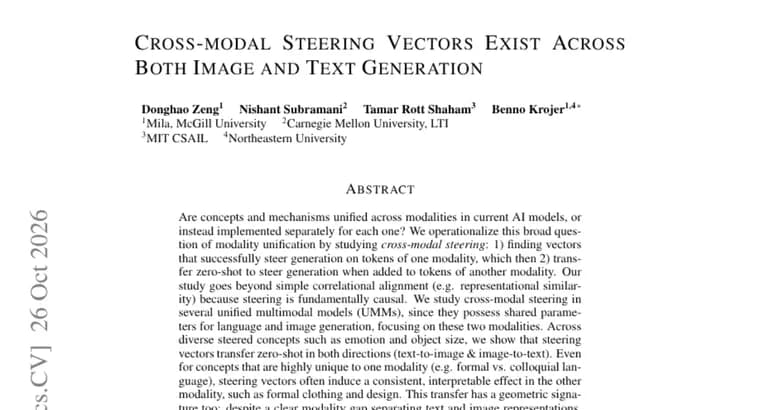
The paper asks whether current AI models handle a concept such as "formal" or "large" with one shared mechanism across modalities, or implement it separately for each one. The authors turn that broad question into a testable one: cross-modal steering. The procedure has two steps. First, find vectors that successfully steer generation on tokens of one modality. Second, add those same vectors to tokens of another modality and see whether they steer generation there, with no further training (zero-shot).
The authors argue this goes beyond correlational alignment, such as measuring representational similarity, because steering is fundamentally causal: the vector is inserted and the output changes. They run the study on several unified multimodal models (UMMs), chosen because these models have shared parameters for language and image generation. The work focuses on those two modalities, text and images.
Across diverse steered concepts, including emotion and object size, the authors report that steering vectors transfer zero-shot in both directions: text-to-image and image-to-text. They also test concepts that are highly unique to one modality, with formal versus colloquial language as the example. Even there, steering vectors often (not always) produce a consistent, interpretable effect in the other modality. For the formal-language case, that effect shows up as formal clothing and design in generated images.
The transfer also has a geometric signature. Text and image representations are separated by a clear modality gap. Despite that, steering vectors with strong cross-modal transferability tend to point in similar directions for the same concept.
The authors conclude that their findings shed light on how vision and language interact inside unified multimodal models, and point towards more general, modality-agnostic approaches for controlling the models' behavior.
Key facts
- The study tests cross-modal steering: a vector that steers generation on tokens of one modality is added to tokens of another modality, with no extra training.
- It is run on several unified multimodal models, which share parameters for language and image generation; the focus is text and images.
- Across concepts such as emotion and object size, the authors report zero-shot transfer in both directions, text-to-image and image-to-text.
- For modality-specific concepts such as formal versus colloquial language, vectors often (not always) produce an interpretable effect in the other modality, for example formal clothing and design.
- Vectors with strong transferability tend to point in similar directions for the same concept, even though a clear modality gap separates text and image representations.
Why it matters
The paper tackles a basic question about multimodal models: whether a concept is handled by one shared mechanism across modalities or by separate ones. Steering gives a causal test, since adding a vector changes the output, which the authors contrast with correlational measures such as representational similarity. Their reported answer is that vectors do carry over between text and image generation in both directions, which they say sheds light on how vision and language interact inside unified multimodal models.
Who it affects
The findings concern unified multimodal models, meaning models with shared parameters for language and image generation. The most direct audience is researchers studying how such models represent concepts and how to interpret or control them. The authors say the results point towards more general, modality-agnostic approaches for controlling model behavior.
How to use it
This is a research finding rather than a product or tool. The practical idea the authors point to is controlling a model's behavior with a steering vector found in one modality and applied in another, for example a vector found on text used to shift generated images toward a concept such as formality. The source gives no details on implementation, and no release of code, data or models is mentioned.
How solid is it
The account rests on the paper's abstract. The authors report results across several unified multimodal models and diverse concepts, in both transfer directions. The abstract names no authors or institutions, does not say which models were tested or how many beyond "several", and gives no quantitative results such as transfer success rates, effect sizes or baselines. The claims use hedged wording: vectors "often" produce an interpretable effect and strongly transferable vectors "tend to" point in similar directions.
Risks and caveats
Transfer is not described as universal. For concepts unique to one modality, the effect appears often but not always, and the abstract does not say that transfer works for all concepts or all models. The directional similarity is a tendency among vectors with strong transferability, not a rule for every vector. Without numbers, baselines or a model list in the abstract, the size of the effects cannot be judged from this summary, and no limitations or failure cases are described there.
“steering vectors with strong cross-modal transferability tend to point in similar directions for the same concept”
— From the paper's abstract