SpyRL extends verifiable RL rewards to open-ended LLM tasks
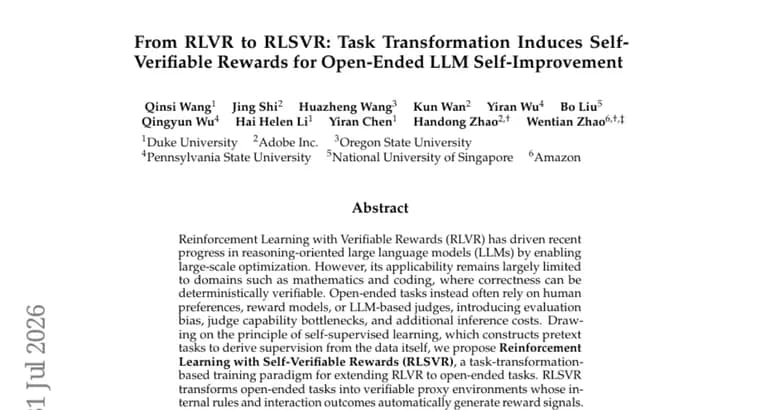
Reinforcement Learning with Verifiable Rewards (RLVR) has driven much of the recent progress in reasoning-focused large language models, but the authors note it mostly works in domains such as mathematics and coding, where a correct answer can be checked deterministically. Open-ended tasks, they argue, do not offer that: systems training on them instead depend on human preferences, reward models, or LLM-based judges, which brings evaluation bias, judge capability bottlenecks, and extra inference cost.
To close that gap, the authors propose Reinforcement Learning with Self-Verifiable Rewards (RLSVR), a task-transformation training paradigm borrowed from the logic of self-supervised learning, which builds pretext tasks to pull supervision out of the data itself. RLSVR reframes an open-ended task as a verifiable proxy environment whose own internal rules and interaction outcomes generate the reward signal automatically, removing the need for an external judge.
The authors instantiate RLSVR as SpyRL, a multi-agent self-play environment modeled on the party game Who Is the Spy?. Agents are given asymmetric information and all work on the same target task, then vote to identify a spy hidden among them. Because the system predetermines who the spy is, the voting outcome is fully verifiable against that ground truth, while how well an agent votes stays closely tied to how well it actually performed the underlying task, making the game a proxy for output quality.
The authors test SpyRL on text summarization, creative writing, and mathematical reasoning. They report that it outperforms existing self-improvement methods on the non-verifiable tasks (summarization and creative writing) and also produces consistent gains on the verifiable reasoning task. The source gives no numeric scores or margins for these comparisons, and does not say whether the reasoning-task gains match or exceed what direct RLVR training achieves on that same task. The authors conclude that task transformation can extend scalable RLVR-style self-improvement beyond domains that are inherently verifiable. Models and code for SpyRL have been released on GitHub at wangqinsi1/SpyRL.
Key facts
- RLVR mostly works in domains like math and coding where correctness is deterministically checkable; open-ended tasks instead need human preferences, reward models, or LLM judges, which the authors say brings evaluation bias, judge bottlenecks, and extra inference cost.
- The proposed RLSVR paradigm converts an open-ended task into a verifiable proxy environment whose own internal rules and interaction outcomes generate the reward automatically.
- RLSVR is instantiated as SpyRL, a multi-agent self-play game based on Who Is the Spy?: agents get asymmetric information, do the same task, then vote to find a predetermined spy, giving a fully verifiable reward tied to task quality.
- Tested on text summarization, creative writing, and mathematical reasoning, SpyRL is reported to beat existing self-improvement methods on the non-verifiable tasks and to add consistent gains on the verifiable reasoning task, though no numeric margins are given.
- Models and code for SpyRL are released publicly on GitHub at wangqinsi1/SpyRL.
Why it matters
RLVR made large-scale reinforcement learning practical, but only where correctness can be checked automatically, leaving open-ended work like writing and summarization dependent on human raters, reward models, or LLM judges. RLSVR's task-transformation trick is an attempt to bring the same scalable, judge-free optimization to those open-ended domains by turning the task itself into a game with a built-in ground truth.
Who it affects
Researchers and engineers building self-improving language models, particularly teams running RLHF- or RLVR-style pipelines who want to reduce their dependence on human annotators, trained reward models, or LLM-based judges for tasks that lack a deterministic correctness check.
How to use it
SpyRL's models and code are released on GitHub at wangqinsi1/SpyRL, so the method is available to try now on tasks such as summarization, creative writing, and math reasoning. The source gives no pricing, licensing, or model-size details.
How solid is it
The work is a published paper with released code and models, evaluated across three different task types (summarization, creative writing, math reasoning) rather than a single benchmark. The authors report that SpyRL beats existing self-improvement baselines on the non-verifiable tasks and adds further gains on the verifiable one, but the source supplies no numeric scores or margins for these claims and does not state whether the reasoning-task gains reach or exceed what direct RLVR training achieves on that same task.
Risks and caveats
No model sizes, training compute, or numeric performance margins are disclosed, making the practical scale of the improvement hard to judge from the source alone. The approach also rests on the assumption that correctly identifying a predetermined spy is closely tied to underlying output quality; how well that proxy holds outside the three tested task types is not established in the text.