StepAudio 3 Gen debuts as a unified audio model without diffusion
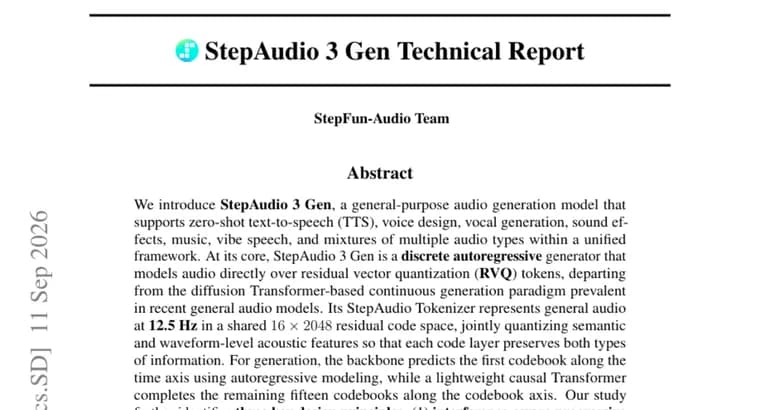
A new technical report introduces StepAudio 3 Gen, a general-purpose audio generation model built to handle zero-shot text-to-speech, voice design, vocal generation, sound effects, music, vibe speech, and mixtures of these audio types, all inside one framework. Its central bet is architectural: rather than the diffusion Transformer-based continuous generation approach used by recent general audio models, StepAudio 3 Gen is a discrete autoregressive generator that models audio directly as residual vector quantization (RVQ) tokens.
That token representation comes from the model's own StepAudio Tokenizer, which represents general audio at 12.5 Hz in a shared residual code space of 16 codebooks of 2048 codes each. The tokenizer jointly quantizes semantic and waveform-level acoustic features, so every code layer carries both kinds of information rather than splitting them across separate systems. During generation, the backbone predicts the first of those codebooks autoregressively along the time axis, then a lightweight causal Transformer fills in the remaining fifteen codebooks along the codebook axis.
The authors credit three design choices for making this work: interference-aware progressive pretraining, which adds audio capability without eroding the underlying language model's text abilities; an RVQ Adaptor for handling multi-codebook acoustic representations; and discrete autoregressive modeling applied over one shared representation across every audio domain the model covers. After progressive pretraining, multi-task instruction training, and supervised fine-tuning, the authors report state-of-the-art performance on both text-to-speech and voice design, plus strong generation across speech, vocals, sound effects, and music, though the report names no specific benchmark or numeric score behind that claim. The only public artifact accompanying the report is a page of audio samples; no code, model weights, release date, or licensing terms are given.
Key facts
- StepAudio 3 Gen is a general-purpose audio generation model that handles zero-shot text-to-speech, voice design, vocal generation, sound effects, music, vibe speech, and mixtures of these within a single framework.
- It departs from the diffusion Transformer-based approach common in recent general audio models: StepAudio 3 Gen is a discrete autoregressive generator that models audio directly as residual vector quantization (RVQ) tokens.
- Its StepAudio Tokenizer represents audio at 12.5 Hz in a shared residual code space of 16 codebooks of 2048 codes each; the backbone predicts the first codebook autoregressively along the time axis, and a lightweight causal Transformer fills in the remaining fifteen codebooks.
- The authors credit three design choices: interference-aware progressive pretraining that preserves the base language model's text abilities, an RVQ Adaptor for multi-codebook acoustic representations, and discrete autoregressive modeling over one shared representation across all audio types.
- After progressive pretraining, multi-task instruction training, and supervised fine-tuning, the authors report state-of-the-art performance on text-to-speech and voice design, though the report gives no benchmark names or numeric scores to support that claim.
Why it matters
The report frames StepAudio 3 Gen as a departure from how recent general audio models work: instead of the diffusion Transformer-based continuous generation that has become common, it commits to a discrete autoregressive approach that predicts residual vector quantization (RVQ) tokens directly. That same architecture is also asked to cover zero-shot text-to-speech, voice design, vocal generation, sound effects, music, vibe speech, and mixtures of these together, rather than treating each as a job for a separate specialized system.
Who it affects
The natural audience is researchers and engineers building systems for text-to-speech, voice design, sound effects, or music generation, and anyone weighing autoregressive token modeling against diffusion for future audio work: the paper's own claim is that one architecture and training recipe can cover all of those tasks together, rather than needing a separate specialized model for each.
How to use it
There is nothing to install or license here: the report gives no release date, no code or model weights, and no pricing or licensing terms. The only public artifact linked from the paper is a page of audio samples at stepaudiollm.github.io, letting listeners judge the text-to-speech, voice design, sound effects, and music the model produces for themselves rather than take the performance claims on faith alone.
How solid is it
The claim of state-of-the-art performance on text-to-speech and voice design is the authors' own: the report names no specific benchmarks and publishes no numeric scores to back it, and it gives no parameter count, model size, or training-data scale either. What it offers instead is a stated rationale, three design principles plus a three-stage training recipe of progressive pretraining, multi-task instruction training, and supervised fine-tuning, but no comparative numbers a reader can check independently.
Risks and caveats
The strongest claim in the report, state-of-the-art performance on text-to-speech and voice design, is unverified by any external benchmark or number in the text, so it should be read as the authors' self-assessment rather than an independently confirmed result. The report also does not say when and how it might become available: there is no release date, code, weights, or licensing information, only a page of audio samples. That leaves real-world availability and reproducibility both open questions.
“StepAudio 3 Gen is a discrete autoregressive generator that models audio directly over residual vector quantization (RVQ) tokens, departing from the diffusion Transformer-based continuous generation paradigm prevalent in recent general audio models.”
— the authors