StereoVLM trains a vision-language model on calibrated stereo for metric 3D reasoning
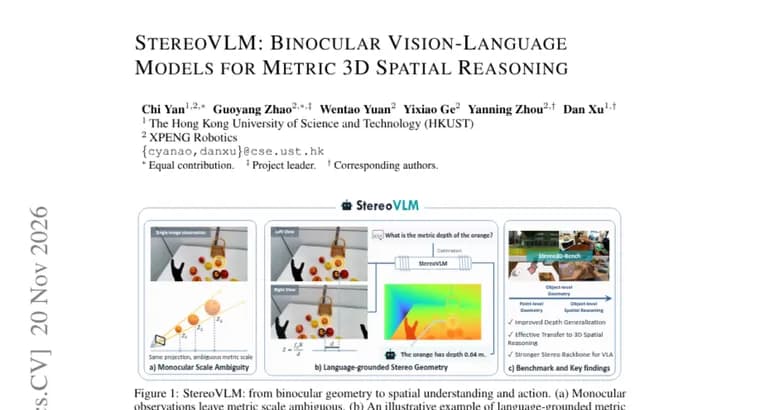
Vision-language models understand meaning well but struggle to reason about metric 3D space in the physical world. The paper behind StereoVLM argues that the cause is how they get their 3D information. Existing VLMs typically infer scene structure from one or more images without known camera calibration or cross-view geometric constraints. That makes metric 3D inference inherently ambiguous, and it leaves open whether a model's spatial predictions come from visual evidence or mostly from semantic priors.
The proposed fix is calibrated stereo, which gives explicit cross-view geometry and, according to the authors, resolves the ambiguity. They investigate how VLMs can learn transferable 3D representations directly from calibrated binocular observations, and they introduce StereoVLM, which they describe as the first geometry-aware binocular VLM for metric 3D spatial reasoning.
StereoVLM follows a hierarchical learning paradigm. It starts with cross-view correspondence and disparity estimation, moves to calibration-conditioned metric depth perception, and ends with semantic spatial reasoning. One finding along the way: disparity supervision generalizes substantially better than direct binocular depth supervision on unseen environments.
To evaluate these skills the authors built Stereo3D-Bench, a benchmark with three levels, running from point-level geometry to object-level spatial reasoning. StereoVLM-8B reaches 95.17% depth accuracy (δ_1) and a 66.98 average object-level score on it.
The authors also ran intervention tests. Their results indicate that performance on Stereo3D-Bench benefits from valid cross-view geometry and cannot be explained solely by additional visual tokens or semantic priors. Finally, the hierarchical geometric supervision yields average gains of 3.54 points across five spatial benchmarks and 4.3 percentage points in RoboCasa manipulation success.
Key facts
- StereoVLM is presented as the first geometry-aware binocular VLM for metric 3D spatial reasoning, learning from calibrated stereo observations.
- Training is hierarchical: cross-view correspondence and disparity estimation, then calibration-conditioned metric depth perception, then semantic spatial reasoning.
- StereoVLM-8B reports 95.17% depth accuracy (δ_1) and a 66.98 average object-level score on the new three-level Stereo3D-Bench.
- Disparity supervision generalizes substantially better than direct binocular depth supervision on unseen environments.
- Hierarchical geometric supervision adds 3.54 points on average across five spatial benchmarks and 4.3 percentage points in RoboCasa manipulation success.
Why it matters
The paper targets a known weakness: VLMs read meaning well but are shaky on metric 3D space, partly because a single image or an uncalibrated set of images leaves scale and geometry ambiguous. Using calibrated stereo gives the model explicit cross-view geometry to learn from, and the authors say this is a more reliable foundation for metric 3D perception and geometric generalization. They also claim StereoVLM is the first geometry-aware binocular VLM for metric 3D spatial reasoning.
Who it affects
The work is most relevant to researchers building spatial reasoning into vision-language models. The RoboCasa result, a 4.3 percentage-point gain in manipulation success, points to relevance for robot manipulation as well. The abstract does not name any authors or institutions.
How to use it
There is nothing to use yet from the abstract. No code, model weights or dataset release is mentioned. The practical takeaways are design choices: feed calibrated stereo pairs, train in stages from correspondence and disparity up to metric depth and semantic reasoning, and prefer disparity supervision over direct binocular depth supervision when generalization to unseen environments matters.
How solid is it
This is a research preprint, and everything here comes from its abstract. The headline numbers are 95.17% depth accuracy (δ_1) and a 66.98 average object-level score for StereoVLM-8B on Stereo3D-Bench, a benchmark the authors created themselves. No baseline models or their scores are given, so those two figures have no stated comparison. The abstract does not say which five spatial benchmarks are used or what the 3.54-point gain is measured against. It also does not say what the 4.3 percentage-point RoboCasa gain is relative to, or the absolute success rate. The intervention tests are the authors' evidence that the geometry, not extra visual tokens or semantic priors, drives the results.
Risks and caveats
The claims are the authors' own, and the abstract gives no baselines, no training data size or compute, and no dataset names. The "first" label is the authors' description. Because the benchmark is new and introduced alongside the model, the scores cannot yet be set against other work. The abstract does not say whether code, weights or the benchmark will be released.
“calibrated stereo provides explicit cross-view geometry that resolves this ambiguity”
— StereoVLM paper abstract