StyleStream 2.0 cuts streaming voice conversion latency to 520 ms
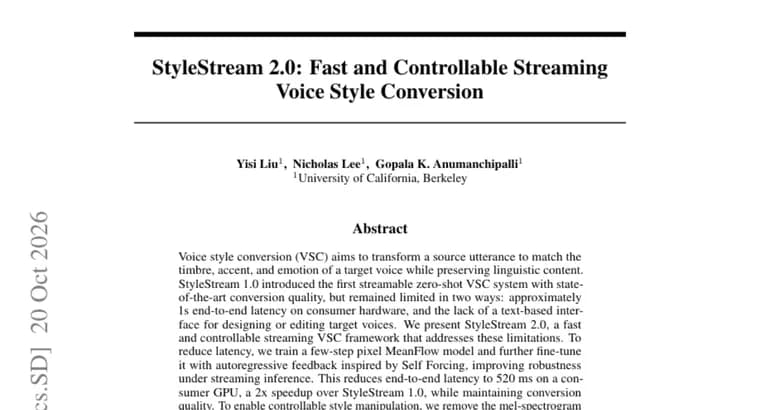
Voice style conversion (VSC) takes a source utterance and changes it to match the timbre, accent and emotion of a target voice, while keeping the linguistic content intact. StyleStream 1.0 introduced the first streamable zero-shot VSC system with state-of-the-art conversion quality, according to the paper. It had two limits: end-to-end latency of approximately 1 s on consumer hardware, and no text-based interface for designing or editing target voices.
StyleStream 2.0 is presented as a fast and controllable streaming VSC framework that addresses both.
On speed, the authors train a few-step pixel MeanFlow model and fine-tune it further with autoregressive feedback inspired by Self Forcing, which they say improves robustness under streaming inference. The result is end-to-end latency of 520 ms on a consumer GPU, a 2x speedup over StyleStream 1.0, while maintaining conversion quality.
On control, the authors remove the mel-spectrogram context and route target style information through a compact style embedding instead. In that embedding space they train a unified text-conditioned flow matching model with two abilities. Text-based voice design maps natural language prompts to voice styles. Instruction-based voice editing modifies one specific attribute of a source utterance while preserving the rest.
The experiments, as summarised in the abstract, show StyleStream 2.0 achieving the strongest target style fidelity on VSC, voice design and voice editing, while remaining competitive on intelligibility and on preserving attributes that were not edited. That is, it is not claimed to be best on those last two measures.
Key facts
- StyleStream 2.0 reduces end-to-end latency to 520 ms on a consumer GPU, a 2x speedup over StyleStream 1.0, which ran at approximately 1 s on consumer hardware.
- Latency is cut by training a few-step pixel MeanFlow model and fine-tuning it with autoregressive feedback inspired by Self Forcing; the authors say conversion quality is maintained.
- Removing the mel-spectrogram context and routing target style through a compact style embedding enables text-based voice design and instruction-based voice editing.
- The authors report the strongest target style fidelity on VSC, voice design and voice editing, and competitive (not best) intelligibility and non-edited attribute preservation.
Why it matters
Version 1.0 was already described as the first streamable zero-shot voice style conversion system, but about 1 s of latency and no way to describe a voice in text limited it. Halving latency to 520 ms and adding text control targets both gaps at once. A single compact style embedding is what ties the two together: the same representation carries the target voice for conversion and is the space where text prompts and edit instructions operate.
Who it affects
The paper is aimed at researchers working on voice conversion and streaming speech generation. Anyone building live voice applications on consumer hardware is the stated frame of reference, since the latency figure is given for a consumer GPU. The source does not name specific products or users.
How to use it
The source mentions no code, model release, demo or licence, so there is nothing to try from the text alone. The practical content is the recipe: a few-step MeanFlow model fine-tuned with autoregressive feedback for streaming, and a text-conditioned flow matching model in a compact style embedding space for voice design and editing.
How solid is it
The claims come from the authors' own abstract. The 520 ms figure is given for a consumer GPU, and the source does not say which GPU, nor whether the number is a mean, median or worst case. No benchmark names, datasets, metric values or baseline systems are given for the style fidelity, intelligibility or preservation results, so the strength of those results cannot be judged from the text.
Risks and caveats
The quality claim is qualitative: conversion quality is said to be maintained, and intelligibility and non-edited attribute preservation are only called competitive, which means they are not claimed to be the best. The 2x speedup compares against the authors' own earlier system, whose latency is given only as approximately 1 s. The source gives no details on author names, institutions or evaluation setup.