Survey maps 259 AI systems built to finish deliverables, not just drafts
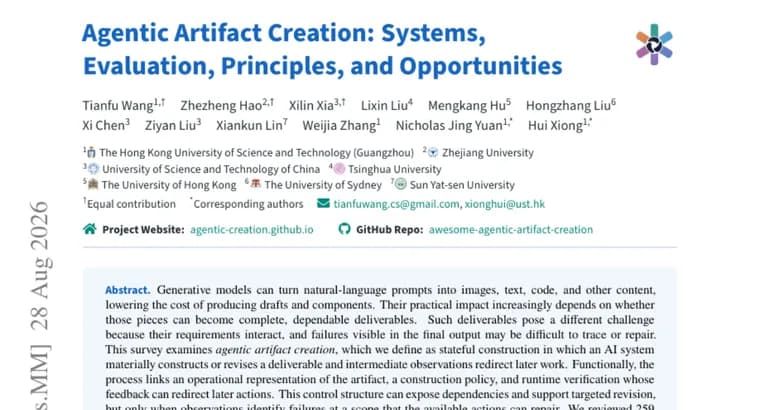
Generative AI can turn a prompt into an image, a piece of text, a block of code or other material, which cuts the cost of producing drafts and components. But how much that matters in practice depends on whether those pieces turn into complete, dependable deliverables rather than fragments someone still has to finish by hand. A new survey led by Tianfu Wang and co-authors sets out to study that gap directly, under the label "agentic artifact creation."
The paper defines agentic artifact creation as stateful construction: an AI system materially builds or revises a deliverable over multiple steps, and what it observes along the way, intermediate checks and feedback, redirects the steps that follow. The authors describe this as tying together three parts: an operational representation of the artifact itself, a construction policy that decides what to do next, and runtime verification that feeds its findings back into the process.
To map the field, the authors reviewed 259 works published through August 20, 2026: 230 systems that meet their definition of agentic artifact creation, and 29 benchmarks used to evaluate such systems. They compare six artifact families against each other, then treat application settings and evaluation practice as separate dimensions rather than folding them into the family comparison.
Two findings stand out. First, what makes construction hard is not just the type of artifact (image, code, text and so on); it also depends on how tightly the AI's decisions are coupled to each other, and on whether a failure becomes visible while it can still be fixed. Second, decomposition, breaking one big construction job into smaller pieces, can make each individual piece simpler to handle, but it raises the cost of coordinating those pieces and reassembling them into a working whole. The authors also warn that learned judges, AI models used to score or verify the work of another AI model, can add little independent evidence when the judge shares the same preferences or blind spots as the system it is judging.
From these observations the authors draw three working principles for building such systems: keep commitments and who is responsible for each decision explicit, turn feedback into targeted repair of the specific part that failed rather than a full redo, and revalidate the parts of the artifact that a change actually affects rather than assuming the rest is still fine. They close by flagging open problems in keeping control over an artifact coherent and accountable as the artifact, the creator's intent and the construction system itself all keep changing. A curated list of the reviewed papers is published on GitHub, at github.com/GeminiLight/awesome-agentic-artifact-creation.
Key facts
- The survey reviews 259 works on AI-driven artifact construction published through August 20, 2026: 230 systems and 29 benchmarks.
- It defines "agentic artifact creation" as stateful construction: an AI system builds or revises a deliverable over multiple steps, steered by its own runtime verification.
- The authors compare six artifact families, then analyze application settings and evaluation practice as separate dimensions.
- Decomposing a build into smaller pieces reduces local complexity but raises the cost of coordinating and reassembling those pieces.
- Learned AI judges can add little independent evidence when they share the same preferences or blind spots as the system they are evaluating; the authors also publish a curated list of the 259 works on GitHub.
Why it matters
Generative models are good at producing a rough draft cheaply, but most real work needs a finished, dependable deliverable, not just a draft. This survey gives that gap a name, agentic artifact creation, and a shared definition: an AI system that materially builds or revises a deliverable over time, steered by its own runtime checks. That common vocabulary lets researchers and builders compare systems that otherwise look unrelated, a coding agent and an image-editing agent, for instance, on the same terms: how they represent the artifact, how they decide the next step, and how they verify their own work.
Who it affects
Researchers designing AI systems that build or revise full artifacts (code projects, documents, images and other outputs across the six families the survey compares), people building benchmarks to evaluate such systems, and engineers deciding how to wire verification and feedback loops into an AI pipeline. The survey's principles are aimed at anyone architecting that kind of stateful, multi-step construction process rather than a single-shot generation call.
How to use it
The paper itself is the primary resource, posted at huggingface.co/papers/2608.28122. The authors also publish a curated list of the 259 reviewed works at github.com/GeminiLight/awesome-agentic-artifact-creation, useful as a reading list or a map of existing systems and benchmarks in the space. Their three working principles, keep commitments and responsibility explicit, turn feedback into targeted repair rather than a full redo, and revalidate only what a change actually affects, read as a practical checklist for anyone designing a construction policy or a verification loop for this kind of system.
How solid is it
The survey is broad by construction: 259 works reviewed against a stated definition, split cleanly into 230 systems and 29 benchmarks, with six artifact families compared side by side. That scale and the explicit definition are its main strength; it is not an anecdotal roundup. What is not stated in the material available here is who the co-authors are beyond the lead author, the venue or peer-review status of the survey, or examples of which specific systems fall into each of the six families, so the categorization itself cannot be checked against the abstract alone.
Risks and caveats
Any survey of 259 works rests on judgment calls: which works counted as meeting the definition of agentic artifact creation, and how the six families were drawn. Those calls are not detailed in the material available here. The authors also give no timeline or roadmap for the open problems they flag, so the "opportunities" in the paper should be read as research directions, not commitments or a product roadmap.
“Decomposition can reduce local complexity while increasing coordination and reassembly costs.”
— the survey's authors