Syensqo positions specialty materials as the limit on AI data centers
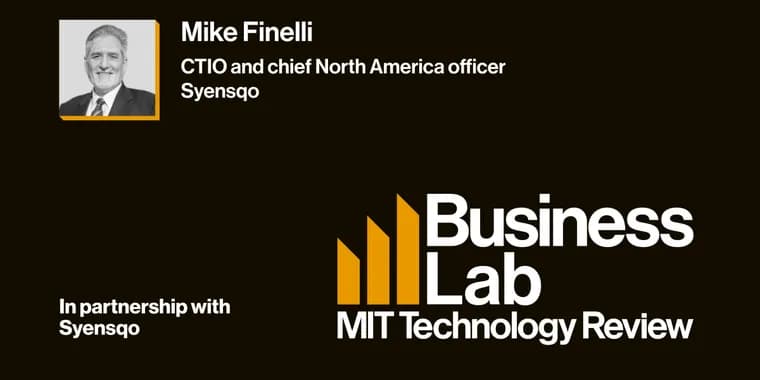
MIT Technology Review's Business Lab podcast published a sponsored episode, produced in partnership with specialty chemicals company Syensqo, in which host Megan Tatum interviews Mike Finelli, Syensqo's chief technology and innovation officer and chief North America officer. Finelli, who says he joined the company 33 years ago, argues that AI is pushing semiconductors and data centers toward physical limits in performance, thermal management, electrical efficiency and reliability, and that the materials used to build that infrastructure are becoming as important as the algorithms running on it. He describes a 'performance pyramid,' with commodity materials at the base and high-performance specialty materials at the top; as a component has to satisfy more requirements at once (his 'and, and, and' principle, such as high temperature and high purity and chemical resistance together), it pushes toward the top of that pyramid, which is where Syensqo says it operates. Finelli says the company is developing materials for high-voltage data center architectures, which he says can raise computing power while improving energy efficiency and reducing energy losses; sealing materials for the chambers used in semiconductor wafer processing, where seals have to withstand aggressive plasmas and reactive chemicals; and thermal-management solutions, including fluids for direct immersion cooling. He adds that some materials developed for electric vehicles can be adapted to the higher voltage and energy-density demands now appearing in data centers. On the discovery side, Finelli says Syensqo uses AI agents to digitally synthesize millions of potential molecular combinations, predict their performance and sustainability characteristics, and narrow that pool to a much smaller set for laboratory testing, which he says lets scientists work 'broader, deeper, and faster.' He frames sustainability as a goal to build in from the start of research rather than add afterward, and says the company wants to 'remove the trade-off between performance and sustainability.' Finelli also cites a company figure: 20% of Syensqo's annual revenue comes from products and applications launched in the last five years. He closes by describing a potential feedback loop in which AI helps develop better materials, which improve AI infrastructure, which in turn enables AI that further accelerates materials discovery.
Key facts
- Syensqo's Mike Finelli says AI is pushing semiconductors and data centers to physical limits across temperature, purity, electrical performance, chemical resistance, plasma resistance and long-term stability.
- The company is developing materials for high-voltage data center architectures, sealing materials for semiconductor wafer-processing chambers, and fluids for direct immersion cooling.
- Syensqo uses AI agents to digitally synthesize millions of candidate molecules, predict their performance and sustainability, and narrow the pool to a small set for lab testing.
- Finelli says 20% of Syensqo's annual revenue comes from products and applications launched in the last five years, and that he has worked at the company for 33 years.
- The piece is sponsored content: an MIT Technology Review Business Lab episode produced in partnership with Syensqo, not independent reporting, and names no customer or specific material.
Why it matters
The interview makes the case that materials science, not just chip design or model architecture, is turning into a hard constraint on how far AI infrastructure can scale, since data centers and semiconductor fabs are hitting simultaneous limits on heat, voltage, purity and durability that ordinary commodity materials cannot meet at once.
Who it affects
The claims are aimed at data center operators and semiconductor manufacturers weighing high-voltage architectures and immersion cooling, and at the broader electronics supply chain; Finelli also points to a crossover with electric-vehicle materials, which he says can be adapted to data centers' higher voltage and energy-density needs.
How to use it
There is nothing here to buy or adopt directly: no product names, prices or availability are given. The practical takeaway is directional, that specialty-materials suppliers are actively marketing high-voltage architecture materials, semiconductor sealing components and immersion-cooling fluids to AI infrastructure buyers, which is worth tracking when evaluating vendors for those categories.
How solid is it
This is sponsored content, an MIT Technology Review Business Lab episode produced in partnership with Syensqo, and the written portion carries no byline and is labeled 'Sponsored.' Every claim about Syensqo's technology and its effects comes from the company's own executive in an interview arranged with the company, not from independent testing or reporting, so it should be read as Syensqo's positioning rather than an evaluated technical claim.
Risks and caveats
No customer or data-center operator is named. No efficiency, cooling-performance or emissions figures are quantified for the high-voltage architectures, sealing materials or immersion-cooling fluids described, and no timeline is given for when they might reach production facilities. No specific molecule, chemical formula or named material product is disclosed for the AI-driven discovery work, and Syensqo's total annual revenue is not stated, only that 20% of it comes from products launched in the last five years.
“AI is now, from a material standpoint, really pushing semiconductors and the data centers to their physical limits”
— Mike Finelli, chief technology and innovation officer and chief North America officer at Syensqo