Tencent's WorldClaw turns a prompt into an editable 3D world
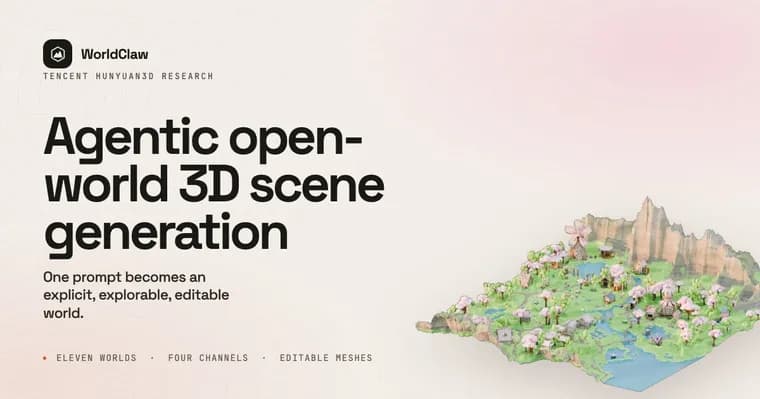
Tencent's Hunyuan3D team has released a project page for WorldClaw, described as a fully agentic, coarse-to-fine framework for open-world 3D scene generation. The pipeline runs in stages: an intent-analysis agent first extracts and normalizes only the constraints a prompt states explicitly, without inventing content or filling gaps; a separate scene-planning agent then resolves ambiguity and completes the attributes the rest of the system needs, following a fixed specification schema. From that structured specification, WorldClaw builds a globally coherent terrain foundation from a semantic layout map, reusable asset prototypes, and generative or procedural surface materials, composed through a region-aware height field and corrected by a render-and-inspect loop. Only the regions that call for fine-grained content then get object-level generation: each is rendered from a recorded camera, turned into a terrain-conditioned composition image, segmented into instances, reconstructed as textured meshes, and placed on the terrain, with a refinement agent checking pose, mesh quality, scale, and object-terrain contact afterward. The stated payoff is that every generated world resolves to explicit terrain plus independently manageable textured meshes, which the team says supports free-viewpoint exploration, per-object editing and reuse, and direct hand-off to rendering, animation-authoring, and game-engine workflows.
The results section shows eleven generated worlds, among them Frontier Mosaic, Grand Canyon, Azure Archipelago, Ember Caldera, and Snowbound Outpost, built from prompts such as "a canyon scene with a river flowing through the entire canyon" with tribal villages on the cliffs, or a tropical island pirate stronghold inspired by One Piece. Each world ships as an isometric layout, aerial and ground-level stills, and a camera orbit rendered four ways: appearance, instance masks, surface normals, and depth. Four of the eleven worlds, a snowline village, a canyon settlement, a tropical island, and an arctic outpost, are singled out to demonstrate a reusable object library and an editable-instance pass, showing that every mesh in a scene stays separate and editable rather than baked into a single render. Asset sourcing is not uniform across the showcase: per-season notes on the page state that for the summer example, scatter assets are sourced from Sketchfab, and for the spring example, scatter assets are built through 3D coding, rather than generated, while all other objects in every season are produced by the system's own 3D generative models.
The team lists two open limitations rather than presenting the system as finished. Generative 3D backbones, including WorldClaw's, rarely recover explicit part hierarchies, parametric structure, articulation, or interaction logic for objects; WorldClaw already authors terrain materials as executable Blender node graphs and shader scripts, but extending that code-native approach to individual objects is flagged as future work, not a current capability. Separately, the team notes that large game worlds need runtime procedural generation, navigation, physics, and interaction beyond what Blender's scriptable access to geometry, materials, and rendering provides, and frames pairing WorldClaw with engine-side procedural tooling as a way to raise both scale and practical applicability. The page links a paper on arXiv (2608.05248) and a code repository on GitHub; it gives no benchmark numbers, generation time, model size, hardware requirements, pricing, or release timeline.
Key facts
- WorldClaw is an agentic, coarse-to-fine framework from Tencent's Hunyuan3D team that turns one open-ended text prompt into an explicit, explorable, editable open-world 3D scene.
- The pipeline separates intent analysis and scene planning, global terrain generation from a semantic layout and height field, and regional object generation that reconstructs and places editable textured meshes only where fine detail is needed.
- The showcase includes eleven generated worlds, with four (a snowline village, a canyon settlement, a tropical island, and an arctic outpost) highlighted to show a reusable object library and per-instance editing.
- Not every showcased asset is model-generated: the summer example's scatter assets are explicitly sourced from Sketchfab and the spring example's are built through 3D coding, while all other objects across the seasons are produced by the system's generative models.
- The team names code-native object modeling (part hierarchies, articulation, interaction logic) and production game-engine integration as open limitations rather than current capabilities; a paper (arXiv 2608.05248) and code are linked, with no benchmarks, pricing, or release timeline given.
Why it matters
Most text-to-3D systems hand back a single fixed mesh or a render. WorldClaw's pitch is structural: it keeps global terrain coherence and rich local detail as separate agentic stages, and resolves every generated world into terrain plus independent, editable textured meshes rather than one baked scene. That distinction, explicit and reusable assets instead of a locked render, is what the team frames as the actual contribution over prior open-world generation work.
Who it affects
The workflows the team points to directly are rendering, animation authoring, and game-engine pipelines, since the output is described as handing off cleanly to them. Game and virtual-production studios building large environments from a written brief, and 3D artists who want a starting scene they can still edit object by object, are the audience the project page targets, even though it names none of them explicitly as users.
How to use it
The page gives no pricing, access method, or run-it-yourself instructions. What it does provide is a paper on arXiv (2608.05248) and a code repository on GitHub (Tencent-Hunyuan/Hunyuan3D-WorldClaw), which is the extent of the access information published so far.
How solid is it
This is a project page in academic-paper format, with abstract, method, conclusion, and citation sections plus a linked arXiv preprint and code, rather than a shipped product. The showcase is eleven generated worlds with layouts, stills, and four-channel camera orbits, but the page carries no benchmark numbers, no quantitative comparison to other 3D-generation systems, and no reported generation time, model size, or hardware requirements.
Risks and caveats
The team's own limitations section says generative 3D backbones, WorldClaw included, rarely recover explicit part hierarchies, parametric structure, articulation, or interaction logic for individual objects, only terrain materials are currently code-native as Blender node graphs and shader scripts. It also flags that large game worlds need runtime procedural generation, navigation, physics, and interaction that Blender's scriptable access alone does not cover. Separately, some assets in the showcase are not model-generated at all: the summer world's scatter assets come from Sketchfab and the spring world's are built through 3D coding, a detail worth keeping in mind when judging how much of what's shown is the system's own output.
“An intent analysis agent extracts and normalizes only the constraints the prompt states explicitly, without inventing content or filling gaps. A scene planning agent then resolves ambiguous descriptions and completes the attributes downstream modules require, following a predefined specification schema.”
— WorldClaw project page, method section