U-OPSD trains LLMs via self-distillation without any supervision
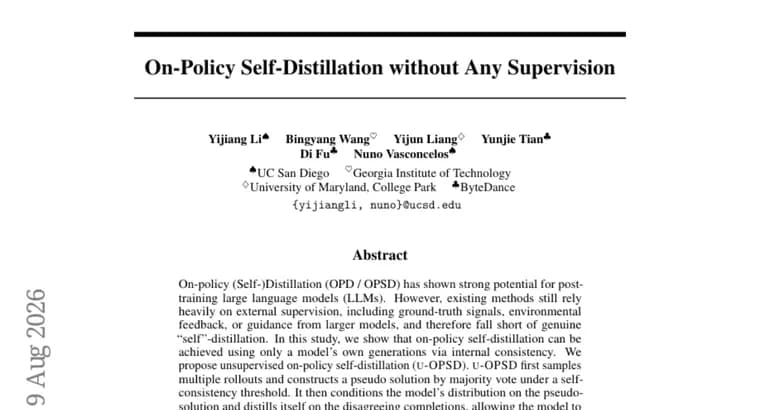
Researchers describe unsupervised on-policy self-distillation (U-OPSD), a post-training method for large language models that needs no external supervision: no ground-truth labels, no environmental feedback, and no guidance from a larger teacher model. They argue that existing on-policy (self-)distillation methods still lean on one of those three supervision sources and so fall short of being genuinely "self"-distillation.
U-OPSD works in two steps. First, the model samples multiple rollouts for a given problem and builds a pseudo-solution by majority vote, applying a self-consistency threshold to decide when that vote counts as solid. Second, it conditions the model's own output distribution on the pseudo-solution and distills the model on the rollouts that disagree with it, letting the model correct itself specifically where it was confidently wrong.
The authors test U-OPSD across multiple base models and training settings and report that it consistently improves over the base models while matching or surpassing supervised methods that do use ground truth, such as OPSD and GRPO. On five mathematical reasoning benchmarks, AIME24, AIME25, HMMT25, MATH500, and AMC23, U-OPSD improves over the Qwen3 base model in non-thinking mode by an average of 8.5% at the 4B parameter scale and 10.7% at the 8B scale. In the same non-thinking setting it outperforms the ground-truth-supervised OPSD method by 3.2% at 4B and 2.3% at 8B, averaged across the five benchmarks. In thinking mode, U-OPSD stays roughly on par with OPSD overall, ahead by 0.9% at the 4B scale and level with it at the 8B scale, while surpassing GRPO by 0.7% at 4B and 1.1% at 8B. Code for the method is released on GitHub.
Key facts
- U-OPSD post-trains LLMs using only the model's own generations, with no ground-truth labels, environmental feedback, or larger teacher model.
- Method: sample multiple rollouts, build a pseudo-solution by majority vote under a self-consistency threshold, then distill the model on the completions that disagree with it.
- On five math benchmarks (AIME24, AIME25, HMMT25, MATH500, AMC23), Qwen3 non-thinking mode improves 8.5% at 4B and 10.7% at 8B over the base model.
- Outperforms the ground-truth-supervised OPSD method by 3.2% at 4B and 2.3% at 8B in non-thinking mode, on average.
- In thinking mode, on par with OPSD (ahead 0.9% at 4B, level at 8B) and ahead of GRPO by 0.7% at 4B and 1.1% at 8B; code released on GitHub.
Why it matters
Post-training large language models typically requires external supervision: labeled ground-truth answers, feedback from an environment, or a larger teacher model to imitate. U-OPSD removes all three, relying only on the model's own generations and their internal consistency. That strips out a major cost in post-training pipelines: no need to collect labels, build a reward environment, or maintain a bigger teacher model just to keep improving a smaller one.
Who it affects
Teams and researchers building post-training pipelines for language models, in particular for smaller or mid-size models where using a large teacher model or extensive labeled data is expensive; the paper tests at 4B and 8B parameter scales on Qwen3. The method is aimed at reasoning-focused use, since all reported benchmarks are math reasoning tasks.
How to use it
The authors have released code for U-OPSD on GitHub at https://github.com/williamium3000/u-opsd. No price or licence terms apply since this is a research method, and the source gives no description of the training compute, dataset size, or hyperparameters used to reproduce the reported results.
How solid is it
The claims rest on evaluation across five established math reasoning benchmarks (AIME24, AIME25, HMMT25, MATH500, AMC23) and multiple base models and training settings, compared against two ground-truth-supervised baselines, OPSD and GRPO. All reported figures are relative gains, percentage differences against a baseline, not absolute accuracy scores; the source does not give the absolute benchmark scores, the exact vote count or threshold value used for the self-consistency check, or the paper's peer-review status.
Risks and caveats
Because the reported numbers are differences rather than absolute accuracies, the practical ceiling of the method is not directly visible from the source. The authors say they test across diverse base models and training settings, but the only quantified results given are for Qwen3 at two scales, 4B and 8B, on math reasoning benchmarks; results for other model families, sizes, or task domains are not given here.